Garage Door Spring Replacement in Jacksonville, FL
Jacksonville's coastal humidity and salt air shorten garage door spring life. Here's how fast they fail, why, and when to replace them.
In Jacksonville, standard torsion springs that would normally last 7 to 10 years often fail sooner — frequently in the 3 to 6 year range for high-use homes — because the city's persistent coastal humidity and salt-laden air corrode spring steel faster than cycle ratings alone predict. The failure mechanism is a combination of two forces working at the same time: mechanical fatigue from daily cycles, and electrochemical corrosion from moisture and salt. Below is how that plays out, and how to tell when your springs are near the end.
How long do garage door springs last in Jacksonville, FL?
A standard torsion spring rated for 10,000 cycles typically lasts 7 to 10 years nationally. In Jacksonville, that same spring often fails earlier — and as little as 3 to 6 years for households that use the garage as their main entrance, with coastal corrosion compressing the timeline further. Coastal corrosion and higher cycle counts both compress the timeline.
Why Jacksonville is harder on springs than the national average
Jacksonville's average daily relative humidity is 76 percent year-round, with morning humidity averaging 89 percent and afternoon lows near 57 percent. Those numbers describe a climate where metal surfaces stay damp for hours every day. Add salt carried inland from the coast and local waterways, and you have the exact chemistry that drives oxidation on exposed spring steel.
What does humidity and salt air actually do to a spring?
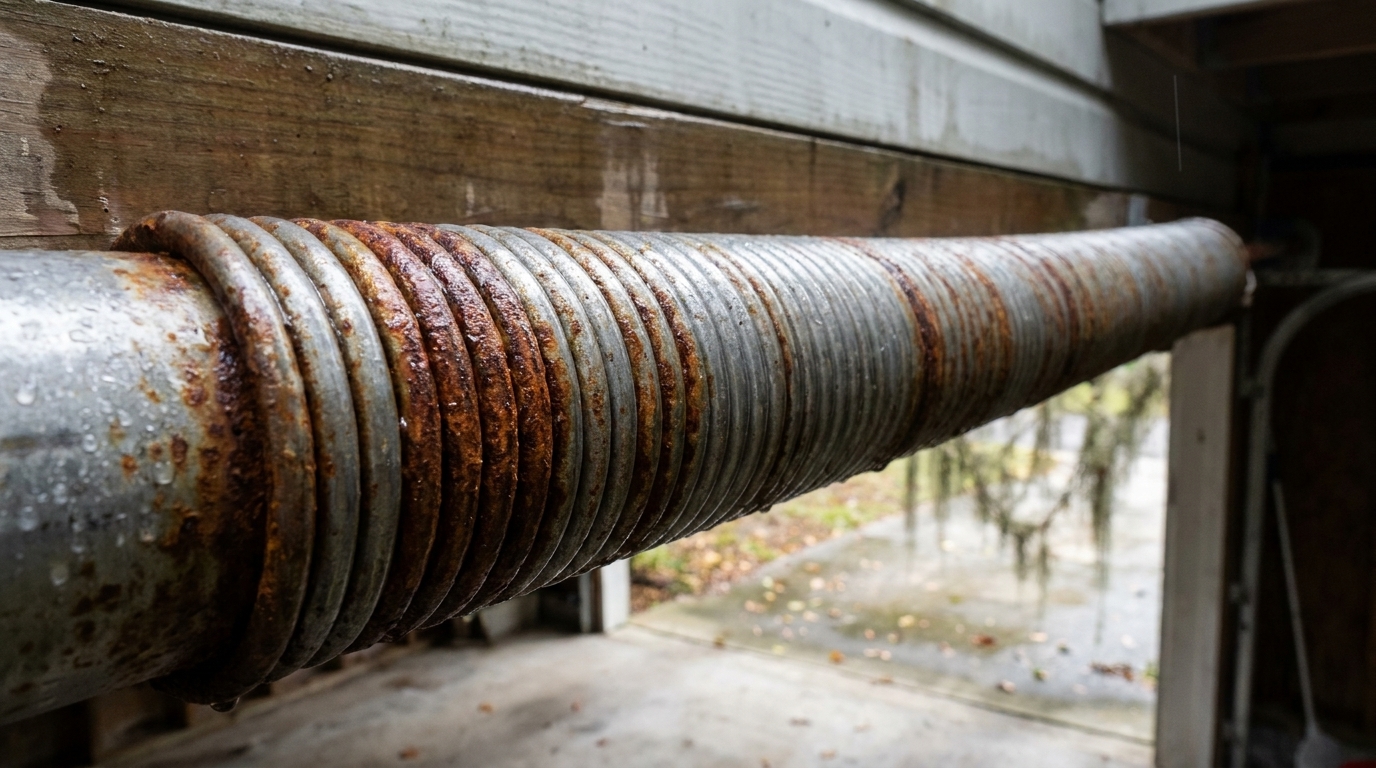
Salt-laden air and high humidity cause oxidation on garage door springs, weakening the metal wire and creating microscopic fractures across the coils. Those fractures become stress concentration points. Every cycle opens and closes them slightly, and the spring eventually snaps — often with no visible warning beyond a thin layer of orange-brown rust between the coils.
The two failure modes, working together
Mechanical fatigue is the baseline: each open-and-close counts as one cycle, and high-use Jacksonville households cycling the door 6 to 10 or more times daily can exhaust a 10,000-cycle spring far sooner than the manufacturer's rating suggests. Corrosion is the accelerant. Rust pits the wire surface, strips lubricant from the coils, and seizes the end bearings — all of which shorten the effective cycle life well below the manufacturer's rating. A spring the factory promises for a decade may give you half that in a salt-air environment.
Which Jacksonville neighborhoods see the worst spring corrosion?
Homes closest to open water take the hardest hit. Properties in Jacksonville Beach, Neptune Beach, Atlantic Beach, Ponte Vedra Beach, and along the Intracoastal Waterway sit directly in salt-spray territory, where sea breezes carry fine salt particles that cling to any exposed metal. Inland neighborhoods still face the humidity, but without the same salt load. If you live within a few miles of the coast or a tidal waterway, assume your springs are aging faster than the label suggests.
King of Home Solutions serves Clay, Duval, and Saint Johns Counties, and the service area spans the full exposure gradient — from beachfront communities to inland neighborhoods like Fleming Island, Orange Park, Nocatee, and World Golf Village.
How do I know if my garage door springs need replacing?
Watch for a door that feels suddenly heavy when lifted by hand, an opener that strains or stalls partway up, a loud bang from the garage with no obvious cause, visible gaps in the spring coils, or orange-brown rust across the spring body. Any one of these is a signal to stop using the door and have it inspected. A broken torsion spring is not a wait-and-see repair.
The visual inspection you can do in sixty seconds
With the door closed, look at the spring above the door or along the tracks. A healthy torsion spring has tight, evenly spaced coils and a clean finish. Warning signs include a visible gap in the coils (that means it's already snapped), rust creeping between coils, uneven spacing, or a spring that sags noticeably at one end. Do not try to adjust or remove a spring yourself — they hold enormous stored tension even when broken.
What are the spring options when it's time to replace?
Jacksonville homeowners generally choose between standard torsion springs, high-cycle torsion springs, and extension springs. For a coastal climate with heavy daily use, upgrading to high-cycle springs often pays for itself in avoided service calls. Here's how the three compare on cycle rating and expected lifespan under typical national usage.
| Spring type | Cycle rating | Typical lifespan (national) |
|---|---|---|
| Extension springs | 5,000–10,000 cycles | 3–7 years |
| Standard torsion springs | ~10,000 cycles | 7–10 years |
| High-cycle torsion springs | 25,000–50,000 cycles | 15–20+ years |
In Jacksonville, expect the practical lifespan at each tier to run shorter than the national figure because of corrosion. A high-cycle spring paired with periodic lubrication and inspection is usually the better long-term value for coastal and waterway-adjacent homes.
When should I schedule a tune-up instead of waiting for failure?
Professionals recommend having a technician check spring tension and inspect for metal fatigue once springs are older than approximately 7 to 10 years in coastal and humid environments — and sooner if you see rust or hear new noises. In Jacksonville, a reasonable rhythm is an annual tune-up, ideally before hurricane season, when wind-driven salt spray and storm humidity add extra stress to already-loaded hardware.
A tune-up typically includes lubricating the coils with a corrosion-resistant product, checking balance, inspecting cables and rollers, and measuring remaining spring tension. It's the lowest-cost way to catch a spring that's weeks away from snapping on a Monday morning when you're trying to leave for work.
King of Home Solutions handles garage door repair for noisy, stuck, damaged, and off-track doors, including broken springs, worn cables, opener issues, and routine maintenance — the same visit can cover an inspection and any immediate fixes.
I'm so glad that I called King of Home Solutions for my garage door! I had it fixed by another company not even a year ago, and they didn't put the care into the work to make sure that it was a lasting repair. That was not the case with King of Home Solutions; they came out the same day I called and even price-matched another garage door repair quote. I will be calling them for all my home needs moving forward! Thank you, Brian, for your amazing customer service, and to Gail in the office!
Frequently asked questions
How long do garage door springs last in Jacksonville, FL humidity?
Properties near the beach and the Intracoastal see the shortest lifespans due to salt exposure.
Can I replace a broken garage door spring myself?
No — garage door springs store enormous mechanical tension, and a slipped tool or incorrect winding can cause serious injury even after the spring has broken. Spring replacement requires winding bars, proper torque settings, and often replacement of both springs as a pair for balance. This is a job for a licensed garage door technician, not a DIY project.
Should I replace one spring or both at the same time?
If your door uses two torsion springs and one breaks, replace both. The surviving spring has already accumulated most of the cycles and corrosion of the broken one and will likely fail within months, triggering a second service call and a second labor charge. Replacing the pair at once is standard practice and the more economical long-term choice.
Why does my garage door feel heavier than it used to?
A door that feels heavy when lifted by hand or that makes your opener strain is almost always a spring tension problem. Springs lose tension gradually as the steel fatigues and corrodes, so the door's weight slowly shifts from the spring to the opener motor. Left alone, this burns out the opener next. Have the spring tension measured before more parts fail.
Are high-cycle springs worth the upgrade in Jacksonville?
For most Jacksonville homes, yes. In a coastal climate where corrosion already shortens spring life, starting with a heavier-duty spring extends the practical service interval and reduces the number of service calls over the life of the door.
How often should I have my garage door tuned up?
An annual tune-up is a reasonable baseline for Jacksonville homes, with the ideal window being spring through early summer — before hurricane season adds storm humidity and wind-driven salt spray to the load. Tune-ups catch early rust, re-lubricate coils with corrosion-resistant products, and verify balance before small issues become broken-spring emergencies.
The bottom line
Jacksonville's climate is genuinely harder on garage door hardware than the national average, and spring lifespans reflect that. Plan on inspecting springs starting around year five rather than year eight, budget for replacement sooner than national averages suggest, and consider upgrading to high-cycle springs the next time a replacement is due. Homeowners in Jacksonville who want this handled professionally can reach King of Home Solutions at (904) 865-4663 or https://kingofhomesolutions.com to schedule an inspection or spring replacement.