Garage Door Spring Replacement in Jacksonville, FL (2026)
Torsion vs extension springs explained for Jacksonville homes: how to tell which you have, which fails first, and what replacement costs in 2026.
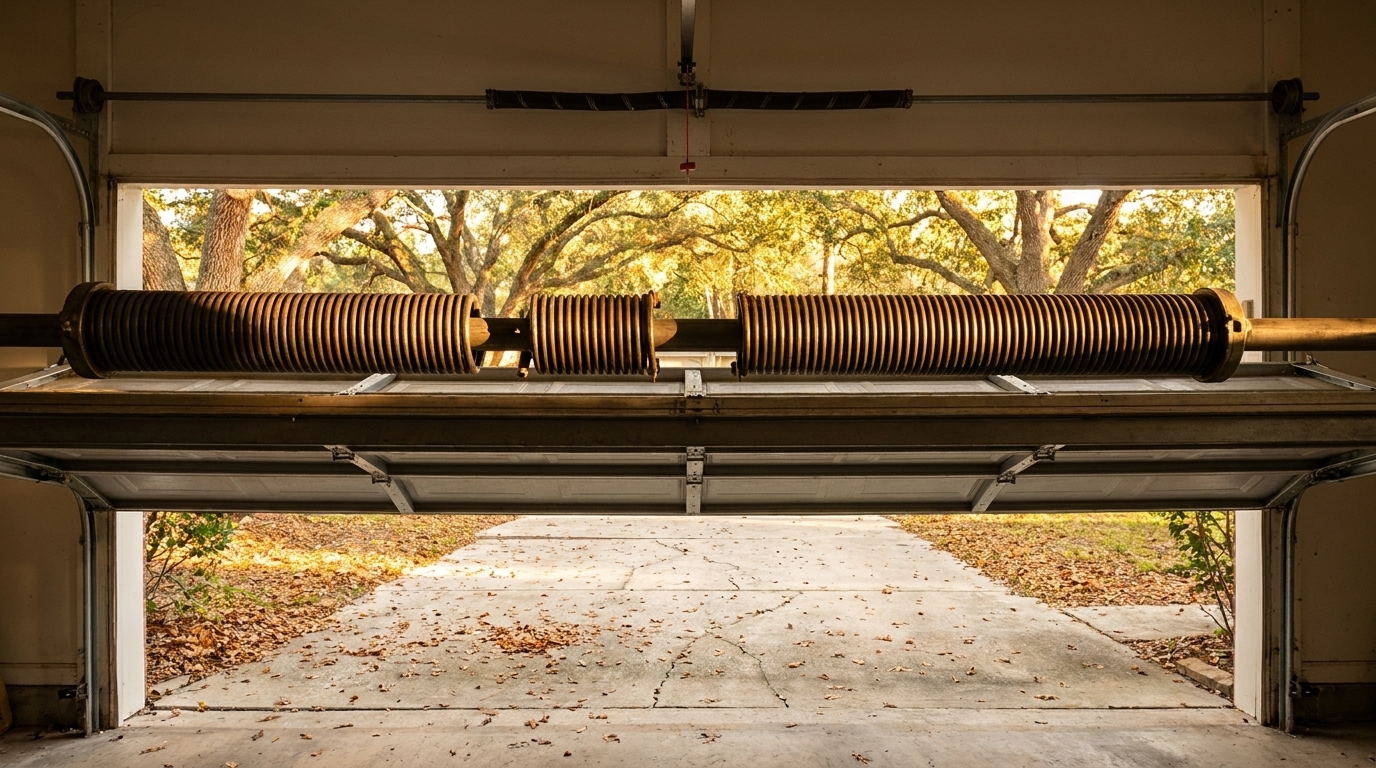
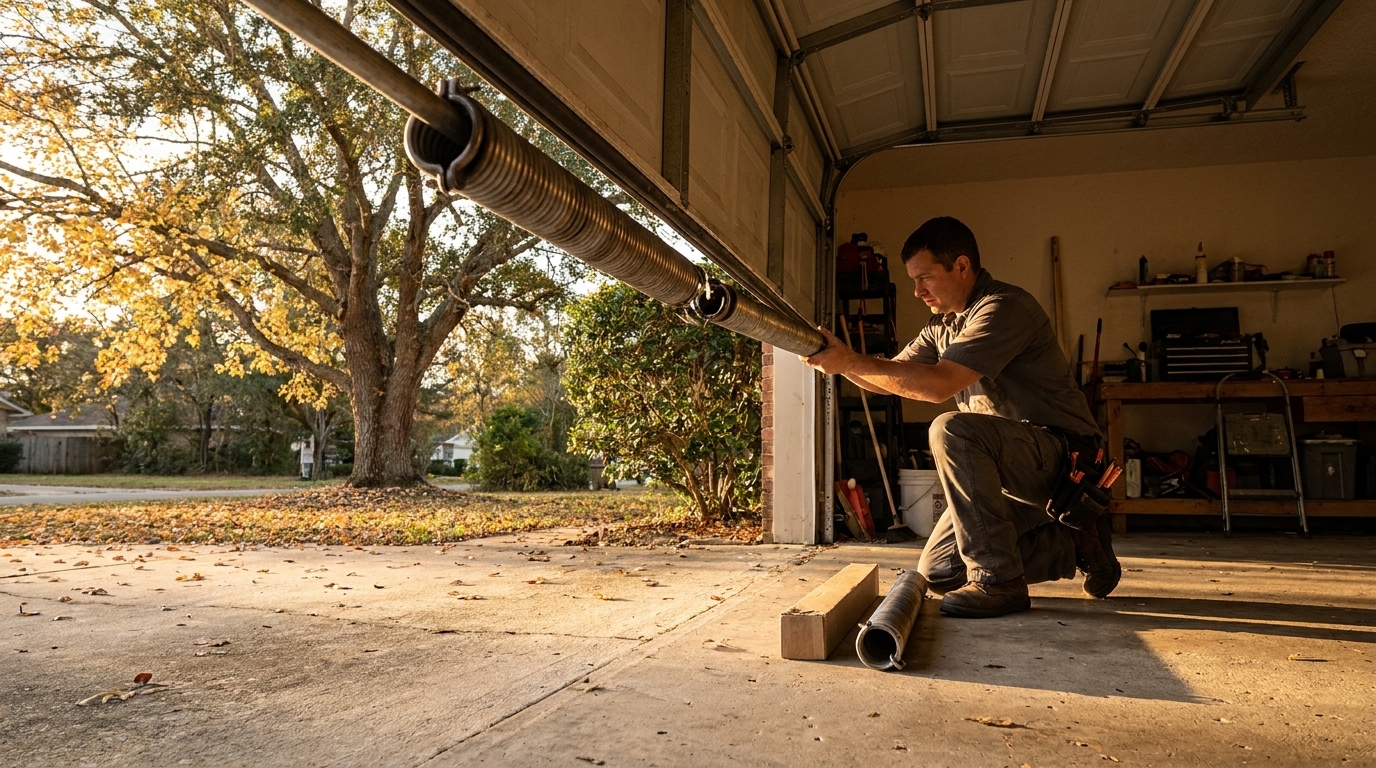
Most Jacksonville homes have one of two garage door spring systems: torsion springs mounted on a horizontal shaft above the door, or extension springs stretched along the horizontal tracks on either side. Torsion is the modern standard on two-car doors; extension springs are found on older or lighter single-car doors.
Below is a mechanism-level breakdown of how to identify what you have, which type fails first in Jacksonville's coastal climate, and what to budget for replacement.
How do I know which type of spring my garage door has?
Look above the door, in the center, with the door closed. If you see a metal shaft running horizontally across the wall with one or two tightly-wound springs mounted on it, you have torsion springs. If instead you see long, stretched springs running parallel to the horizontal tracks on each side of the door, you have extension springs. Torsion is above; extension is beside.
Most two-car doors installed in Jacksonville over the last twenty years use torsion systems because they handle heavier door weights more safely and smoothly. Extension springs persist on older single-car doors — think the mid-twentieth-century housing stock in neighborhoods like Murray Hill and Avondale — and on lightweight uninsulated doors used on detached garages and sheds.
What is the actual mechanical difference between torsion and extension springs?
Torsion springs store energy by twisting around a shaft; extension springs store energy by stretching. When you lift the door, a torsion spring unwinds in a controlled rotation that transfers lift through cable drums at each end of the shaft. An extension spring instead pulls back as it contracts, transmitting force through pulleys and cables along the tracks.
That difference matters for safety and lifespan. A torsion spring, if it breaks, typically releases its energy into the shaft and stays contained. An extension spring under tension can become a projectile if a cable or safety cable fails, which is why building codes and manufacturers have required containment cables on extension systems for decades. The experts at King of Home Solutions see this often during inspections — extension systems on older Jacksonville doors frequently lack the safety cable that modern code expects.
Which type of spring fails first in Jacksonville's climate?
Both types fail from cycle fatigue, but Jacksonville's humid, salt-tinged coastal air accelerates corrosion on uncoated steel. Standard springs are rated for roughly 10,000 cycles — about 7–10 years for an average household opening the door four times a day. In homes closer to the ocean (Atlantic Beach, Neptune Beach, Jacksonville Beach, Ponte Vedra), surface rust can shorten that lifespan noticeably, which is why galvanized or coated high-cycle springs are a sensible upgrade here.
Extension springs tend to show symptoms earlier because every coil stretches and relaxes on every cycle, exposing more surface area to moisture. Torsion springs fail more suddenly — you'll often hear a loud bang from the garage, then find the door won't open and there's a visible gap in the coil above the door.
How can I tell if my spring is actually broken or just worn?
The clearest sign is a visible gap of one to two inches in a torsion spring coil, or a snapped extension spring hanging loose along the track. Short of that, the door itself will tell you: it feels unusually heavy when you try to lift it manually, the opener strains or stops partway, the door opens crooked, or you hear grinding and popping noises. A balanced door should hold its position when lifted halfway by hand; one that slams down has lost spring tension.
Do not keep operating the door once you notice these symptoms. According to industry guidance from cheneydoor.com, delaying spring repair can increase costs if additional components — cables, rollers, drums, or the opener itself — are damaged while the door runs on a failing spring.
How much does garage door spring replacement cost in Jacksonville, FL in 2026?
No Jacksonville-specific published price schedule exists for this service; these are national ranges that local contractors broadly follow, and your final price depends on door weight, spring cycle rating, and whether cables or drums need replacement at the same time.
| Spring Type | Installed Price Range (2026) | Typical Application |
|---|---|---|
| Single torsion spring | $200–$400 | Lighter two-car or heavy single-car door |
| Torsion pair (both replaced) | $350–$700 | Standard two-car door; recommended when both are same age |
| Extension spring pair | $180–$400 | Older or lighter single-car doors |
| High-cycle upgrade (add-on, per spring) | +$50–$150 | 20,000–30,000 cycle rating; sensible near the coast |
Why the "replace both" recommendation on torsion pairs? If one torsion spring has reached end-of-life, the matched spring installed on the same day is at the same cycle count and will likely fail within months. Paying for a second service call usually costs more than installing the pair together.
Should I upgrade to high-cycle springs in a coastal Florida home?
For most Jacksonville homeowners who use their garage as the primary entrance, high-cycle springs are worth the upgrade. A higher-cycle spring significantly outlasts a standard spring at typical daily use rates, and galvanized coatings resist the salt-humidity combination that attacks bare steel in the Jacksonville area.
If your door is used lightly — a detached garage, a workshop, a rarely-opened second bay — standard springs are usually fine. The upgrade pays off most clearly on daily-use doors within a few miles of the ocean.
Is spring replacement a safe DIY project?
No. Torsion springs are wound to several hundred pounds of torque, and a slip of the winding bar can cause serious injury or death. Extension springs under full tension can snap and strike with similar force. The parts cost of a DIY replacement is substantially lower than installed pricing, but the required specialty tools (winding bars, vise grips, a sturdy ladder) and the sequence of de-tensioning, replacing, and re-tensioning are unforgiving of mistakes.
King of Home Solutions and other licensed Jacksonville contractors include balancing and a full safety check — cables, drums, bearings, rollers, opener force settings — with every spring replacement, which is where much of the value in the installed price actually sits.
Frequently Asked Questions
How long does a garage door spring replacement take?
Most spring replacements take 45 minutes to 90 minutes on site, including de-tensioning the old spring, installing the new one, winding to the correct turn count, balancing the door, and testing the opener's force settings. A full cable or drum replacement alongside the springs adds roughly 30 minutes. Same-day service is common in Jacksonville because the parts are standardized.
Can I use my garage door with one broken spring on a two-spring system?
You should not. With one torsion spring broken, the remaining spring and the opener are carrying nearly double the designed load, which rapidly wears cables, drums, and the opener's gears. Running the door this way often turns a $350–$700 pair replacement into a repair that also includes cables, drums, or a new opener motor.
Do I need both torsion springs replaced if only one broke?
If both springs were installed at the same time (which is standard), yes — the surviving spring is at the same cycle count and typically fails within months. Replacing both during one visit at $350–$700 installed costs less than paying for a second service call. If one spring is clearly newer, replacing just the broken one is reasonable.
How often do garage door springs need to be replaced in Jacksonville?
Standard 10,000-cycle springs last about 7 to 10 years for a household opening the door four times a day. In homes near the ocean, salt air and humidity can shorten that by a year or two due to corrosion. High-cycle springs rated at 20,000 to 30,000 cycles can last 15 years or longer under the same usage.
Does Florida sales tax apply to garage door spring replacement?
Florida sales tax applies to the parts portion of a spring replacement. Tax treatment of the labor portion varies by how the contractor structures the invoice, so your written estimate should clearly separate parts and labor. Ask your contractor for an itemized quote before work begins so there are no surprises on the final bill.
What else should be inspected when springs are replaced?
A professional spring replacement visit should include inspection of the cables, drums, bearings, rollers, hinges, and the opener's force and travel settings. These components wear on the same timeline as the springs, and catching a frayed cable or worn bearing during the same visit avoids a second service call. A proper balance test — the door holding position when lifted halfway by hand — is the final check.
Getting it handled in Jacksonville
Spring replacement is one of those repairs where the right call is almost always a licensed local contractor — the safety risk is real, the cost difference versus DIY is modest once you factor in tools and risk, and a proper installation includes the balance and safety check that keeps the rest of the door system healthy. King of Home Solutions is locally owned and operated, serves Clay, Duval, and St. Johns counties, and handles garage door repair including broken springs, worn cables, and opener issues as part of its residential services. Jacksonville homeowners who want this handled professionally can reach King of Home Solutions at (904) 865-4663 or https://kingofhomesolutions.com to schedule a visit.