Gas Line Plumber in Jacksonville, FL: What to Expect
What a gas line plumber in Jacksonville, FL actually does — permits, pressure testing, inspections, and why waiting on a suspected leak gets expensive fast.
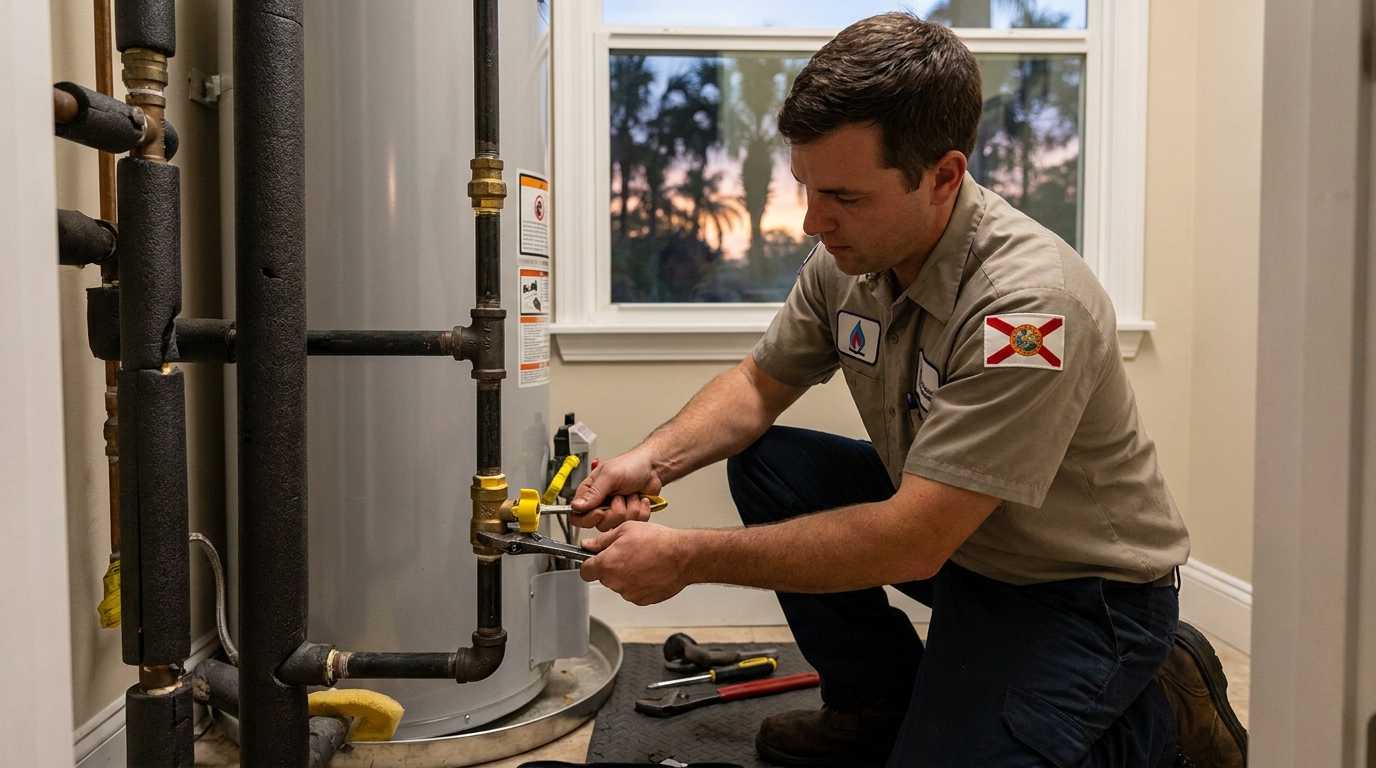
The job is not a handyman task: it requires a state-licensed contractor registered with the City of Jacksonville, a permit pulled through the JaxEPICS portal, and both rough and final inspections from the Building Inspection Division (BID) before the system is signed off.
That framework matters because gas work has a real cost of waiting. A slow leak, a corroded connector, or an unpermitted DIY tie-in doesn't stay static — it compounds into higher repair bills, failed home sales, insurance denials, and, at the worst end, fire risk. This guide walks through what the work actually involves in Duval County and where delay stops being harmless.
What does a gas line plumber in Jacksonville actually do?
A licensed gas line plumber installs new gas service lines, extends or modifies existing piping, buries underground runs, and connects appliances like generators, pool heaters, tankless water heaters, outdoor kitchens, and fireplaces to hard piping. In Jacksonville, this work must be performed by a contractor holding a state-certified or registered plumbing, mechanical, or specialty fuel gas license under Florida Statutes Chapter 489, with that license current in the city's permitting system.
Relighting a pilot, adjusting an existing shutoff, or swapping a listed flexible connector in kind at an existing appliance generally does not require a permit. Almost everything else does. At King of Home Solutions, we see homeowners assume a "quick tie-in" for a new range or dryer is informal work — it isn't, and inspectors catch it during resale.
What's the permit and inspection process in Duval County?
Any new, extended, or modified residential gas piping in Jacksonville requires a gas or mechanical permit applied for through the JaxEPICS online portal or the BID office. The contractor's license must be registered and current in the city's system before the application can even be submitted. Pipe sizing calculations — BTU demand per appliance, branch and trunk sizes, design pressure, and allowable pressure drop — must accompany the application.
Two inspections follow. A rough inspection must be scheduled and passed before any piping is backfilled or concealed in walls, floors, or above ceilings. A final inspection is required after appliances are connected and the system is operational. As of June 8, 2026, BID only accepts the revised 2026 permit and inspection forms — older editions are rejected outright.
What does pressure testing involve, and why is it non-negotiable?
New gas piping in Jacksonville must be pressure tested at not less than 3 psig for a minimum of 10 minutes with no loss in pressure, measured on an approved gauge, before any piping is covered or concealed.
If a plumber offers to skip the test, backfill before rough inspection, or "just eyeball" a joint under soap bubbles, that is the moment to stop the job. A failed test caught during rough is a $0 fix — the pipe is still exposed. The same failure discovered after drywall goes up means opening walls, and after a slab pour it means demolition.
What are the rules for underground and appliance connections?
Underground gas piping in Jacksonville must be polyethylene (PE) conforming to ASTM D2513, buried at least 12 inches deep measured to the top of the pipe. The transition from plastic to metallic pipe must occur before the piping enters the building, using an approved transition fitting.
Two Jacksonville-specific wrinkles are worth flagging. Installing or upsizing an LP/propane tank requires a separate mechanical permit under Jacksonville Ordinance Code §320.409(d)(6), with tiered fees and Fire Marshal review for certain above-ground tanks. Standby generators — increasingly common after hurricane seasons — need both an electrical permit for the transfer switch and a gas permit for the line tie-in and valve, with siting compliant with FBC 8th Edition wind-resistance provisions (M1905.2.4).
What does waiting on gas line work actually cost you?
Waiting compounds cost in four predictable stages. Early on, a suspected issue is diagnostic-only — a locate and a pressure test. Mid-stage, corrosion or a failing connector becomes an isolated repair. Late-stage, concealed leaks force wall or slab access. At the worst stage, an unpermitted or failed system triggers insurance and resale problems that can hold up a closing for weeks.
| Stage of delay | What's usually involved | Risk profile |
|---|---|---|
| Suspected smell or hissing | Diagnostic visit, pressure test at 3 psig / 10 min | Lowest — the system is still accessible |
| Confirmed small leak | Isolated repair, permit, rough + final inspection | Moderate — appliance downtime, one permit cycle |
| Concealed / underground leak | Excavation or wall opening, PE replacement, re-inspection | High — restoration work stacks on top of gas repair |
| Unpermitted prior work discovered at resale | Retroactive permit, corrections, re-test, re-inspection | Highest — can delay or kill a closing |
There are cases where waiting is defensible: a planned kitchen remodel where the gas run will be reworked anyway, or a generator project you're bundling with electrical work. What is never defensible is delaying diagnosis on a suspected leak or continuing to use an appliance with a known connector problem.
How do you find a qualified gas line plumber in Jacksonville?
The short version: verify the license is active with the Florida DBPR under Chapter 489, confirm the contractor is registered in the City of Jacksonville's permitting system, and ask directly who is pulling the permit. If the answer is "we don't need one for this," that's your cue to call someone else — every scope in this article except pilot relights and in-kind connector swaps requires a permit.
Weekend and after-hours availability matters for gas because you often can't wait until Monday to keep using a suspect line. King of Home Solutions serves Duval County neighborhoods from Mandarin and San Marco to the Beaches and the Northside, and holds a 4.9-star rating across 55 Google reviews as of July 2026, with customers repeatedly noting responsiveness and clear communication. One recent reviewer described the team as "very responsive (even during a holiday week), great service, professional, on time."
Frequently asked questions
Do I need a permit to move my gas range a few feet in Jacksonville?
Yes. Any modification or extension of existing gas piping in Jacksonville requires a gas or mechanical permit through the JaxEPICS portal, performed by a licensed contractor registered with the city. Only relighting a pilot, adjusting an existing shutoff without piping changes, or replacing a listed flexible connector in kind at an existing appliance is exempt. Moving the range means new piping, which means a permit and inspections.
How long does a typical residential gas line job take from permit to final inspection?
For a straightforward appliance tie-in, expect several days to two weeks: permit submittal through JaxEPICS, the installation itself, the mandatory rough inspection before concealment, appliance connection, and the final inspection once the system is operational. Larger jobs — new underground service lines, generator hookups, or repipes — run longer because of excavation, Fire Marshal review for certain LP tanks, and coordination with electrical permitting.
Can I hire a plumber that works on weekends in Jacksonville, FL for a suspected gas leak?
Yes, and you should treat a suspected leak as urgent rather than waiting for a weekday appointment. If you smell gas, leave the home, avoid switches and flames, and call your gas utility first, then a licensed gas line plumber. Weekend service in Duval County is available from contractors who staff after-hours calls; confirm the responder is state-licensed and city-registered before work begins.
What is the pressure test requirement for new gas piping in Duval County?
The rough inspection verifies this test. Piping that fails must be corrected and retested before backfill or drywall.
Can Jacksonville ban gas appliances in my home?
No. Florida Statutes §366.032 limits local authority to restrictions necessary to enforce the Florida Building Code and Florida Fire Prevention Code. Jacksonville cannot enact or enforce ordinances that outright ban fuel-gas appliances. The city can and does require permits, licensed contractors, code-compliant materials, and passing inspections — but the choice of gas versus electric appliances remains with the homeowner.
What happens if a previous owner did unpermitted gas work I'm now discovering at resale?
You'll typically need a licensed contractor to pull a retroactive permit, expose the work for inspection, correct any deficiencies (materials, burial depth, shutoff valves, connector length), and pass both rough and final inspections. Expect timeline pressure — buyers and lenders don't wait long. Addressing suspected unpermitted work before listing, rather than during due diligence, is nearly always cheaper and faster.
The bottom line
Gas line work in Jacksonville is a licensed, permitted, inspected trade for good reason: the failure modes are severe and the code exists to prevent them. The cost of waiting on suspected issues almost always exceeds the cost of a diagnostic visit, and unpermitted prior work has a habit of surfacing at the worst possible time — usually during a home sale.
Readers in Jacksonville, FL who want gas line installation, repair, or an honest diagnostic handled by a licensed team can reach King of Home Solutions at 5151 Sunbeam Road, Jacksonville, FL 32257, by phone at (904) 865-4663, or online at https://kingofhomesolutions.com to get started.