Why HVAC Lifespan in Jacksonville, FL Runs Short
Jacksonville's coastal humidity, salt air, and long cooling season shorten HVAC lifespan. Here's why systems fail early and when to plan a replacement.
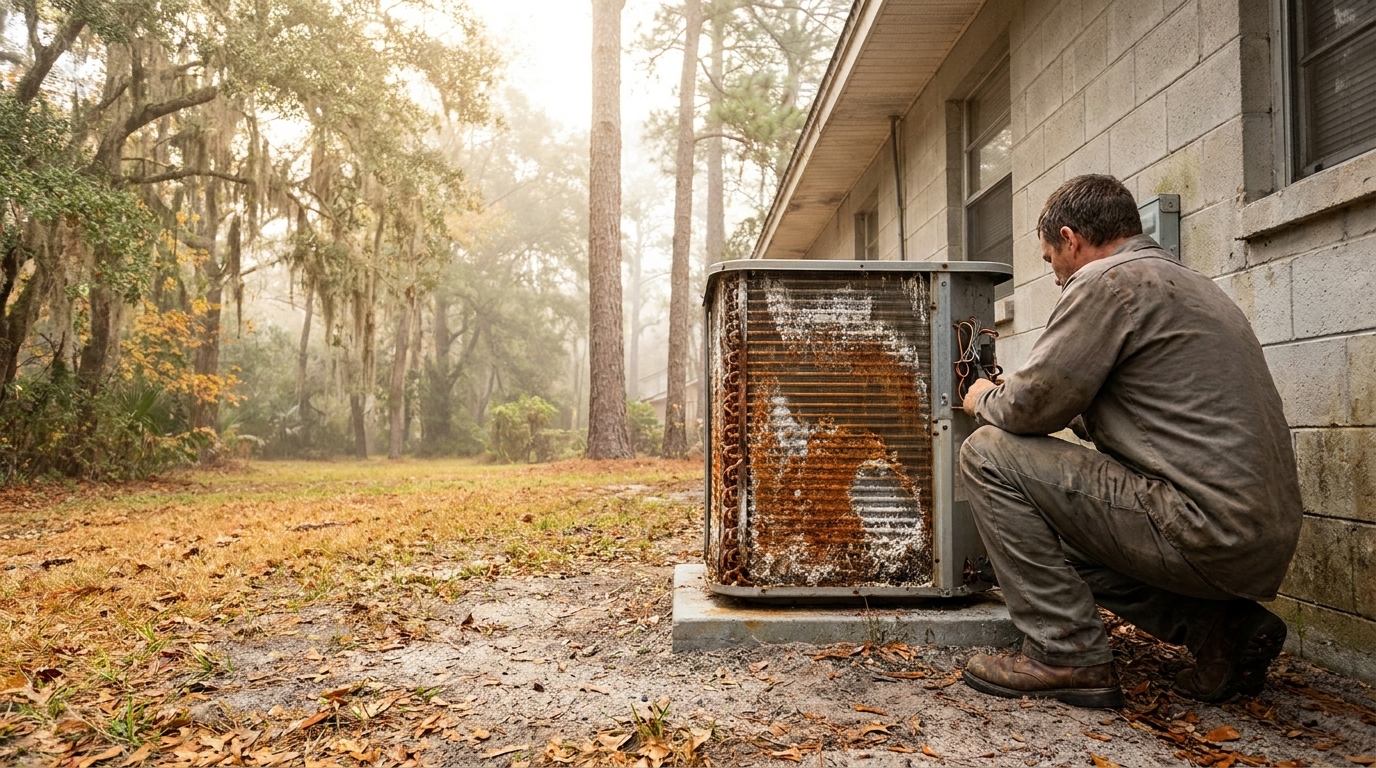
The reason is simple: our coastal-humid environment forces equipment to run longer, remove more moisture, and resist salt-air corrosion that northern systems never face.
If your unit is approaching the end of its expected lifespan and you're seeing recurring problems, you're in the normal Jacksonville replacement window. Below is why, backed by the climate data and the specific wear factors our team sees in local homes every week.
How long does an HVAC system actually last in Jacksonville, FL?
In Jacksonville, a well-maintained central AC or heat pump typically lasts a limited number of years before replacement becomes practical. Systems reaching the later years of their lifespan with recurring repair issues are generally considered candidates for replacement evaluation. That's roughly five years shorter than the same equipment installed in a cooler, drier climate, and the gap comes down to run time, humidity load, and coastal exposure.
Equipment doesn't fail on a calendar — it fails on cumulative stress. A condenser in Jacksonville that has run through years of intense heat and humidity has often done the equivalent work of a much older condenser in a cooler northern climate. That's the core of the lifespan story here.
Why does Jacksonville's climate wear HVAC systems down faster?
Jacksonville sits in ASHRAE Climate Zone 2A with roughly 2,803 cooling degree days annually, making it one of the most demanding cooling environments in the continental United States. More cooling degree days means longer compressor run hours, more fan cycles, and more wear on every moving part — year after year.
Jacksonville's demanding cooling load means systems here work longer hours under higher humidity than in cooler, drier climates. Larger equipment working longer hours in higher humidity is the baseline reality for every system installed here.
The humidity load nobody talks about
Air conditioning doesn't just cool — it dehumidifies. In Jacksonville's year-round high humidity, your system is pulling gallons of moisture out of the air on top of lowering the temperature. That continuous moisture-removal demand stresses compressors, blower motors, and especially condensate drains, which clog and overflow far more often here than in drier markets.
Salt air and coastal corrosion
Homes in Atlantic Beach, Neptune Beach, Jacksonville Beach, and the surrounding coastal communities — and really anything close to the ocean or the Intracoastal Waterway — face salt-laden air that corrodes outdoor condenser coils, cabinet metal, and aluminum fins. Even inland homes aren't immune; sea breezes carry salt further than most homeowners realize.
What specifically shortens AC lifespan in Northeast Florida?
Five wear factors do most of the damage in this market: extended run time from a long cooling season, continuous dehumidification load, salt-air corrosion of outdoor components, condensate drain issues from constant moisture, and undersized or poorly maintained systems forced to run even harder. Address these and you can push toward the top of the expected lifespan range instead of the bottom.
- Extended run time: 2,803 cooling degree days annually means compressors rarely get a long rest.
- Humidity stress: continuous moisture removal taxes the entire refrigeration cycle.
- Salt corrosion: coils, fins, and cabinets degrade faster near the coast.
- Drain line failures: algae and biofilm clog condensate lines year-round.
- Deferred maintenance: dirty coils and low refrigerant force the system to work harder, accelerating every other failure.
That last factor is the one homeowners actually control. King of Home Solutions' HVAC Maintenance Plan includes two service visits per year that cover cleaning evaporator and condenser coils, flushing drain lines and drain pans, checking wiring, compressor, thermostat, refrigerant pressures, and safety devices. In this climate, twice-yearly service isn't optional if you want to reach the upper end of the lifespan range.
When should Jacksonville homeowners plan to replace?
Start evaluating replacement as your system matures, and treat the later years as the active replacement window — especially if you're seeing repeat repairs, rising energy bills, or weak dehumidification. A compressor replacement on a 12-year-old system rarely pays off; that money is usually better applied to a new, higher-efficiency unit sized correctly for Jacksonville's load.
| System Age | What to Expect | Recommended Action |
|---|---|---|
| 0–8 years | Normal operation with routine maintenance | Twice-yearly tune-ups, filter changes |
| 8–12 years | First major repairs appear; efficiency drops | Weigh repair cost vs. remaining life |
| 12–15 years | Recurring issues, higher bills, humidity complaints | Get a replacement evaluation |
| 15+ years | Past typical service life for this climate | Plan proactive replacement before failure |
What does replacement typically cost in Jacksonville?
According to hvacprojectcost.com, central AC only (2–3 ton) replacement in Jacksonville typically costs $4,500–$9,000, a 3-ton heat pump system runs $6,500–$13,000, and a full AC plus air handler replacement runs $7,000–$15,000+. For most 1,500–2,500 sq ft homes, hvacprojectcost.com puts a mid-range complete system in the $9,000–$13,000 range.
Ductwork is often the hidden cost. Replacing deteriorated ductwork adds $2,000–$5,000 to a project, per hvacprojectcost.com, but it's frequently necessary in older homes where leaky ducts have been forcing the new system to compensate. Mechanical permits for HVAC work in Jacksonville cost $50–$200 through the JAXEPICS system, per hvacprojectcost.com, and must be pulled before installation begins under City of Jacksonville requirements. For a quote specific to your home and equipment, contact King of Home Solutions.
How can you extend the life of your system?
Three habits meaningfully extend lifespan in this climate: consistent twice-yearly professional maintenance, prompt attention to small issues (a weak capacitor, a slow drain, a dirty coil) before they cascade, and proper sizing at installation. Oversized systems short-cycle and fail to dehumidify; undersized systems run nonstop and burn out early.
King of Home Solutions serves Clay, Duval, and Saint Johns Counties, including Jacksonville, Atlantic Beach, Neptune Beach, Jacksonville Beach, Orange Park, Fleming Island, Nocatee, Ponte Vedra Beach, St. Augustine, and World Golf Village. Maintenance Plan members also receive 15% off all repairs, and new customers can get 15% off repairs when they enroll in the HVAC Preventative Maintenance Plan.
"Will the technician was very pleasant and helpful. He took his time to do a thorough check of the system inside and outside. All is working great. I would recommend King of Home Solutions to others."
Frequently Asked Questions
How long does an HVAC system last in Florida?
Jacksonville sits in ASHRAE Climate Zone 2A with roughly 2,803 cooling degree days annually, which extends run times and accelerates wear. Coastal salt air and continuous humidity further shorten lifespan for homes near the Atlantic or Intracoastal Waterway.
Does Jacksonville humidity really wear out HVAC equipment faster?
Yes. Jacksonville's year-round high humidity forces your HVAC system to perform continuous moisture removal on top of cooling, stressing compressors, blower motors, and condensate drains. That dehumidification load, combined with roughly 2,803 cooling degree days annually, keeps equipment running longer and harder than in drier climates, leading to earlier compressor fatigue, coil issues, and drain line failures.
At what age should I replace my HVAC system in Jacksonville?
Plan to evaluate replacement between year 12 and 15, especially if you're seeing recurring repairs, rising energy bills, or weak humidity control. Systems past 10 years that need a major repair — like a compressor — are usually better replaced than fixed. The 10-to-15-year window is the standard planning range for Jacksonville's climate, not a guarantee of exact service life.
Why do coastal Jacksonville homes have shorter HVAC lifespans?
Salt-laden coastal air corrodes outdoor condenser coils, cabinet metal, and aluminum fins, which can shave years off system life in neighborhoods like Atlantic Beach, Neptune Beach, Jacksonville Beach, and Ponte Vedra Beach. Equipment within proximity to the ocean or Intracoastal Waterway is most affected, though sea breezes can carry salt well inland. Corrosion risk depends on distance, wind exposure, and coil finish, not just address.
How much does HVAC replacement cost in Jacksonville, FL?
According to hvacprojectcost.com, central AC replacement (2–3 ton) in Jacksonville typically runs $4,500–$9,000, a 3-ton heat pump runs $6,500–$13,000, and a complete AC plus air handler replacement runs $7,000–$15,000+. Most 1,500–2,500 sq ft homes fall in the $9,000–$13,000 mid-range, per the same source. Ductwork adds $2,000–$5,000 if replacement is needed.
Do I need a permit to replace an HVAC system in Jacksonville?
Yes. Mechanical permits are required through the City of Jacksonville's JAXEPICS system for HVAC replacement and installation work. According to hvacprojectcost.com, permit fees typically range $50–$200 depending on system tonnage. A licensed Florida HVAC contractor — regulated through the Department of Business and Professional Regulation under Chapter 489 — pulls the permit as part of a proper installation.
Can regular maintenance really extend my HVAC's life in this climate?
Yes, meaningfully. Twice-yearly professional service that cleans coils, flushes drain lines, checks refrigerant pressures, and catches small issues early can push a system toward the top of the 10-to-15-year range instead of the bottom. In Jacksonville's humidity and salt-air environment, skipping maintenance is one of the fastest ways to shorten equipment life and void manufacturer warranties.
Planning your next step
Jacksonville's climate is tough on HVAC equipment — that's just the physics of a humid, coastal, long-cooling-season market. Knowing the real lifespan range lets you plan ahead instead of scrambling when a system fails in August. Homeowners in Jacksonville, FL who want an honest system evaluation or a maintenance plan built for this climate can reach King of Home Solutions at (904) 865-4663 or https://kingofhomesolutions.com to get started.