Garage Door Won't Open in Woodland Acres, Atlantic Beach FL
Woodland Acres garage door stuck shut? Learn how Atlantic Beach salt air corrodes springs and rollers, and when to call for emergency repair.
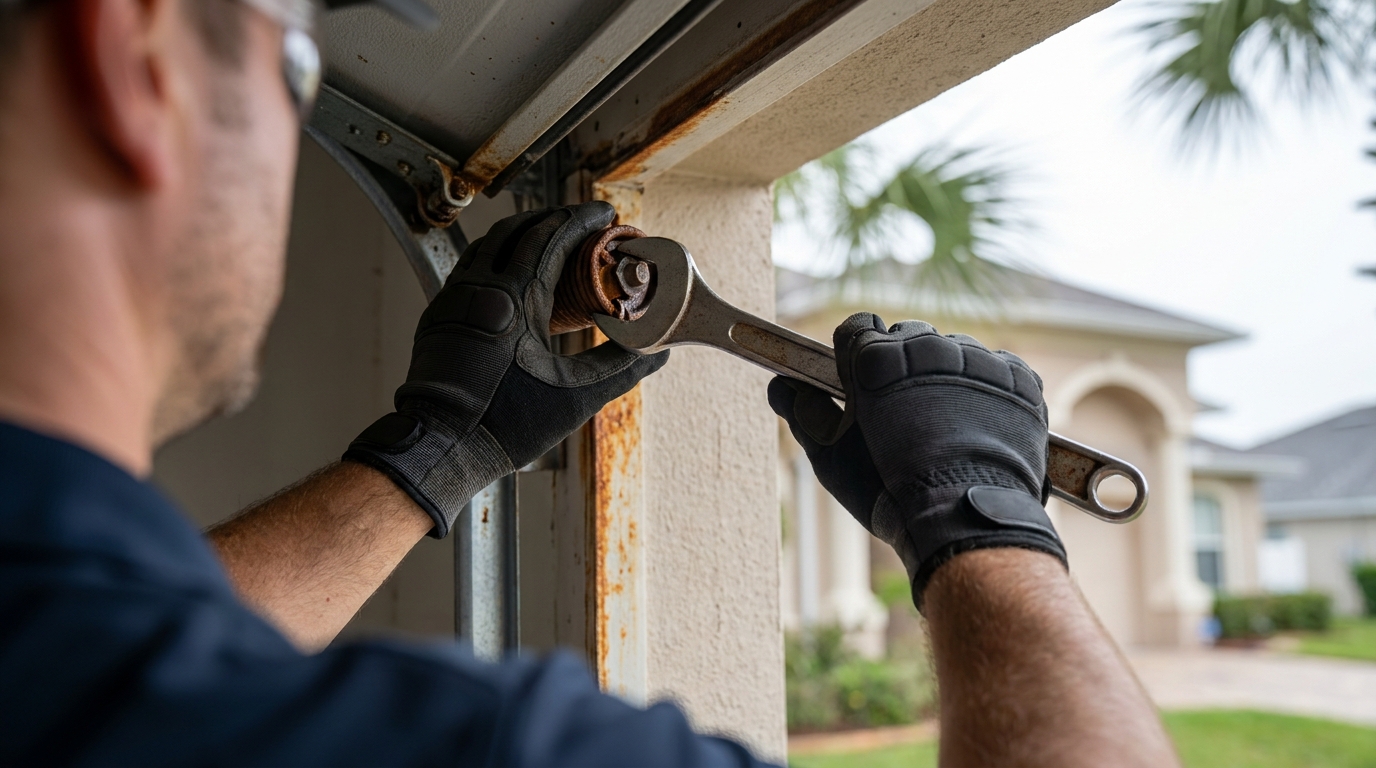
If your garage door won't open in Woodland Acres, Atlantic Beach, the culprit is usually one of three things: a snapped torsion spring corroded by salt air, seized rollers or hinges that have rusted in their tracks, or a dead opener capacitor after a coastal power surge. Salt-driven corrosion is the top suspect in beachside neighborhoods — it accelerates the same failures inland Jacksonville homes see, but on a compressed timeline.
Why does salt air cause so many garage door failures in Woodland Acres?
Woodland Acres sits close enough to the Atlantic that airborne salt settles on garage hardware every day. Salt pulls moisture out of the air and holds it against steel springs, hinges, rollers, and cables — accelerating oxidation. In beachside Atlantic Beach ZIP codes, torsion springs commonly fail in 5–7 years instead of the 10-year, 10,000-cycle life the manufacturer rates them for inland.
Woodland Acres has a mix of older concrete-block homes and newer builds, and many garages open directly to the driveway with no weather-side buffer. That means the same easterly breeze that makes the neighborhood pleasant is also depositing chloride on your door hardware around the clock. At King of Home Solutions, we see the pattern clearly: coastal-side hardware fails faster and more suddenly than the same parts a few miles inland.
What are the most common reasons a garage door won't open here?
The top causes in Woodland Acres are a broken torsion spring (you'll hear a loud bang, then nothing lifts), corroded rollers seized in the track, a snapped or frayed lift cable, a burned-out opener capacitor after a lightning storm, and misaligned safety sensors after humidity swells the bracket. Salt air makes the first three dramatically more common than they'd be inland.
- Broken torsion spring: The single most common no-open call. Corroded coils fatigue and snap, often when the door is closed overnight.
- Seized rollers or hinges: Rust binds moving parts. The opener strains, then the logic board cuts power to protect itself.
- Frayed lift cable: Salt attacks the braided steel. A cable can unravel or snap under load.
- Opener electronics: Summer thunderstorms and coastal humidity are hard on capacitors and logic boards.
- Sensor misalignment: Photo-eye brackets shift with heat and humidity, blocking the down-to-up cycle.
How do I tell if it's salt corrosion or a mechanical failure?
Look at the hardware before you touch anything else. If springs, hinges, or cables show orange-brown rust bloom, flaking, or a rough scaly surface, corrosion is the root cause even if the immediate symptom is mechanical. Clean, shiny hardware that suddenly fails usually points to an opener, sensor, or remote issue — a purely mechanical or electrical fault.
A quick coastal-corrosion check for Woodland Acres homeowners:
- Pull the emergency release cord and try lifting the door by hand. If it feels like it weighs 200+ pounds, the spring is broken.
- Shine a flashlight on the springs above the door. Look for rust rings, gaps in the coil, or a clean break.
- Run a fingertip along the lift cables (door closed only). Any fraying, flaking, or grit means salt damage.
- Check the rollers. If they don't spin freely by hand, they're seized.
If two or more of those checks flag corrosion, replacing one part is a short-term fix — the rest of the hardware is on the same clock.
Repair vs. replacement: what makes sense in a coastal home?
Repair a single failed component if the rest of the hardware is under about 5 years old and shows minimal corrosion. Replace the full spring-and-hardware set (or the whole door) when multiple parts show heavy rust, the door is 10+ years old, or you've already had two salt-related failures. In Woodland Acres, galvanized or stainless hardware upgrades usually pay for themselves within one replacement cycle.
| Situation | Typical Fix | Ballpark Cost | Expected Life (coastal) |
|---|---|---|---|
| Single broken spring, rest of hardware clean | Replace spring (upgrade to galvanized) | $250–$450 | 5–8 years |
| Rusted rollers + noisy operation | Full roller set (nylon w/ sealed bearings) | $150–$300 | 7–10 years |
| Frayed cables + visible spring rust | Cables + springs + hardware refresh | $500–$850 | 6–8 years |
| Door 12+ years old, multiple corrosion points | New door + coastal-rated hardware | $1,400–$3,500+ | 12–15 years |
| Opener won't respond, door lifts by hand | Capacitor, logic board, or opener replacement | $180–$650 | 10–15 years |
When is this an emergency and when can it wait?
Call for emergency garage door repair in Atlantic Beach if the door is stuck open (security risk), if a spring or cable has snapped (safety hazard — never operate the door), or if the door is trapping a vehicle you need. A door stuck closed with the car inside can usually wait until the next business day if you have alternate transportation, but same-day service is worth requesting during hurricane watches or before travel.
Woodland Acres homeowners should treat any pre-storm door failure as urgent. Florida Building Code Section 1620 requires garage doors in wind-borne debris regions to meet specific pressure ratings, and a door with a broken spring or corroded track cannot seal properly against storm loads. Duval County falls inside that wind-borne debris region, so a compromised door is a code and insurance issue as well as a safety one.
How should I choose a garage door company in Atlantic Beach?
Prioritize five things: current Florida state contractor licensing, general liability and workers' comp insurance, documented experience with coastal hardware, transparent written quotes before work begins, and warranty terms that account for salt exposure. Ask specifically whether the springs and hardware they install are galvanized or standard black-oxide — the difference matters a lot in Woodland Acres.
Local track record is the single strongest signal. A company that services beachside Atlantic Beach neighborhoods regularly will stock galvanized springs and stainless fasteners on the truck; a contractor who mostly works inland won't. King of Home Solutions holds a 4.9-star rating across 55 Google reviews, with one recent customer noting the crew "showed up on time" and delivered "outstanding" craftsmanship on a new garage door install — the kind of feedback that tracks with the coastal-specific approach the work demands.
Frequently Asked Questions
How long does a garage door spring last in Atlantic Beach compared to inland?
A standard torsion spring is rated for about 10,000 cycles, or roughly 10 years of typical use. In beachside Atlantic Beach neighborhoods like Woodland Acres, salt-air corrosion typically cuts that to 5–7 years. Galvanized or coated springs can extend life back toward the 8–10 year range, which is why coastal homeowners often see them as worth the modest upgrade cost.
Is it safe to try opening a garage door with a broken spring?
No. A door with a broken torsion spring can weigh 150–250 pounds and will slam down if the opener drags it up. Operating the door in that condition can also strip the opener gears, snap a cable, or injure anyone underneath. Pull the emergency release, leave the door in place, and call a technician.
Do I need a permit to replace a garage door in Atlantic Beach?
Yes, in most cases. The City of Atlantic Beach and Duval County require a permit for garage door replacement because doors must meet Florida Building Code wind-load requirements for the wind-borne debris region. A licensed contractor pulls the permit and provides the product-approval documentation your insurer may request after installation.
Why does my garage door open fine sometimes but stick other times?
Intermittent operation in coastal homes usually points to seized rollers, a weakening spring, or a failing opener capacitor. Humidity and temperature swings expand and contract corroded parts, so the door works on cool mornings and binds by afternoon. Have the hardware inspected before it fails completely — intermittent symptoms almost always progress to a full lockout.
Can I lubricate my garage door to prevent salt damage?
Regular lubrication helps but doesn't stop corrosion. Use a lithium-based or silicone garage door spray on springs, hinges, rollers, and the opener chain every 3–4 months in Woodland Acres — more often than the 6-month schedule recommended for inland homes. Avoid WD-40, which displaces water short-term but strips protective coatings over time.
What's the typical response time for emergency garage door repair in Atlantic Beach?
Same-day service is standard for true emergencies (door stuck open, snapped spring, trapped vehicle) when you call before mid-afternoon on a weekday. Weekend and after-hours response varies by provider — confirm availability when you call, and ask whether the trip fee is credited toward the repair if you proceed with the work.
Getting it handled
A garage door that won't open in Woodland Acres almost always traces back to the same coastal reality: salt air is hard on steel, and the hardware that came standard on your door was probably specified for a milder climate. Diagnosing the failure through a corrosion lens — not just replacing the broken part — is what keeps you from another lockout in 18 months.
Readers in Woodland Acres and the wider Atlantic Beach area who want this diagnosed and repaired properly can reach King of Home Solutions at https://kingofhomesolutions.com to schedule a coastal-hardware inspection or same-day repair.