Why AC Loses Efficiency Near the Coast in Jacksonville, FL
Salt air corrodes coils, fins, and electrical parts on Jacksonville coastal AC systems. Here's the mechanism, the warning signs, and how to slow it down.
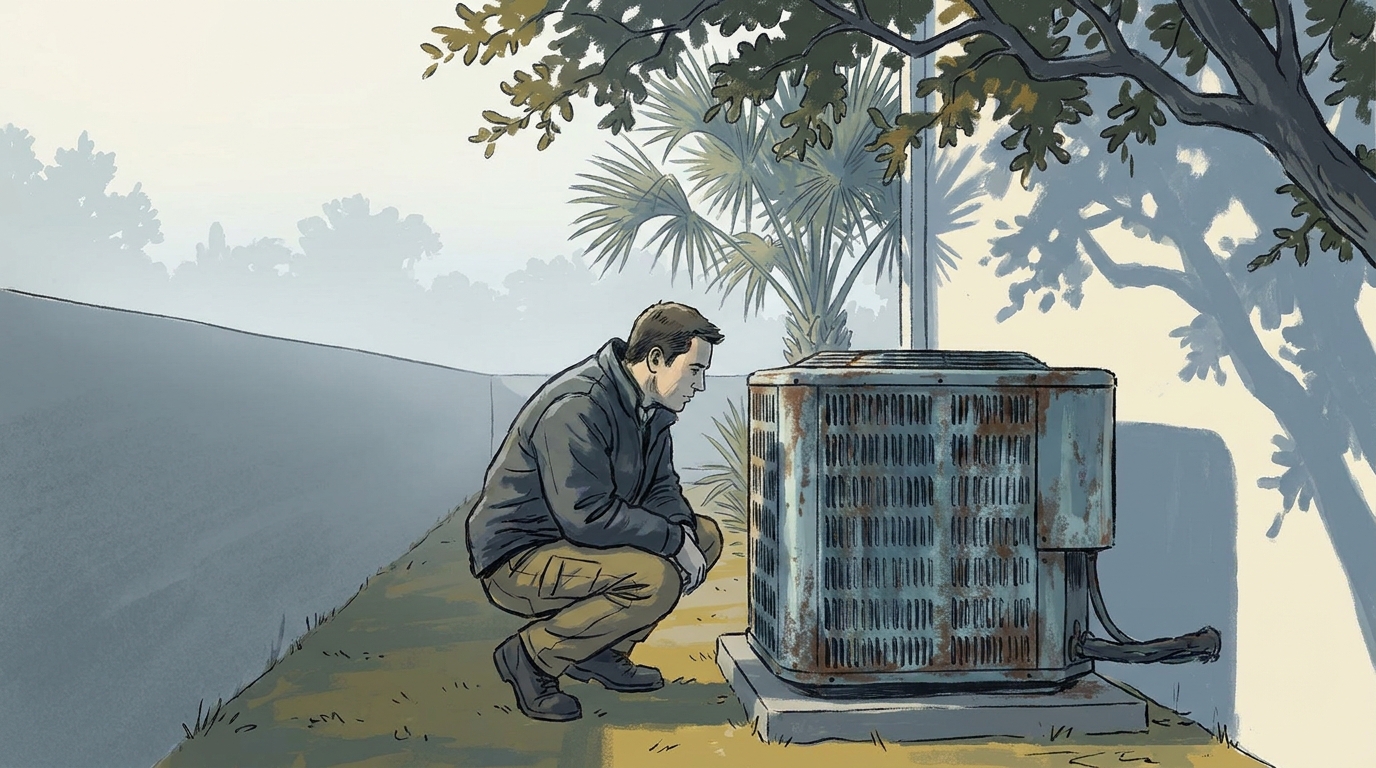
Your AC loses efficiency faster near the Jacksonville coast because salt-laden air carried from the Atlantic and tidal waterways deposits on your outdoor unit, where it combines with heat and humidity to corrode condenser coils, aluminum fins, copper tubing, and electrical terminals. That corrosion insulates heat-transfer surfaces and degrades electrical connections, forcing the system to work harder for less cooling. The closer your home sits to open water or a wind-exposed lot, the faster the damage accumulates.
What exactly is salt air doing to your outdoor unit?
Salt air damages your AC through electrochemical corrosion. Microscopic salt particles settle on the condenser coil, fins, cabinet, fasteners, and electrical contacts, then combine with Jacksonville's high humidity to form a conductive film that eats aluminum and copper. The result is reduced heat transfer at the coil, pitted electrical terminals, and rust on the cabinet and fasteners that hold the system together.
Published local guidance in the Jacksonville market identifies nine distinct mechanisms by which coastal salt air damages HVAC equipment, from fin degradation to connector failure. The common thread is that salt doesn't need to touch bare metal to cause harm — once a conductive salt film forms, corrosion continues even on finished surfaces every time the humidity rises.
Why does Jacksonville's coast make this worse than inland Florida?
Jacksonville's coast makes salt corrosion worse because proximity to the ocean, major rivers, and tidal waterways creates variable but persistent salt exposure across a very large geographic footprint. Homes in beachside communities face the most aggressive conditions; prevailing wind, surrounding buildings, and landscaping then dial the severity up or down lot by lot.
Inland neighborhoods still see salt influence on windy days, but the dose is far smaller. Our team at King of Home Solutions sees the sharpest degradation on homes within a few blocks of open water or on wind-exposed lots with no vegetation break between the ocean and the condenser pad.
How fast will a coastal AC actually lose efficiency?
There is no universal percentage. No primary manufacturer or industry-association source quantifies a specific efficiency-loss percentage or service-life penalty for coastal Jacksonville homes, so anyone quoting a precise figure is guessing. What is documented is the mechanism: coil fouling, fin corrosion, and electrical pitting all reduce heat transfer and raise electrical resistance, which shows up as longer run times and higher bills.
Severity depends on distance from the shoreline, prevailing wind direction, equipment placement, surrounding structures, and how often the unit is cleaned. A beachfront condenser rinsed quarterly and inspected twice a year will outlast an identical unit three blocks away that is never touched.
Which parts of your system fail first?
The outdoor condenser coil and its aluminum fins usually show damage first because they sit directly in the salt-laden airstream and run wet with condensation. Electrical contactors, capacitor terminals, and fastener heads tend to follow, with cabinet rust appearing last. Indoor evaporator coils are better protected but still see accelerated wear if the outdoor side is already struggling.
| Component | Salt-air failure mode | Efficiency impact |
|---|---|---|
| Aluminum fins | White oxidation, fin collapse | Reduced airflow across coil |
| Copper tubing | Pitting, formicary corrosion | Refrigerant leaks |
| Electrical contacts | Pitting, high resistance | Hard starts, contactor burnout |
| Steel cabinet & fasteners | Rust-through | Panel gaps, structural failure |
| Condenser coil surface | Salt film, debris binding | Poor heat rejection, high head pressure |
What are the warning signs your coastal AC is losing efficiency?
The clearest warning signs are longer cooling cycles, rising electric bills with no change in thermostat habits, warmer supply air than usual, ice on the outdoor refrigerant line, visible white powder or green patina on the condenser, and a hum or click from a struggling contactor. Any one of these on a coastal Jacksonville home is a reason to schedule an inspection before summer peaks.
Catching these signs early matters because Jacksonville's long, humid cooling season concentrates demand in the summer months. Appointment availability tightens during peak periods, and a borderline system that limps through June often fails outright in August.
How can you slow coastal corrosion down?
You slow coastal corrosion by rinsing the outdoor coil with fresh water on a regular schedule, keeping salt-tolerant landscaping and debris away from the unit, and booking twice-yearly professional maintenance that specifically inspects coil surfaces, cabinet integrity, and electrical connections. For new installations near the water, coated coils and corrosion-resistant hardware are worth asking about.
The King of Home Solutions HVAC Maintenance Plan is built around this exact pattern: two service visits per year that include cleaning evaporator and condenser coils, flushing drain lines and drain pans, and checking wiring, the compressor, the thermostat, refrigerant pressures, and safety devices. Plan members also receive 15% off repairs, which matters when a corroded contactor or capacitor needs replacing mid-season.
Should coastal homeowners repair or replace a corroded system?
Repair is usually the right answer when the compressor and coil are intact and the failure is a single corroded component — a contactor, capacitor, or fan motor. Replacement enters the conversation when the condenser coil itself is leaking, the cabinet is rusted through, or repair costs start approaching a meaningful share of a new system. Installed-system starting prices for single-stage equipment vary by market, with national ranges extending considerably higher depending on capacity, efficiency, and ductwork.
Those are advertised starting prices, not quotes. Actual cost depends on equipment model, capacity, efficiency rating, labor, refrigerant and electrical work, duct modifications, permits, and disposal — any of which can move the number materially. Replacement or substantial mechanical HVAC work in Jacksonville typically requires permits, which should be confirmed with the local authority before work begins.
Who should do this work in Jacksonville?
Hire a Florida-licensed air-conditioning contractor regulated by the Department of Business and Professional Regulation's Construction Industry Licensing Board. Certified contractors have statewide authority; registered contractors are limited to jurisdictions where they are registered. Florida does not license individual HVAC technicians the same way at the state level, so verify the contracting business's license and ask who will actually be on your property.
King of Home Solutions serves Clay, Duval, and Saint Johns Counties, with a service area that includes Jacksonville, Atlantic Beach, Neptune Beach, Jacksonville Beach, Orange Park, Fleming Island, Nocatee, Ponte Vedra Beach, St. Augustine, and World Golf Village. That coastal and near-coastal footprint is exactly where salt-air degradation shows up most often.
I called King of Home Solutions for an HVAC repair and was impressed by their reliability and timeliness. The technician arrived on schedule, was very professional, responsive to my questions, and genuinely friendly. Great service and fair pricing – I’ll definitely call them again.
Frequently asked questions
How long does an HVAC system last in coastal Jacksonville?
There is no verified Jacksonville-specific service-life figure for coastal exposure, so any universal number should be treated with caution. What is well established is that salt-air corrosion of coils, fins, and electrical components accelerates wear, and that a maintained unit on an exposed oceanfront lot will typically give up ground to an identical unit kept inland. Regular rinsing and twice-yearly maintenance meaningfully extend useful life.
How often should a coastal AC be professionally maintained?
Twice a year is the standard recommendation for coastal and near-coastal homes in Jacksonville — once before the cooling season and once ahead of heating use. The King of Home Solutions HVAC Maintenance Plan includes two service visits per year that cover coil cleaning, drain line and pan flushing, and inspection of wiring, the compressor, the thermostat, refrigerant pressures, and safety devices.
Can I just rinse my condenser myself?
Yes, a gentle fresh-water rinse of the outdoor coil every few weeks is one of the most useful things a coastal homeowner can do. Shut power off at the disconnect first, avoid high-pressure spray that can bend the aluminum fins, and skip harsh chemicals. Rinsing supplements — but does not replace — professional cleaning that reaches the inner coil surfaces and inspects electrical components.
How much does an annual HVAC maintenance plan cost in Jacksonville?
Annual HVAC maintenance plans and one-off routine maintenance visits vary in cost; getting itemized quotes from local contractors is the most reliable way to budget accurately. Actual pricing varies by provider, number of visits, and what the plan includes. Contact King of Home Solutions for current pricing on its two-visit maintenance plan.
Does a new coastal AC need special features?
Coastal homeowners should ask about coated condenser coils, corrosion-resistant fasteners, and protective cabinet finishes designed for seaside exposure. These options add cost but can slow fin degradation and extend the service life of equipment installed in high-salt-exposure locations. A site visit matters — equipment placement and wind exposure drive the right spec more than the street address alone.
Do I need a permit to replace my AC in Jacksonville?
Replacement or substantial mechanical HVAC work in Jacksonville typically requires permits. Specific local permitting requirements and fees should be confirmed with the local authority before work begins. A licensed Florida air-conditioning contractor regulated by the DBPR's Construction Industry Licensing Board will pull the appropriate permits as part of the job.
Getting ahead of coastal wear
Salt air is a slow, patient opponent — it rarely kills an AC overnight, but it chips away at efficiency season after season until a hot August afternoon exposes what the previous winter already decided. The homes that fare best are the ones where someone is paying attention: rinsing the coil, watching for white powder on the fins, and getting professional eyes on the system twice a year.
Readers in Jacksonville, Atlantic Beach, Ponte Vedra Beach, or anywhere else across Clay, Duval, and Saint Johns Counties who want this handled professionally can reach King of Home Solutions at (904) 865-4663 or https://kingofhomesolutions.com to schedule a maintenance visit or an on-site assessment.