HVAC Lifespan in Jacksonville, FL: How Long It Lasts
Jacksonville's humidity and salt air shorten HVAC lifespan. Learn how long systems actually last here, replacement signs, and repair-vs-replace guidance.
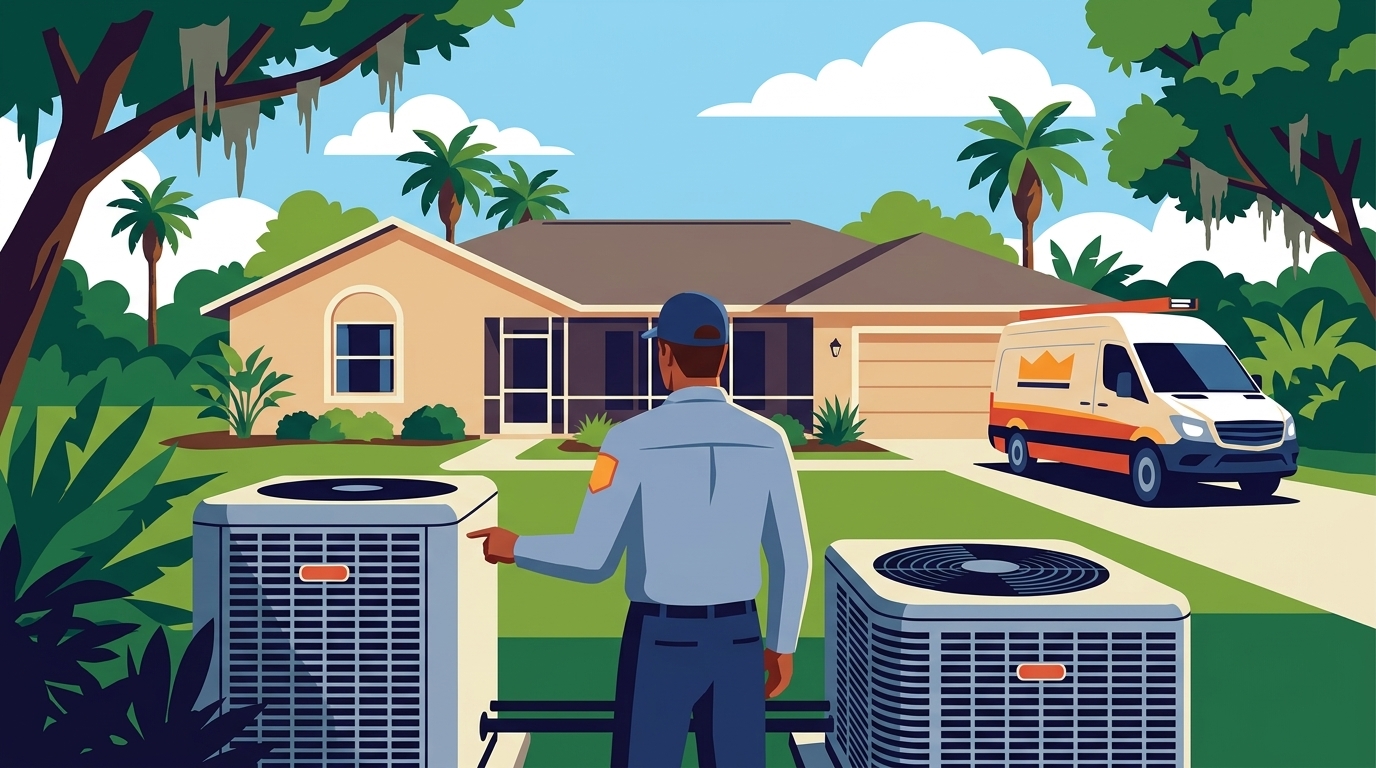
In Jacksonville, FL, a typical residential HVAC system lasts 10 to 15 years — shorter than the 15-to-20-year national average. The combination of coastal humidity, salt air from the St. Johns River and Atlantic, and near-year-round runtime accelerates coil corrosion, compressor wear, and refrigerant-line degradation. Well-maintained systems can push toward 15 years; neglected ones often fail by year 10.
If you're staring down a noisy condenser in Riverside or a struggling air handler in a Southside two-story, the question isn't really "how long should it last?" — it's "how long will mine last, and when do I stop pouring money into it?" That's what this guide is built to answer.
Why do HVAC systems wear out faster in Jacksonville's humidity?
Jacksonville HVAC systems wear out 3-5 years earlier than national averages because they run 8-9 months a year against 70%+ average humidity, salt-laden coastal air corrodes outdoor coils and electrical contacts, and afternoon thunderstorms cycle systems through constant load swings. Every one of those factors compounds the others.
Your air conditioner in Duval County isn't just cooling — it's removing gallons of moisture from your home every day. That latent load means the compressor and blower work longer per cycle than they would in a drier climate like Atlanta or Charlotte.
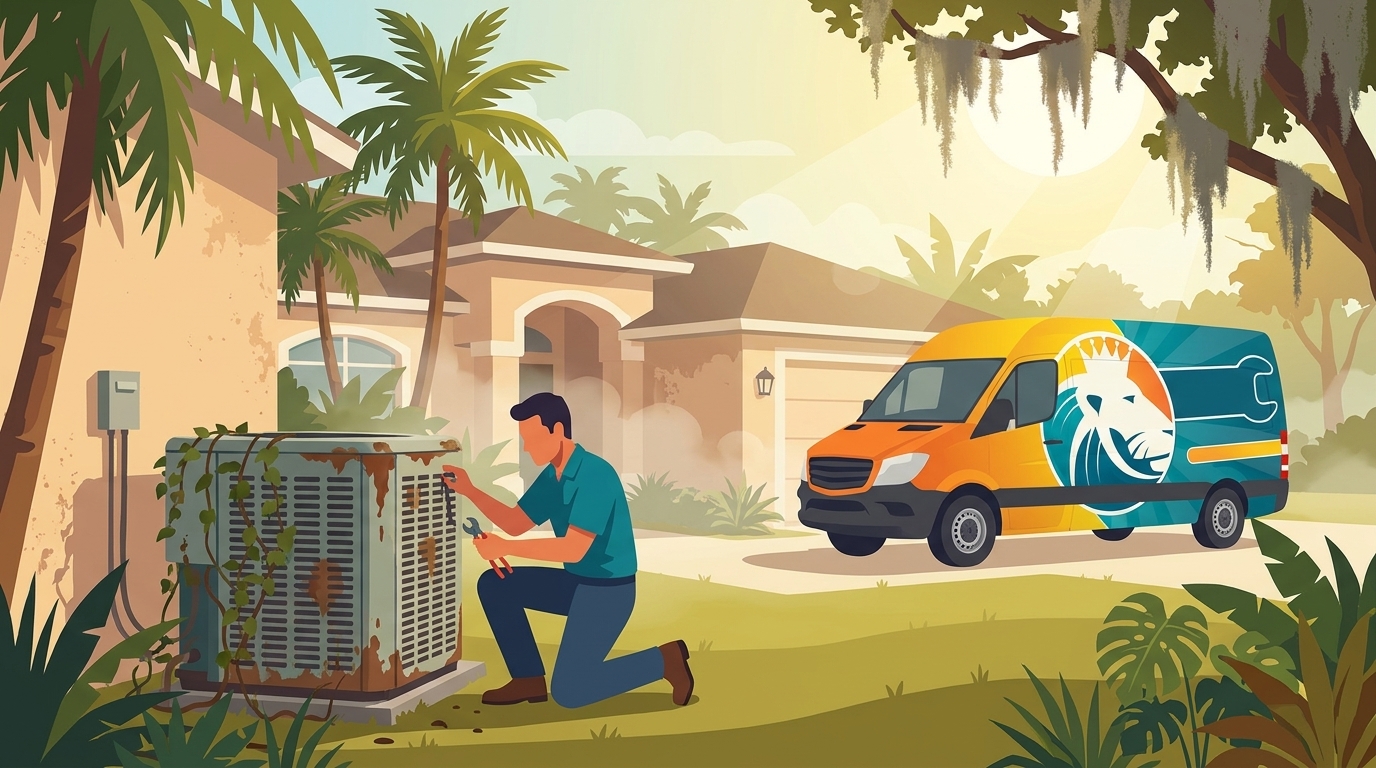
Homes closer to the coast — Atlantic Beach, Neptune Beach, Mayport — see the worst of it. Salt air pits aluminum fins and eats copper connections on outdoor units, sometimes cutting condenser life to 8-10 years even with regular service. Inland neighborhoods like Mandarin or Julington Creek fare better, but no part of Jacksonville escapes the humidity.
What's the realistic lifespan by HVAC component in Jacksonville?
In Jacksonville's climate, expect central air conditioners to last 10-15 years, heat pumps 8-12 years (they run year-round here, unlike in the north), gas furnaces 15-20 years, ductwork 15-25 years, and thermostats 10+ years. Heat pumps take the biggest hit locally because they handle both heating and cooling duties.
| Component | National Average | Jacksonville, FL Reality | Main Local Stressor |
|---|---|---|---|
| Central AC (split system) | 15-20 years | 10-15 years | Humidity, runtime hours |
| Heat pump | 15 years | 8-12 years | Year-round operation |
| Gas furnace | 20-25 years | 15-20 years | Low usage extends life |
| Air handler / blower | 15 years | 10-12 years | Constant moisture load |
| Ductwork | 20-25 years | 15-25 years | Attic heat, condensation |
| Outdoor coil (coastal) | 15 years | 8-10 years | Salt air corrosion |
Manufacturers like Carrier, Trane, and Lennox publish warranty terms that reflect these realities — most standard parts warranties run 10 years with registration, which aligns closely with expected Florida service life. That's not an accident.
What are the signs I need a new air conditioner?
The clearest signs you need a new air conditioner in Jacksonville are: your system is 10+ years old, uses R-22 refrigerant, cycles on and off constantly, can't hold temperature during August afternoons, produces higher energy bills without lifestyle changes, or has needed two or more major repairs in the past two years. Any two of these together usually points to replacement.
A few Jacksonville-specific red flags the team at King of Home Solutions watches for:
- Humidity above 55% indoors even when the AC is running — the system can cool but no longer dehumidify effectively.
- Musty smells or visible mold around vents or the air handler closet. One customer recently had King of Home Solutions clean and remediate mold from an HVAC system while preparing a home for sale — a common issue in older Jacksonville homes with aging equipment.
- Ice on the outdoor unit or refrigerant lines, which usually signals a failing compressor or refrigerant leak.
- Uneven temperatures between rooms, especially in older Ortega or Avondale bungalows with original ductwork.
- Loud vibration or grinding from the outdoor unit — often a fan motor or compressor bearing on the way out.
Is it worth repairing an old air conditioner in Jacksonville?
Repair makes sense if your system is under 10 years old, the repair costs less than $500, and the unit still uses R-410A refrigerant. Replacement usually wins if the system is 12+ years old, the repair exceeds $1,500, or the unit uses phased-out R-22 refrigerant — where a single recharge can now cost $600-$1,200 due to limited supply.
The industry rule of thumb is the $5,000 rule: multiply the repair cost by the system's age. If the number exceeds $5,000, replace it. A $600 repair on a 9-year-old unit ($5,400) is a coin flip; a $400 repair on a 6-year-old unit ($2,400) is an easy yes to repair.
Florida also has building code implications worth knowing. Under the Florida Building Code, replacement systems must meet current minimum efficiency standards (currently SEER2 15.2 for the Southeast region, per the U.S. Department of Energy's 2026 regional efficiency mandate). Any replacement in Duval County requires a mechanical permit, and inspectors will verify the new equipment meets these standards.
How can Jacksonville homeowners extend HVAC lifespan?
To maximize HVAC lifespan in Jacksonville, schedule professional maintenance twice a year (spring and fall), change filters every 30-60 days during heavy runtime months, keep the outdoor condenser clear of debris and rinsed of salt residue, maintain proper attic insulation, and address refrigerant leaks or duct issues immediately rather than letting them stress the system.
Two maintenance visits per year matter more here than in most of the country because the system barely rests. Spring service preps the AC for the brutal May-through-September stretch; fall service catches wear before heat-pump heating season and identifies humidity-control issues that intensify during rainy summer months.
For homes east of the Intracoastal, a quick freshwater rinse of the outdoor condenser every few months materially slows salt corrosion. It's a five-minute job that can add years to a coil.
Frequently Asked Questions
How long does an HVAC system last in Florida humidity?
In Florida's humid climate, most residential HVAC systems last 10-15 years, compared to 15-20 years in drier parts of the country. Heat pumps typically last 8-12 years because they run year-round. Coastal Jacksonville homes near the ocean or St. Johns River often see shorter lifespans on outdoor equipment due to salt-air corrosion, sometimes as little as 8 years for condenser coils.
Should I replace my 15-year-old AC unit even if it still works?
Usually yes. A 15-year-old system in Jacksonville is past typical service life, likely uses obsolete R-22 refrigerant, and runs at efficiency levels 30-50% below current SEER2 15.2 standards. Even without a breakdown, you're paying a premium on every electric bill. Planning a proactive replacement lets you avoid an emergency install during August peak season when scheduling and pricing both tighten.
How much does a new HVAC system cost in Jacksonville, FL?
A complete residential HVAC replacement in Jacksonville typically runs $6,000-$12,000 for a standard split system, and $10,000-$18,000 for higher-efficiency heat pump or variable-speed setups. Costs vary based on tonnage, SEER2 rating, ductwork condition, and whether permitting and equipment disposal are included. Duval County requires a mechanical permit for any full system replacement.
Does homeowners insurance cover HVAC replacement in Florida?
Standard Florida homeowners insurance covers HVAC damage from covered perils like lightning strikes, fire, or hurricane damage, but not gradual wear, mechanical breakdown, or age-related failure. Some policies offer optional equipment breakdown coverage for a small annual premium, which is worth considering given Jacksonville's storm exposure. Review your policy before assuming coverage.
How often should I service my HVAC system in Jacksonville?
Twice a year — once in spring before cooling season and once in fall before heating season. Jacksonville's near-year-round runtime and high humidity load make biannual service more important than in cooler climates. Between professional visits, change filters every 30-60 days, keep the outdoor unit clear, and watch indoor humidity levels as an early warning sign of system decline.
What's the most reliable HVAC brand for Florida homes?
Trane, Carrier, Lennox, and Rheem all perform well in Florida when properly sized and maintained. Brand matters less than correct sizing, quality installation, and matched components — an oversized unit will short-cycle and fail to dehumidify, shortening lifespan regardless of brand. Coastal Jacksonville homes benefit from models with corrosion-resistant coil coatings, which several manufacturers offer as an upgrade option.
The bottom line for Jacksonville homeowners
Plan on 10-15 years from a Jacksonville HVAC system, not the 20 you might read about in a national article. Coastal proximity, humidity, and year-round runtime are the real limits, and they don't care what the manufacturer's brochure says. Twice-a-year maintenance, prompt repairs, and honest repair-vs-replace math are what actually stretch a system to the top of that range.
Readers in Jacksonville who want a straight assessment of their system's remaining life — or a second opinion on a replacement quote — can reach King of Home Solutions at https://kingofhomesolutions.com. The team holds a 4.9-star rating across 55 Google reviews, with customers consistently citing clear communication, on-time arrival, and fair pricing on HVAC work.