Local vs National HVAC Companies in Jacksonville, FL
Myth: national HVAC chains always beat local pros in Jacksonville. Here's what actually matters — licensing, code knowledge, warranty terms, and real accountability.

The common belief is that a national HVAC chain automatically means better pricing, better warranties, and a safer bet than a local Jacksonville contractor. That's wrong — or at least incomplete. In this market, the brand on the truck tells you almost nothing about who will actually size your system, pull the permit, or honor the labor warranty three summers from now. What matters is the specific crew, the written scope, and whether the company knows how Florida's building code treats your installation.
This guide walks through the real criteria that separate a good HVAC installation from a bad one in Duval County — and where local independents like King of Home Solutions tend to have structural advantages over national chains operating through local branches or franchises.
Is a national HVAC chain really more reliable than a local Jacksonville contractor?
No — company size does not determine installation quality. A national brand name doesn't tell you who will perform the work, how your system will be sized, or who handles warranty service a year later. In Jacksonville, the installer's state license, Manual J load calculation, and written labor warranty matter far more than the logo on the paperwork.
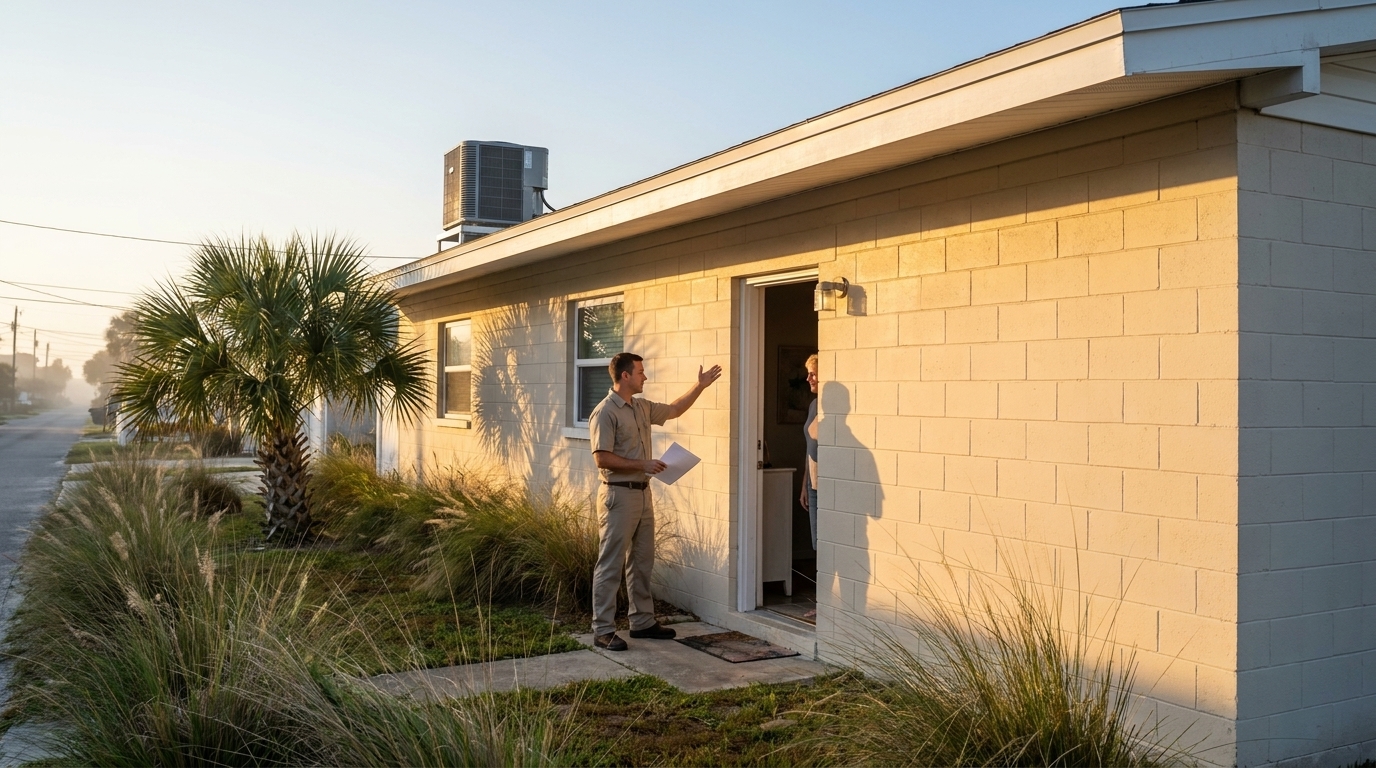
Here's the mechanism behind the myth: national chains invest heavily in brand marketing, which creates a halo of credibility. But the actual installation is almost always performed by a local branch, franchisee, or subcontracted crew — the same labor pool local independents draw from. The brand doesn't install your air handler. A technician does.
At King of Home Solutions, serving Clay, Duval, and Saint Johns Counties, the people answering the phone are the same people accountable for the work. That direct line of responsibility is harder to replicate through a multi-layer franchise structure.
What should you actually verify before hiring any HVAC company in Jacksonville?
Verify three things before signing: the state Air Conditioning license (through the Florida Department of Business and Professional Regulation's myfloridalicense.com database), the Duval County specialty contractor registration (through the Duval County CTQB database), and active workers' compensation coverage (through the Florida Division of Workers' Compensation data portal). All three are free public records.
You can also check whether any contractor has judgments against them through the Duval County Clerk of the Court, which maintains official records including legal judgments against contractors. If a national chain's local branch can't produce clean results on all four checks, the national brand doesn't protect you — Florida law does, and only if the paperwork is in order.
Does a local contractor really know Jacksonville's building code better?
Usually, yes — and this is where the myth of national-chain superiority breaks down fastest. Florida's building code imposes specific technical requirements that out-of-market crews frequently miss. Florida's building code requires heating and cooling equipment to be properly sized based on building loads — a calculation that accounts for your home's specific conditions — and installed in accordance with the manufacturer's instructions.
That's not boilerplate. A proper Manual J load calculation accounts for your home's orientation, insulation, window area, and infiltration — not a rule-of-thumb square-footage guess. In Jacksonville's humid subtropical climate, oversizing is one of the most common installation failures: the system short-cycles, humidity stays high, and the home feels clammy even at a comfortable thermostat setting.
Other code specifics a Jacksonville installer should know by heart:
- Equipment installed in flood hazard areas — relevant for homes near the St. Johns River, the Intracoastal, and beachside neighborhoods — must be located or installed in accordance with applicable flood hazard provisions of Florida's building code.
Local crews that pull permits regularly tend to internalize these details. Out-of-town or rotating crews often do not.
How do pricing structures actually compare between local and national HVAC providers?
Neither category is inherently cheaper. National chains often appear to offer standardized package pricing, while local contractors typically quote per-job after a site visit. In both cases, the real cost drivers are tonnage, SEER2 efficiency rating, duct condition, electrical work, and permit requirements — not the brand overhead. A written, itemized quote is the only way to compare apples to apples.
Market estimates for Jacksonville-area ducted system replacements commonly fall into the mid-four to low-five figures, with ductwork, variable-speed upgrades, and code-related electrical work pushing the top of that range. But those are general budgeting figures from third-party estimate pages, not quotes. The number that matters is the one on your written proposal.
What a comparable quote should include
| Line Item | Why It Matters |
|---|---|
| Indoor and outdoor model numbers | Lets you verify the exact SEER2 rating and capacity against manufacturer specs |
| Manual J load calculation | Required by Florida code; prevents oversizing in a humid climate |
| Permit and inspection fees | Duval County requires permitted installation; unpermitted work can jeopardize insurance claims |
| Duct modifications and line-set work | Often the hidden cost that separates a low bid from a complete one |
| Labor warranty terms | Separate from manufacturer parts warranty; defines who pays for diagnostic and repair labor |
| Startup and commissioning | Refrigerant charge verification and airflow balancing determine long-term efficiency |
What about warranty and ongoing service?
Manufacturer parts warranties travel with the equipment regardless of installer, but labor warranties are governed by the contract you sign with the installing company — not the national brand on their marketing. If the local branch of a national chain changes hands or closes, your labor warranty may become difficult to honor. A locally rooted contractor you can reach by name is often easier to hold accountable.
Ongoing maintenance is where this plays out over years, not days. King of Home Solutions' HVAC Maintenance Plan includes two service visits per year, covering cleaning of evaporator and condenser coils, flushing drain lines and drain pans, checking wiring, compressor, thermostat, refrigerant pressures, safety devices, and providing proactive system recommendations. Plan members also receive 15% off all repairs. In a climate where coils run nearly year-round and drain lines clog from biological growth, that consistent attention matters more than it would in a milder market.
"King of home solutions was right there when we lost AC in a heat wave! Quick response time, professional workers and easy to deal with. They knew what they were doing and fixed our AC the same day! Highly recommend them." — 5★ · Elyssa, Aug 2025
Who is each option actually best for?
Choose a local Jacksonville contractor if you want direct accountability, flexibility across equipment brands, and a crew that pulls permits routinely. Choose a national or multiregional provider only if you've confirmed that the Jacksonville branch — not the corporate brand — can match the licensing, warranty, and response terms a reputable local firm offers.
For most homeowners in Jacksonville, Atlantic Beach, Neptune Beach, Jacksonville Beach, Orange Park, Fleming Island, Nocatee, Ponte Vedra Beach, St. Augustine, and World Golf Village — the service area King of Home Solutions covers — the practical answer is to get three written proposals from licensed local providers and compare the scopes line by line.
Frequently Asked Questions
How do I verify a Jacksonville HVAC contractor's license?
Check two databases: the Florida Department of Business and Professional Regulation's myfloridalicense.com for the state Air Conditioning license, and the Duval County CTQB database for county-level registered or specialty contractor status. Both are free and public. If a contractor cannot be found in either, do not hire them regardless of brand affiliation or marketing.
Why does Manual J load calculation matter in Jacksonville's climate?
Florida's humidity makes oversized systems perform worse than correctly sized ones. An oversized AC cools quickly but short-cycles before removing moisture, leaving the home clammy. Florida's building code requires load calculations (or an approved equivalent) for sizing. A proper calculation accounts for insulation, window area, orientation, and infiltration — not just square footage.
Does a national HVAC chain's warranty transfer better than a local contractor's?
Manufacturer parts warranties travel with the equipment regardless of who installed it. Labor warranties are between you and the installing company — the local branch or franchise, not the corporate brand. If that branch closes or changes ownership, labor coverage can become difficult to claim. A stable local contractor you can reach directly is often easier to hold accountable long-term.
How can I check if an HVAC contractor has complaints or judgments against them?
The Duval County Clerk of the Court maintains all official county records, including legal judgments against contractors. You can also verify active workers' compensation coverage through the Florida Division of Workers' Compensation data portal. Running both checks takes a few minutes and surfaces issues that online reviews often miss.
What's the difference between SEER2 and the older SEER rating?
SEER2 is the current efficiency rating standard for air conditioners and heat pumps, using updated testing conditions that better reflect real-world performance. When comparing quotes, confirm the SEER2 rating of each proposed indoor and outdoor model combination — not just the brand or tier label — so you're comparing equivalent equipment rather than marketing names.
Should Jacksonville homeowners near the water follow special HVAC installation rules?
Yes. Under Florida's building code, heating and cooling equipment installed in designated flood hazard areas must be located or installed in accordance with applicable flood hazard provisions. Homes near tidal rivers, waterways, and the beaches may fall into these zones. A local contractor familiar with regional flood zone requirements is better positioned to handle this correctly.
Closing thoughts
The local-versus-national question is really a licensing, code-knowledge, and accountability question wearing a branding costume. Verify the credentials, insist on a Manual J calculation, read the labor warranty, and get the full scope in writing — and the brand on the truck becomes a secondary consideration.
Readers in Jacksonville, FL who want this handled by a locally rooted team can reach King of Home Solutions at (904) 865-4663 or https://kingofhomesolutions.com to get started.