Signs Your Garage Door Opener Needs Replacing in Jacksonville
Learn the warning signs your Jacksonville garage door opener is failing, how long openers last in Florida's climate, and when replacement beats repair.
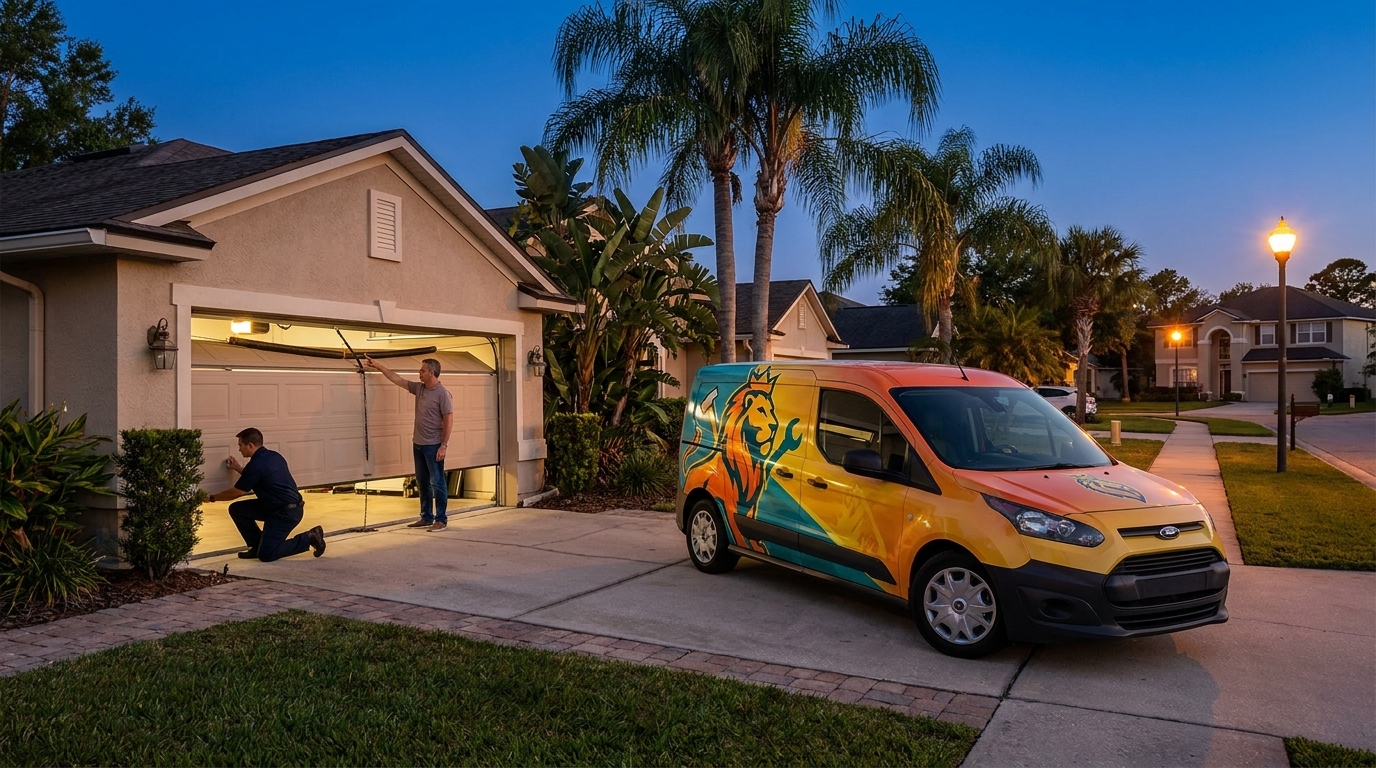
If your garage door opener is making new noises, hesitating, or acting up in ways it didn't a year ago, it's probably telling you something. In Jacksonville's salt-tinged, humid coastal air, openers rarely fail all at once — they give you a series of small warnings first. Catching those signs early is the difference between a planned replacement on your schedule and a dead motor stranding your car in the garage on a Monday morning.
Below is a straightforward guide to the signs that your opener is on its way out, how long these units typically last here on the First Coast, and when repair stops making financial sense.
How Long Do Garage Door Openers Last in Jacksonville?
Most residential garage door openers last 10 to 15 years, but in Jacksonville, FL, the practical range trends toward the lower end — often 10 to 12 years. Salt air from the Atlantic, high summer humidity, and the temperature swings around cold snaps in January and February all accelerate wear on circuit boards, gears, and steel components.
Homes closer to the coast — think Atlantic Beach, Neptune Beach, and Jacksonville Beach — tend to see corrosion faster than homes further inland in areas like Mandarin or Julington Creek. If your opener is more than a decade old and you live near the water, you're in the replacement window whether it's failing yet or not.
7 Signs Your Garage Door Opener Needs to Be Replaced
Here are the warning signs we see most often on service calls across Duval County. Any one of these on its own may just need a repair. Two or three together usually mean the opener is on borrowed time.
1. It's Louder Than It Used to Be
A gradual increase in grinding, rattling, or straining noise is one of the earliest signs of an aging opener. Chain-drive units get noisier as gears wear; belt-drive units start to whine when the motor is struggling. If neighbors can hear your garage open from across the street, the internals are wearing out.
2. The Door Reverses or Hesitates Without Reason
Modern openers use safety sensors and force settings to stop or reverse the door if they detect resistance. When an aging control board misreads those signals, the door will reverse mid-cycle, pause halfway, or refuse to close on the first try. Sensor alignment can cause this too — but if a technician has already re-aligned them and it's still happening, the logic board is likely failing.
3. It Runs Slowly or Struggles to Lift
Openers should move the door at a consistent speed. If yours has started laboring on the way up, especially in Jacksonville's peak summer humidity when everything expands slightly, the motor is losing torque. Once a motor starts weakening, it rarely recovers.
4. No Rolling-Code or Smartphone Features
Openers manufactured before roughly 1993 don't have rolling-code technology, which means the remote signal can be copied. If your opener still uses a fixed code — or worse, a DIP-switch remote — it's both a security risk and well past its service life. Newer units also offer Wi-Fi control, battery backup (which matters during hurricane season power outages), and smartphone alerts.
5. It Won't Work During a Power Outage
Florida law has required battery backup on new residential garage door openers installed in the state for several years, tied to hurricane preparedness. If your opener has no battery backup and you're relying on the manual release rope every time a summer storm knocks out power, that's a strong sign it's time to upgrade — and current Florida code will require the new unit to have backup built in.
6. Intermittent or Unresponsive Remotes
If you've replaced remote batteries, reprogrammed the units, and remotes still work only sometimes, the receiver inside the opener is degrading. Humidity-driven corrosion on the internal antenna and board is a common culprit in coastal Jacksonville homes.
7. Visible Corrosion or Repeated Repairs
Rust on the motor housing, corroded terminals, or a service history that's turned into a monthly appointment all point the same direction. When you've spent more than half the cost of a new opener on repairs in a single year, replacement is the smarter call.
Is It Worth Repairing an Old Garage Door Opener in Jacksonville?
Repair makes sense when the opener is under about 8 years old and the fix is a single, contained issue — a broken gear, a bad capacitor, a failed sensor. Below that age, quality components still have plenty of life left.
Replacement usually makes more sense when the opener is 10+ years old, when the logic board has failed, or when multiple symptoms are stacking up. A new opener with battery backup, rolling code security, and a modern motor typically pays for itself in reliability alone — and in Jacksonville's climate, you're often trading a corroded unit for one that will comfortably outlast it.
The honest test we use at King of Home Solutions: if the repair quote exceeds 50% of a new opener installed, and the unit is past 10 years, we tell homeowners to replace. That's not upselling — it's math.
Choosing a Garage Door Opener Repair Company in Jacksonville
When you search for the best garage door repair company near you in Jacksonville for opener issues, focus on a few things that actually matter:
- Same-day or next-day availability. A stuck garage door is a security issue. Companies offering same-day garage door repair in Jacksonville for opener problems should be your first calls.
- Straight diagnostics. A good technician tells you whether repair or replacement is smarter — not just quotes you the more expensive option.
- Familiarity with Florida code. Battery backup requirements, wind-load considerations, and permit expectations vary by state. Local matters.
- Transparent pricing. No surprise fees after the truck arrives.
King of Home Solutions carries a 4.9-star average across Google reviews, with homeowners consistently pointing to on-time arrival, clear communication, and fair pricing. One recent client called the craftsmanship on a new garage door install "outstanding" — the same standard we apply to opener replacements.
FAQ
How much does a new garage door opener cost installed in Jacksonville?
Most homeowners in Jacksonville spend somewhere in the mid-hundreds for a standard belt-drive opener installed, with smart Wi-Fi models and heavy-duty units running higher. Get a written quote that includes the unit, battery backup, labor, and haul-away of the old opener.
Do I need a permit to replace a garage door opener in Jacksonville?
Replacing just the opener (not the door itself) generally does not require a permit in Duval County, but rules can change and installations tied to a full door replacement often do. A licensed installer will handle any permitting the job requires.
Can I replace the opener without replacing the door?
Yes, in most cases. As long as the door itself is balanced, the springs are in good shape, and the tracks are sound, a new opener bolts right up to the existing hardware.
How long does an opener replacement take?
A straightforward opener swap usually takes 2 to 3 hours, including programming remotes and keypads and testing the safety reverse.
The Bottom Line
If your opener is over a decade old, getting louder, hesitating on close, or lacks battery backup, you're in the replacement conversation — not the repair conversation. Jacksonville's coastal climate shortens the honest lifespan of these units, and waiting for a full failure usually costs more than acting on the early signs.
Homeowners in Jacksonville, FL who want a straight assessment of whether their opener needs repair or replacement can reach King of Home Solutions at kingofhomesolutions.com for a free estimate. We'll tell you which side of the line your unit is on, and why.