Slab Leak Warning Signs in Arlington Hills, Jacksonville
Spotting a slab leak early protects your Arlington Hills home's foundation. Learn the warning signs, detection methods, and when to call an emergency plumber.
You walk into the kitchen one morning and the tile feels warm under your bare feet. Or your water bill jumps by forty dollars with no explanation. Or you hear a faint hiss coming from somewhere behind the wall, even though every faucet is off. These are the small, easy-to-dismiss moments that often turn out to be the first signs of a slab leak.
In Arlington Hills, where many homes were built mid-century on concrete slab foundations, slab leaks are one of the more serious plumbing problems a homeowner can face. Catching one early can mean the difference between a targeted repair and tearing up half your living room floor.
Here's what every Arlington Hills homeowner should know about identifying, confirming, and handling a slab leak before it becomes a structural problem.
What a Slab Leak Actually Is
A slab leak is a leak in one of the water lines that runs underneath your home's concrete foundation. In most Arlington Hills houses, the supply lines (copper, in older homes) were poured directly into or beneath the slab when the home was built. Over decades, those pipes corrode, shift, or wear thin at friction points, and eventually they crack or develop pinhole leaks.
Because the leak is hidden under several inches of concrete, you almost never see water. You see the symptoms.
Why Arlington Hills Homes Are Particularly Vulnerable
Arlington Hills sits on the east side of the St. Johns River, and much of its housing stock dates back to the 1950s and 1960s post-war building boom. Most of those homes were built slab-on-grade with copper supply lines, which is exactly the recipe that produces slab leaks fifty to seventy years later.
Jacksonville's groundwater is also fairly aggressive on copper. Our local water has a mineral profile that, over decades, can eat through copper from the inside out. Combine that with sandy North Florida soil that shifts with our heavy summer rains and the occasional tropical system, and you have pipes that are both corroding and being mechanically stressed.
Homeowners in newer Arlington neighborhoods with PEX or CPVC plumbing are at lower risk, but the older ranch-style homes near Arlington Road and the streets closer to Jacksonville University tend to be the ones we see slab leaks in most often.
Signs You Have a Slab Leak in Jacksonville
Slab leak symptoms can be subtle at first. Here are the ones to take seriously:
- Unexplained spike in your JEA water bill. If your usage suddenly jumps and your habits haven't changed, water is going somewhere it shouldn't.
- Warm or hot spots on the floor. A leak on the hot water side will heat the slab above it. Tile and vinyl transmit this clearly; you'll feel it through socks.
- The sound of running water when nothing is on. Stand in a quiet room and listen near the floor. A faint, continuous hiss or trickle is a classic sign.
- Low water pressure throughout the house. A leak under the slab bleeds off pressure before it reaches your fixtures.
- Cracks in flooring, baseboards, or interior walls. Water under the slab can lift or shift sections of concrete, causing hairline cracks that weren't there before.
- Damp carpet, warped wood floors, or musty smells. Especially in rooms where there shouldn't be any moisture source.
- Mildew or mold appearing along baseboards. In Jacksonville's humidity, this can spread fast once moisture is trapped under flooring.
- Your water meter spins when everything is off. Shut off every fixture, check the meter — if it's still moving, water is escaping somewhere.
Any single one of these can have other explanations. Two or three together almost always points to a foundation leak.
The Water Meter Test You Can Do Right Now
Before calling anyone, here's a five-minute check that gives you real information:
- Turn off every faucet, appliance, and water-using device in the house, including ice makers and irrigation.
- Walk out to your JEA water meter (usually near the curb) and note the reading or watch the small leak-indicator dial.
- Wait 20 to 30 minutes without using any water.
- Check the meter again.
If the meter has moved, you have a leak somewhere between the meter and your fixtures. If you've already ruled out visible leaks under sinks, behind toilets, and at the water heater, a slab leak is the likely culprit.
How Professional Foundation Leak Detection Works
Confirming and locating a slab leak is not a job for guesswork. Cutting into a concrete foundation in the wrong spot is expensive and pointless. Professional detection uses non-invasive equipment to pinpoint the leak before any concrete is touched.
Electronic listening devices
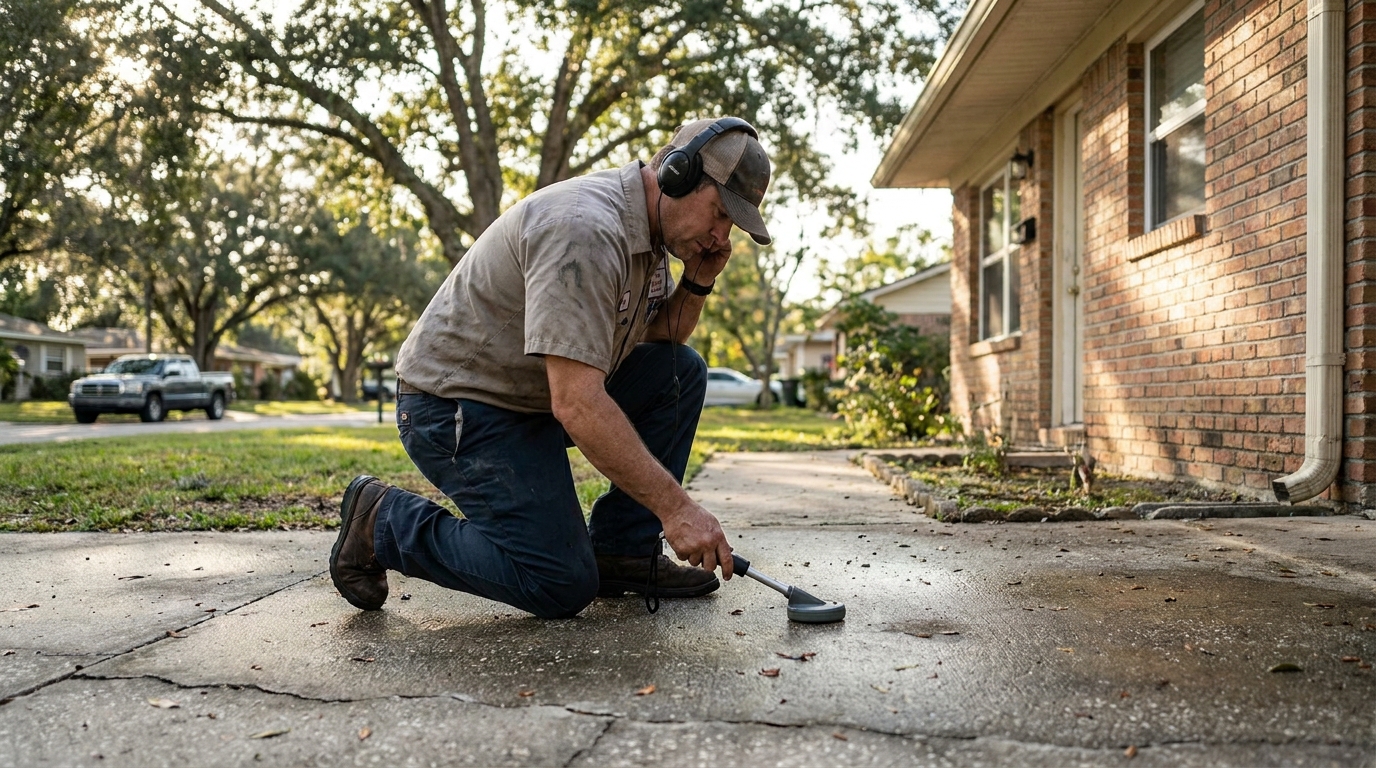
Sensitive acoustic equipment amplifies the sound of water escaping a pressurized line. A trained technician can often locate a leak within a foot or two of its actual position.
Thermal imaging
Infrared cameras detect temperature differences in the slab. A hot water leak shows up clearly as a warm signature spreading from the source.
Pressure testing
Isolating the hot and cold lines and pressurizing each separately tells the plumber which side the leak is on, and how severe it is.
Tracer gas
For trickier leaks, a safe inert gas is introduced into the line and detected as it rises through the slab and flooring.
The experts at King of Home Solutions use a combination of these methods because relying on just one often gives a misleading reading, especially in older Arlington Hills homes where the original plumbing diagrams are long gone.
Repair Options Once the Leak Is Found
You generally have three paths forward, and the right one depends on the age of your plumbing and how many leaks the system has had.
Spot repair. The plumber breaks through the slab at the exact leak location, repairs that section of pipe, and patches the concrete. This is the least invasive and least expensive option when the rest of the system is sound.
Rerouting. Instead of going through the slab, the affected line is abandoned and a new line is run through the walls or attic. This makes sense when the existing pipe location is hard to access.
Whole-home repipe. If you've already had one or two slab leaks, more are coming. Repiping the entire home with PEX is often the most cost-effective long-term solution for older Arlington Hills properties.
When a Slab Leak Becomes an Emergency
Not every slow drip needs a midnight call. But certain situations do warrant searching "emergency plumber near me" and getting someone out the same day:
- Water actively pooling on flooring or seeping up through tile grout
- A noticeable drop in water pressure paired with a running meter
- Hot spots that are getting hotter, or a water heater that won't stop running
- Visible foundation cracks that have widened
- Any sign of electrical hazard near where water is appearing
Left alone, a slab leak undermines the soil beneath your foundation. In Jacksonville's sandy substrate, that erosion happens faster than people expect.
Frequently Asked Questions
How much does slab leak repair cost in Jacksonville?
Costs vary widely depending on access, leak location, and repair method. A spot repair is generally the least expensive route; a full repipe for an older Arlington Hills home is a larger investment but often the better long-term value. A reputable plumber will give you a written estimate after detection, not over the phone.
Will homeowners insurance cover a slab leak?
Many Florida policies cover the resulting water damage to your home but not the cost of repairing the pipe itself. Coverage varies by carrier and policy, so check your specific declarations page and call your agent before assuming.
Can I just ignore a small slab leak?
No. Even a pinhole leak wastes thousands of gallons over time, erodes the soil supporting your slab, and creates conditions for mold under your flooring. It will not heal itself.
Do I need a permit for slab leak repair in Jacksonville?
Plumbing work that involves cutting the slab or repiping generally requires a permit pulled through the City of Jacksonville's Building Inspection Division, and the work must be done by a licensed plumbing contractor. Spot repairs may have different requirements; a licensed plumber will know what your specific job needs.
Getting It Handled
Slab leaks reward early action and punish delay. If you're seeing two or more of the warning signs above in your Arlington Hills home, the next step is a professional detection — not another month of watching the water bill climb.
King of Home Solutions's 4.9-star rating from Jacksonville homeowners reflects what people consistently mention in reviews: clear communication, on-time arrival, and explanations in plain language rather than plumber-speak. As one recent reviewer put it, the technician "explained everything in plain language" — which matters when you're trying to make a decision about your home's foundation.
Homeowners in Arlington Hills and across Jacksonville who want a slab leak diagnosed and resolved professionally can reach King of Home Solutions at kingofhomesolutions.com for an estimate and a clear plan forward.