Water Heater Runs Out of Hot Water: The Palms at Nocatee
Hot water running out fast in The Palms at Nocatee? Learn the real causes — sediment, dip tubes, sizing, recovery rate — and how to fix each one.
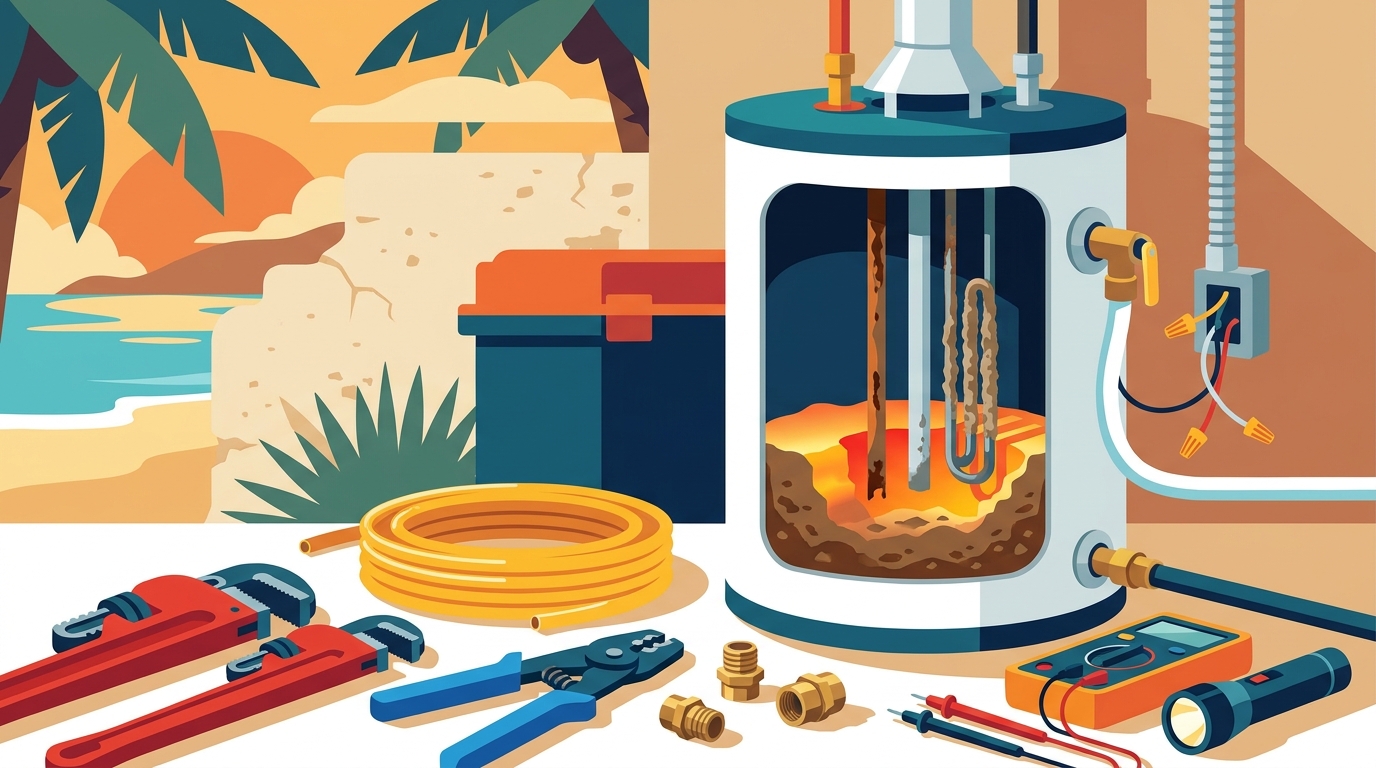
If your water heater keeps running out of hot water halfway through a shower in The Palms at Nocatee, the most common causes are sediment buildup coating the tank bottom, a broken dip tube mixing cold water into the hot outlet, a failing lower heating element or thermostat, or an undersized tank for your household's actual demand. Each has a distinct fingerprint — and a distinct fix.
This is a partial-loss problem, not a total outage, and it usually points to a system that's still working but no longer delivering its rated capacity. Below, we open the tank up (figuratively) and walk through what's actually happening inside — and what Palms at Nocatee homeowners should do about it.
Why does my water heater keep running out of hot water so quickly?
Your tank is either losing usable capacity (sediment, broken dip tube), losing heat input (failed element, bad thermostat, weak burner), or losing the recovery race (undersized unit for your demand). In newer Palms at Nocatee homes, sediment and dip-tube failure are the two most common culprits we see under the hood.
The Palms at Nocatee sits inside the larger Nocatee master-planned community, and most homes here were built in the last 10 to 15 years — meaning a lot of the original builder-grade water heaters are now hitting the age where internal components start giving out. A tank rated for 50 gallons might only be delivering 30 gallons of usable hot water because the bottom third is packed with mineral sediment.
How does sediment buildup shrink my hot water supply?
Sediment — mostly calcium and magnesium precipitated out of the water — settles at the bottom of the tank and forms an insulating layer between the burner (or lower element) and the water above it. The heater works harder, heats less water, and the sediment itself occupies volume that used to hold hot water. You lose capacity and recovery speed at the same time.
Northeast Florida's municipal water carries meaningful mineral content, and homes served by the JEA and St. Johns County utility systems commonly see noticeable scale accumulation within 3 to 5 years on an unflushed tank. If you hear popping, rumbling, or crackling when the heater fires, that's steam bubbles escaping from under a sediment layer — a reliable audio diagnosis. A yearly flush is the standard preventive maintenance the manufacturers recommend, and it's the single highest-value service call for a water heater that's still mechanically sound.
Could a broken dip tube be the reason my hot water runs out fast?
Yes — a cracked or disintegrated dip tube is one of the most misdiagnosed causes of sudden hot water loss. The dip tube carries incoming cold water down to the bottom of the tank so it heats from below. When it breaks, cold water dumps in at the top and mixes directly into the hot outlet, so you get lukewarm water within minutes of turning on the tap.
The tell: your water gets warm, then cool, then warm again in an unpredictable pattern, and you may find small white or bluish plastic flakes in faucet aerators or showerheads. Dip tubes are inexpensive to replace, but the diagnosis matters — a plumber at King of Home Solutions will typically check the dip tube early when a customer describes "hot water for five minutes, then gone," because the symptom is so specific.
What role do heating elements and thermostats play in recovery time?
On an electric tank, the upper element heats the top third of the water and the lower element heats the rest. If the lower element fails, you'll get a small burst of hot water from the top of the tank and then nothing — classic "runs out in one shower" behavior. A failed upper element usually means no hot water at all. On a gas unit, a weak burner, dirty flame sensor, or drifting thermostat produces the same partial-loss symptom.
Recovery time — how fast the tank reheats after being drained — is directly tied to element wattage or burner BTU input. A standard 50-gallon electric tank recovers roughly 20 to 25 gallons per hour; a 40,000 BTU gas tank recovers around 40 gallons per hour. If your recovery has slowed noticeably, an element or burner is underperforming, not necessarily dead.
Is my water heater simply too small for my household?
It might be. Builder-installed tanks in newer Palms at Nocatee homes were sized to a code minimum, not to actual family use. If your household has grown, added a soaking tub, upgraded to rainfall showerheads, or is running back-to-back showers on school mornings, a 40- or 50-gallon tank that worked in 2026 may simply be undersized for 2026 demand.
Rough sizing guide by household
| Household size | Standard tank (gal) | Tankless (GPM) | First-hour rating target |
|---|---|---|---|
| 1-2 people | 30-40 | 5-7 GPM | 45-58 gal |
| 3-4 people | 50-60 | 7-9 GPM | 60-72 gal |
| 5+ people | 75-80 or tankless | 9-11 GPM | 75-90+ gal |
| Home with soaking tub | Add 20 gal | Add 2 GPM | Add 15 gal |
When is it time to replace instead of repair in 2026?
Replace when the tank is past 10 to 12 years old, when you see rust-colored hot water (interior tank corrosion), when the tank itself is leaking, or when repair costs exceed roughly half the price of a new unit. Repair when the issue is a dip tube, a single element, a thermostat, or a sediment problem on a tank under 8 years old.
Standard tank-style water heaters carry manufacturer warranties of 6, 9, or 12 years depending on tier, and Ponte Vedra Beach installations require a licensed plumber to pull a permit through the St. Johns County Building Department for a replacement — a step DIY swaps often skip and later regret at resale inspection. King of Home Solutions handles the permit as part of a replacement so the paperwork is clean.
What should Palms at Nocatee homeowners do first when hot water runs short?
Start with three quick checks before calling anyone. First, verify the thermostat setting — 120°F is the standard, and someone may have bumped it down. Second, listen to the tank while it's heating; popping or rumbling means sediment. Third, run a hot tap and time how long before it turns cold — under 10 minutes on a 50-gallon tank points to a dip tube or lower element issue.
If none of that resolves it, the next step is a professional diagnosis. King of Home Solutions carries a 4.9-star rating across 55 Google reviews, and one recent client described the plumbing team as "professional, on time, excellent communication and great price." That kind of straightforward diagnostic visit is what separates a $200 dip-tube fix from an unnecessary $2,000 replacement.
Frequently asked questions
How long should a 50-gallon water heater last during a shower?
A properly functioning 50-gallon tank should support two to three back-to-back 8-10 minute showers before the temperature drops noticeably, assuming a standard 2.0 GPM showerhead and no other simultaneous hot water use. If yours can't manage even one full shower, something is wrong internally — most commonly sediment, a failed lower heating element, or a broken dip tube — not a sizing issue.
How often should I flush my water heater in Ponte Vedra Beach?
Once a year is the standard recommendation for Ponte Vedra Beach and the broader Nocatee area, given the mineral content in local municipal water. Homes with water softeners can stretch to every 18-24 months. Skipping flushes for 3-plus years is when sediment starts causing measurable capacity loss, popping noises, and premature element or burner failure. It's a 30-45 minute service and one of the cheapest ways to extend tank life.
Why does my hot water get warm, then cold, then warm again?
That fluctuating pattern almost always points to a broken dip tube. When the dip tube cracks or disintegrates, incoming cold water no longer travels to the bottom of the tank — it dumps in near the top and mixes unpredictably with the hot water exiting through the outlet. You may also find small plastic flakes in your faucet aerators. Replacement is inexpensive but requires draining the tank.
Can a water softener help my hot water last longer?
Indirectly, yes. A water softener removes the calcium and magnesium that create sediment buildup, which means your tank retains its full internal volume and heating elements stay clean. Softened water won't increase your tank's rated capacity, but it protects the capacity you paid for and can extend water heater life by several years — especially valuable on the harder municipal water common in newer Ponte Vedra Beach developments.
Is a tankless water heater worth it in The Palms at Nocatee?
For households running out of hot water because of demand rather than a broken component, tankless makes sense. It delivers continuous hot water at a set GPM rate, takes up less space, and typically lasts 20 years versus 10-12 for a tank. Upfront cost is higher, and installation may require gas line or electrical upgrades. For 1-2 person households with modest use, a properly sized tank is usually more economical.
Do I need a permit to replace a water heater in Ponte Vedra Beach?
Yes. Water heater replacements in Ponte Vedra Beach fall under St. Johns County Building Department permit requirements, and the work must be performed or supervised by a Florida state-licensed plumbing contractor. Permitted installations are inspected for proper venting, expansion tank, T&P valve, drain pan, and shutoff — all items commonly missed on unpermitted swaps that surface later during home sale inspections.
Getting it sorted
Running out of hot water isn't a mystery — it's almost always sediment, a dip tube, an element or thermostat, or a sizing mismatch, and each has a clear diagnostic path. The trick is matching the right fix to the right cause instead of defaulting to a full replacement when a $200 repair would have restored the tank to full capacity.
Homeowners in The Palms at Nocatee who'd rather have this diagnosed properly can reach King of Home Solutions at https://kingofhomesolutions.com for a professional look under the hood and an honest recommendation on repair versus replacement.