Why Your Garage Door Won't Open or Close All the Way — Atlantic Beach
Garage door stuck partway open or closed in Atlantic Beach, FL? Here's what's causing the partial-travel problem and how to fix it safely.
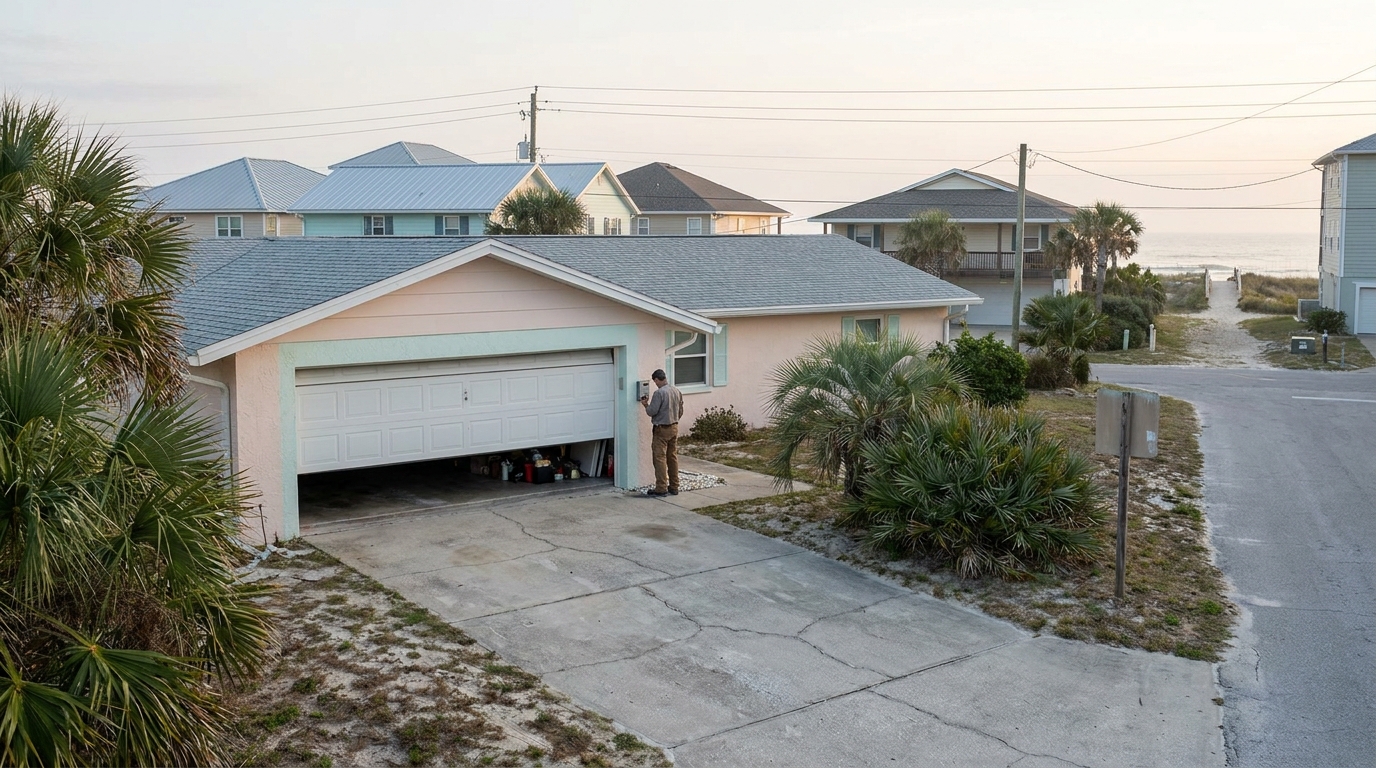
You hit the button. The door starts to move — then stops halfway. Or it closes almost all the way, hesitates, and reverses back up. It's one of the more frustrating garage door failures because the door isn't broken, exactly. It just won't finish the job.
In Atlantic Beach, this partial-travel problem is one of the most common calls we field. Salt air off the Atlantic, humidity, sand blown up from the dunes, and the age of the housing stock along Seminole Road and Beach Avenue all play a part. Below is how to think through the issue, what you can safely check yourself, and when it's time to bring in a pro.
Why won't my garage door open or close properly?
A door that won't fully open or fully close is almost always telling you something specific. Unlike a door that won't move at all — which usually points to power, a dead opener, or a snapped spring — a door that partially moves is a diagnostic clue. The opener is working. The motor is engaging. Something is interrupting the travel.
The four most common culprits we see in Atlantic Beach homes are:
- Misaligned or dirty safety sensors (the small photo eyes near the floor)
- Travel limit settings on the opener that have drifted out of range
- Track obstructions, bent sections, or roller problems
- Spring tension issues that make the door too heavy for the opener to finish the lift
Each one has a distinct signature. Once you know what to look for, you can usually narrow it down in a few minutes.
The door closes partway, then reverses: sensor issues
If your door starts closing and then stops and rolls back up on its own, the safety sensors are almost always the cause. Every residential garage door opener made since the early 1990s uses a pair of photo eyes mounted a few inches off the floor on either side of the door. One sends an infrared beam, the other receives it. If the beam breaks — or the sensors think it's broken — the door reverses as a safety response.
In Atlantic Beach, sensor problems spike for three reasons:
- Salt and humidity corrosion on the sensor lenses and wiring terminals. Homes closer to the ocean see this faster.
- Sand and pollen buildup on the lens face, especially in spring and early summer.
- Bumped alignment — a bike, a beach chair, a cooler dragged across the garage floor knocks the bracket a few degrees off, and the beam misses.
What to check: look at the small LED on each sensor. Both should be lit and steady. If one is off, flickering, or dim, wipe both lenses gently with a soft cloth, then adjust the bracket until both LEDs are solid. If the lights won't stabilize even after cleaning and realignment, you likely have a wiring or moisture issue that needs a technician.
The door opens partway, then stops: travel limits and spring tension
If the door goes up a few feet and stops, or opens most of the way and quits before it fully retracts, you're looking at either the opener's travel limits or the door's counterbalance system.
Travel limit settings
Every opener has upper and lower travel limits — the points where it tells the door to stop. These can drift over time, especially on units that are 10–15 years old. If the upper limit has crept down, the door will stop short of fully open. Most openers have small adjustment screws or buttons on the motor housing marked "up" and "down." Consult your opener's manual before adjusting — setting limits incorrectly can damage the door or the opener.
Spring tension and door weight
This is the more serious possibility. Your garage door is counterbalanced by torsion springs above the opening (or extension springs along the tracks on older doors). Those springs do the actual lifting — the opener just guides the motion. When a spring weakens or breaks, the opener suddenly has to do all the work, and it can't. It'll strain partway up and give up.
Quick test: with the door closed, pull the red emergency release cord to disconnect the opener. Lift the door by hand. A properly balanced door should feel like it weighs about 8–10 pounds and stay in place when you let go halfway up. If it slams down, feels like a boulder, or won't stay put, your springs need attention.
Important safety note: torsion springs store enormous energy and cause serious injuries every year when homeowners try to adjust them. This is one repair we consistently recommend leaving to a trained technician.
The door binds or shudders partway through: track and roller problems
If the door moves smoothly for part of its travel and then hitches, grinds, or shudders at a specific point, the problem is usually mechanical — not electrical. Common causes:
- A bent track section, often from a low-speed bump by a vehicle or a heavy item leaning against the door
- A cracked or flat-spotted roller that catches at a specific point in travel
- Loose hinges or brackets, especially on doors that have seen 15+ years of Atlantic Beach salt air
- Debris in the track — a pebble, a wasp nest, a loose fastener
Older homes in the Atlantic Beach core, particularly the mid-century block houses off Sherry Drive and the Selva Marina area, often still have the original tracks. Coastal corrosion works on the fasteners and hinges from the inside out, and by the time you can see rust, the metal underneath is often compromised.
Local factors that make Atlantic Beach garage doors fail sooner
Florida's coastal building code requires garage doors in wind-borne debris regions to meet impact and pressure ratings — a factor worth knowing about if your door is aging and you're considering replacement rather than repair. Duval County enforces these requirements, and permits are typically required for door replacements. Repairs to existing doors generally don't require a permit, but a reputable contractor will know when the line is crossed.
Beyond code, three environmental realities shape how garage doors age here:
- Salt exposure. Homes east of Mayport Road, and especially those within a few blocks of the ocean, see accelerated corrosion on springs, hinges, tracks, and fasteners.
- Humidity swings. Wood-panel doors and wood-jamb frames swell and contract, which throws off sensor alignment and track geometry.
- Hurricane season. Ideally, you want any partial-open or partial-close issue diagnosed and resolved before June, not during a named-storm advisory.
What you can safely check yourself
- Look at both sensor LEDs. Clean the lenses. Confirm alignment.
- Visually inspect the tracks for bends, debris, or loose bolts.
- Listen for grinding, popping, or scraping at the point the door stops.
- Pull the emergency release and test the door's balance by hand (only with the door closed).
- Check the opener's travel limit adjustments if the manual is available.
What to leave to a technician: anything involving springs, cables, drums, or opener internal wiring. These systems are under tension or carry loads that can cause real injury.
FAQ
Why does my garage door close halfway and then go back up?
Nearly always a safety sensor issue. Clean the photo eyes, check that both LEDs are steady, and confirm the brackets haven't shifted. If cleaning and alignment don't restore steady LEDs, the sensor or its wiring likely needs replacement.
Why does my garage door stop before fully opening?
Either the opener's upper travel limit has drifted, or the torsion spring has weakened and the opener can't complete the lift. Test the door's balance by hand with the opener disconnected to tell which it is.
Can I fix a partial-close problem myself?
Sensor cleaning, alignment, and track debris removal are reasonable DIY tasks. Spring, cable, and drum work is not — the injury risk is significant, and the parts require specialized tools.
How urgent is a garage door that won't fully close?
Fairly urgent, since a door that won't close leaves your home unsecured and exposed to weather. It's worth resolving in days, not weeks — particularly heading into hurricane season.
When to bring in a professional
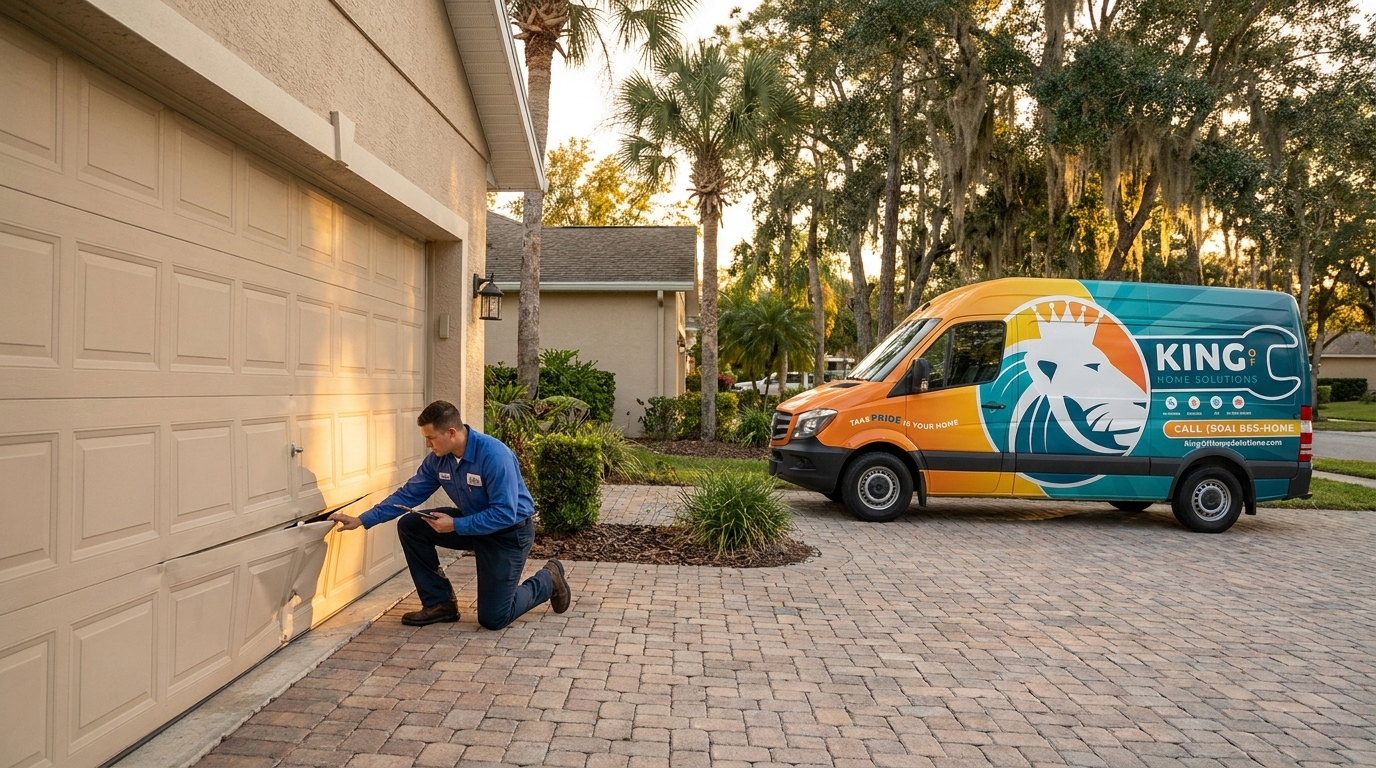
If you've cleaned the sensors, checked the tracks, and the door still won't complete its travel, the diagnosis is usually spring tension, opener logic, or a mechanical issue that needs hands-on evaluation. Homeowners in Atlantic Beach who want this handled professionally can reach King of Home Solutions at https://kingofhomesolutions.com for a free estimate. The team works throughout Atlantic Beach and the surrounding Duval County beaches communities, and their 4.9★ Google rating reflects the kind of clear communication and on-time service one recent reviewer described as "professional, on time, excellent communication and great price." A partial-travel door is almost always fixable — the goal is figuring out which system is actually failing before you start replacing parts.