Why Your Home Won't Cool Down Even With the AC Running in Jacksonville, FL
Your AC is running but your Jacksonville home still feels hot? Here's what's actually causing it — and how to get your house cool again.
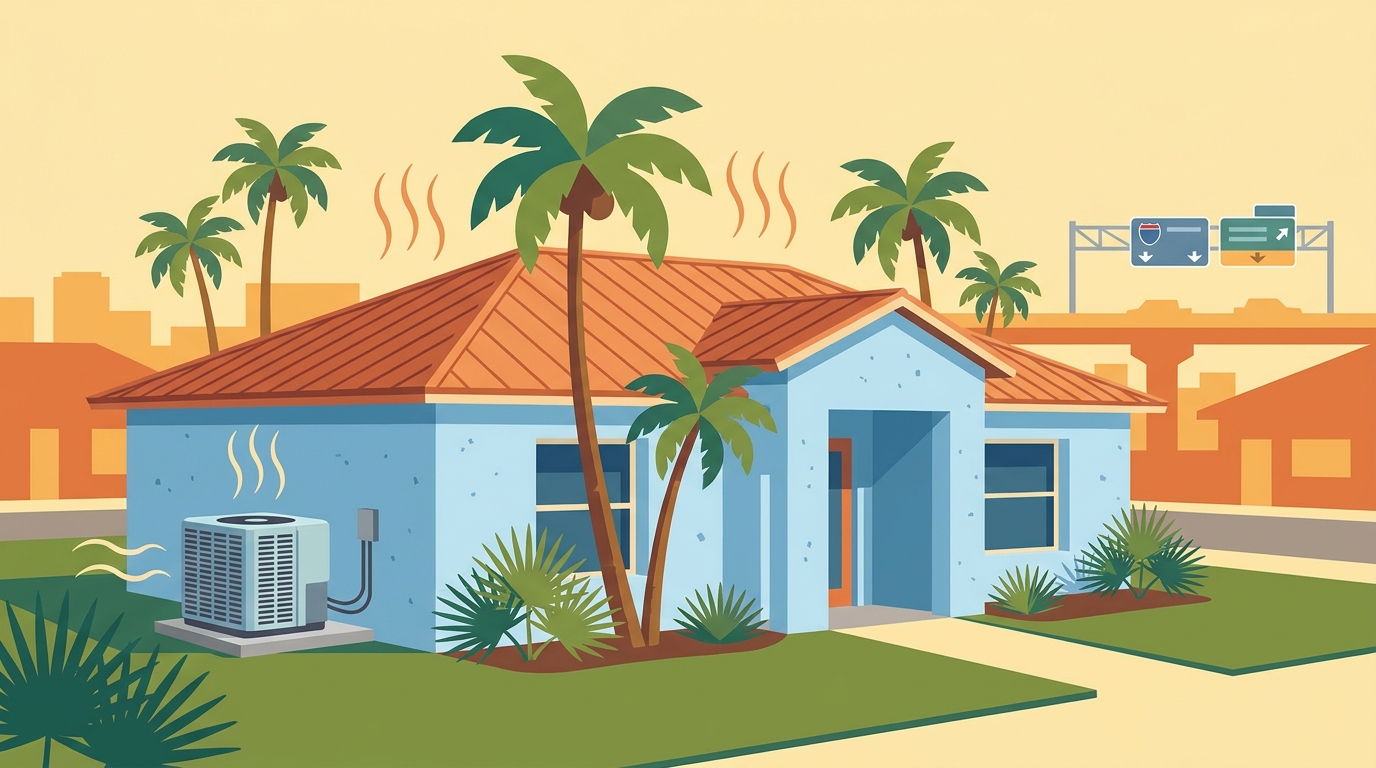
You can hear the AC humming. You can feel air coming out of the vents. But your living room thermostat reads 80°F and climbing, and the house just won't cool down. If that sounds familiar, you're not imagining it — and you're definitely not alone in Jacksonville, FL.
This is one of the most common calls we get during the long stretch from May through September, when humidity creeps past 80% and afternoon heat indexes regularly push triple digits. The system is working — it's just losing the fight against the Florida climate, a hidden problem, or both.
Here's what's actually going on when your air conditioner won't cool your home, and what you can do about it.
The Difference Between "Running" and "Cooling"
An AC system can run all day and still fail to drop the indoor temperature. That's because cooling isn't just about producing cold air — it's about removing heat and humidity faster than your house gains it.
In Jacksonville, your home is constantly absorbing heat from the sun, the attic, leaky ductwork, and even the moisture in the air. If any link in that chain breaks, your AC ends up running nonstop while the thermostat barely budges.
So when homeowners ask us, "Why is my house so hot if the AC is on?" — we usually start by checking these culprits in order.
1. A Dirty or Clogged Air Filter
This is the simplest fix and the most overlooked one. A clogged filter chokes airflow across the evaporator coil, which means less cold air reaching your rooms — and in extreme cases, a frozen coil that stops cooling altogether.
In Jacksonville's pollen-heavy spring and dust-prone summer months, filters can clog in as little as 30 days. We recommend checking yours monthly between April and October.
What to do
- Pull the filter out and hold it up to the light. If you can't see through it, replace it.
- Use a MERV 8–11 filter for most Jacksonville homes — high enough to catch pollen and dust, low enough to allow strong airflow.
2. Low Refrigerant From a Slow Leak
If your AC is running constantly but blowing only mildly cool air, low refrigerant is a strong suspect. Refrigerant doesn't "get used up" — if you're low, you have a leak somewhere in the coil or line set.
This is especially common in older systems in neighborhoods like Riverside, Avondale, and Murray Hill, where homes built mid-century often have aging copper lines that develop pinhole leaks over time.
Topping off refrigerant without fixing the leak is a temporary patch and, depending on the refrigerant type, can get expensive fast. A proper diagnosis from a licensed HVAC contractor is the right move here.
3. Duct Leaks in the Attic
This one frustrates a lot of Jacksonville homeowners. Your AC is producing cold air — it's just leaking into your attic instead of your bedrooms.
Attics in Northeast Florida can hit 130°F+ in July. If 20–30% of your conditioned air is escaping into that oven through cracked duct joints or torn flex duct, the system will run constantly and never catch up.
Signs your ducts may be leaking:
- Some rooms cool fine, others stay hot
- Energy bills jumped without a usage change
- The attic feels noticeably cooler than it should
- You see visible dust around vent registers
4. An Undersized or Aging System
Jacksonville's heat is brutal on AC equipment. Most residential systems here last 10–15 years, and performance drops in the final few. If your unit is pushing that age and struggling on 95°F afternoons, it may simply be losing capacity.
The other issue we see in newer construction — particularly in additions and converted Florida rooms — is undersized equipment. A 2.5-ton unit that handled the original footprint can't keep up after you enclose a porch or finish a garage.
A proper Manual J load calculation is the only honest way to know if your system is sized correctly for your home as it stands today.
5. Direct Sun, Poor Insulation, and Hot Attics
Sometimes the AC isn't the problem — the house is. Many Jacksonville homes, especially those built before the late 1990s, were insulated to standards that don't hold up against modern summer heat.
If your attic insulation is thin, your west-facing windows have no shading, or your ductwork runs uninsulated through that hot attic, the cooling system is fighting an uphill battle every afternoon.
Florida's current building code requires R-30 attic insulation for new construction. Many older homes are sitting at R-11 or R-19, which makes a measurable difference in indoor comfort.
6. A Failing Capacitor or Weak Compressor
If the outdoor unit is humming but the fan isn't spinning, or the compressor cycles on and off rapidly, you may have a failing capacitor. These small parts are inexpensive to replace but cause big cooling problems when they go.
A weak compressor is a bigger issue — it can run without actually pumping refrigerant effectively, which means the system is "on" but not cooling. This usually shows up as warm air at the vents and an outdoor unit that feels strangely quiet or unbalanced.
7. Humidity Is Winning
This is the Jacksonville-specific factor most homeowners underestimate. Your AC doesn't just cool air — it dehumidifies it. When indoor humidity creeps above 55%, the air feels hot even when the thermostat reads 74°F.
If your system is oversized, short-cycling, or simply not pulling moisture effectively, you'll feel sticky and warm no matter how hard it runs. A whole-home dehumidifier, a properly sized system, or a variable-speed air handler can change the game here — particularly during the August humidity peak.
When to Call an HVAC Contractor in Jacksonville
If you've checked the filter, the thermostat is set correctly, and the outdoor unit is running but your home still won't cool below the mid-to-high 70s on a hot afternoon, it's time for a professional diagnostic. Specifically, call when:
- The system runs continuously without reaching the set temperature
- You see ice on the refrigerant lines or indoor coil
- Some rooms are dramatically hotter than others
- Indoor humidity stays above 55–60% with the AC running
- Your energy bill has climbed without a clear reason
At King of Home Solutions, we've worked on systems across Jacksonville — from older bungalows on the Southside to newer builds out near the St. Johns Town Center — and the diagnostic process is the same: airflow, refrigerant charge, ductwork, and load. Skipping any of those leaves you guessing.
Frequently Asked Questions
Why does my AC run all day but never reach the set temperature?
The most common causes in Jacksonville are low refrigerant from a slow leak, leaking attic ductwork, a dirty coil, or a system that's too small for the current size of the conditioned space. Extreme outdoor heat can also push an aging system past its capacity.
Is it normal for an AC to run constantly in Jacksonville summers?
On 95°F+ days with high humidity, longer run times are normal — that's how the system pulls moisture out of the air. But if the system literally never cycles off and the house still isn't comfortable, something is wrong.
Could my thermostat be the problem?
Yes. A miscalibrated thermostat, one placed in direct sunlight, or one with weak batteries can cause the system to read incorrect temperatures and run inefficiently. It's worth ruling out before assuming the AC itself is failing.
How much does an AC diagnostic cost in Jacksonville?
Pricing varies by company and the complexity of the issue. Reputable HVAC contractors will quote the diagnostic fee upfront and apply it toward repairs if you move forward.
The Bottom Line
An AC that runs without cooling is almost always a sign of a fixable problem — a clogged filter, leaking duct, low refrigerant, or a system that's outgrown your home. The longer it runs in that state, the more it costs you in electricity and equipment wear.
Homeowners in Jacksonville, FL who want this diagnosed and handled properly can reach King of Home Solutions at kingofhomesolutions.com for a service visit. With a 4.9★ rating across recent Google reviews — where customers have described the team as professional, on time, and clear in their communication — it's a straightforward way to find out exactly why your home isn't cooling, and what it'll take to fix it.