Garage Door Reverses Before Closing — University Park, FL
Your garage door reverses before it closes in University Park, Jacksonville? Learn the exact causes — sensors, limits, tracks — and how to fix each one.

If your garage door starts down and then reverses back up before it closes, the most common cause in University Park homes is a misaligned or obstructed safety sensor (photo-eye) near the floor. Other frequent culprits are an incorrect close-limit setting on the opener, a worn or damaged roller catching in the track, or a failing logic board. Federal law (16 CFR 1211) requires this auto-reverse behavior on every residential opener made since 1993, so the door is doing exactly what it's designed to do — something is telling it to stop.
Below, we walk through each cause in the order you should check them, with the specific quirks University Park's older ranch-and-brick housing stock and Jacksonville's humidity tend to introduce.
Why does my garage door reverse right before it hits the floor?
A door that reverses in the final few inches before closing almost always has a close-limit setting that's set too far, or a spring/roller problem making the door feel like it hit an obstruction. The opener senses resistance (or thinks it has touched the floor too early) and reverses as a safety response. This is separate from a photo-eye reversal, which typically happens the moment you press close.
In University Park, we see this often on doors installed in the 1990s and early 2000s where the close-limit screw on the opener has vibrated out of adjustment over two decades of Jacksonville thunderstorms and daily use. A quarter-turn adjustment on the limit screw usually resolves it — but only after ruling out a mechanical binding issue first.
Are my safety sensors the problem?
Photo-eye sensors cause roughly 70% of unexpected reversals. The two small units mounted about six inches off the floor on each side of the door must see each other with an unbroken infrared beam. If anything blocks, misaligns, or dirties them, the door will start down and immediately reverse — usually with the opener light blinking 10 times as a diagnostic code.
How to check the sensors yourself
- Look at the LEDs on both sensors. One should be steady green (or amber) — the sender. The other should be steady red — the receiver. A flickering or off receiver LED means misalignment or obstruction.
- Wipe both lenses with a soft dry cloth. Jacksonville's humidity leaves a film that scatters the beam, and University Park garages that sit near mature oak canopy collect fine pollen dust that does the same.
- Check for cobwebs, leaves, or a stray garden hose crossing the beam path.
- Gently reposition each sensor bracket until both LEDs go solid. Snug the wingnut — do not overtighten the bracket.
Could it be the close-limit setting on the opener?
Yes — if sensors check out and the door reverses only in the last few inches, the close-limit is the next suspect. The close-limit tells the opener how far down is "closed." If it's set past the floor, the door contacts the concrete, the opener reads that as an obstruction, and it reverses. If it's set short, the door stops with a gap.
On most LiftMaster, Chamberlain, and Genie openers, the adjustment is a small screw or a pair of buttons on the motor housing. Turn the close-limit screw counterclockwise in quarter-turn increments and re-test after each turn. Never force a full turn — small changes make big differences.
What about the force setting and worn rollers?
The force setting controls how much resistance the opener will push through before it decides it has hit something. If it's set too sensitive, ordinary friction from a dry or worn roller feels like an obstruction, and the door reverses. This is extremely common on Jacksonville garages because the salt air off the St. Johns River and the year-round humidity accelerate roller and hinge wear compared to inland Florida markets.
Signs the problem is mechanical rather than electronic:
- The door is louder than it used to be, or vibrates as it moves.
- You can see a roller wobbling or a hinge with visible rust.
- Manual operation (with the opener disconnected via the red release cord) feels heavy or catches at a specific point.
If manual operation isn't smooth, the opener isn't the problem — the door itself is. Lubricate rollers, hinges, and springs with a garage-door-specific silicone lubricant (not WD-40, which strips grease). If binding persists, a roller or spring is failing and needs professional replacement.
Quick diagnostic reference
| Symptom | Most Likely Cause | Fix |
|---|---|---|
| Door reverses immediately when close is pressed | Safety sensor misalignment or obstruction | Realign and clean photo-eyes |
| Door reverses in final 2–6 inches | Close-limit set too far | Adjust close-limit screw counterclockwise |
| Door reverses mid-travel | Force setting too sensitive or worn roller | Inspect rollers, lubricate, adjust force |
| Opener light blinks 10 times | Sensor circuit fault | Check wiring, replace sensor if needed |
| Door reverses intermittently, no pattern | Failing logic board or loose wiring | Professional diagnostic required |
When is it a logic board or wiring failure?
If sensors are aligned, limits are set correctly, and the door moves smoothly by hand but still reverses randomly, the opener's logic board is likely failing. Boards degrade from Jacksonville's heat and humidity, and University Park's older attached garages — often uninsulated — see summer attic-adjacent temperatures well above 110°F, which shortens board life. Sensor wire staples backed out over time can also cause intermittent shorts that mimic board failure.
Board replacement or opener replacement is the right call once you've ruled out the simpler causes. Openers over 15 years old are usually more economical to replace than repair, and newer units meet the current UL 325 standard with better safety-eye diagnostics.
When should you call a Jacksonville garage door pro?
Call a professional if the door binds when operated manually, if a spring shows a visible gap or looks stretched, if you see cable fraying, or if the reversal continues after you've cleaned sensors and adjusted limits. Springs and cables hold enormous stored tension — Florida requires garage door contractors to be licensed for this work under Chapter 489 of the Florida Statutes, and DIY spring repair is the leading cause of garage door injuries nationally.
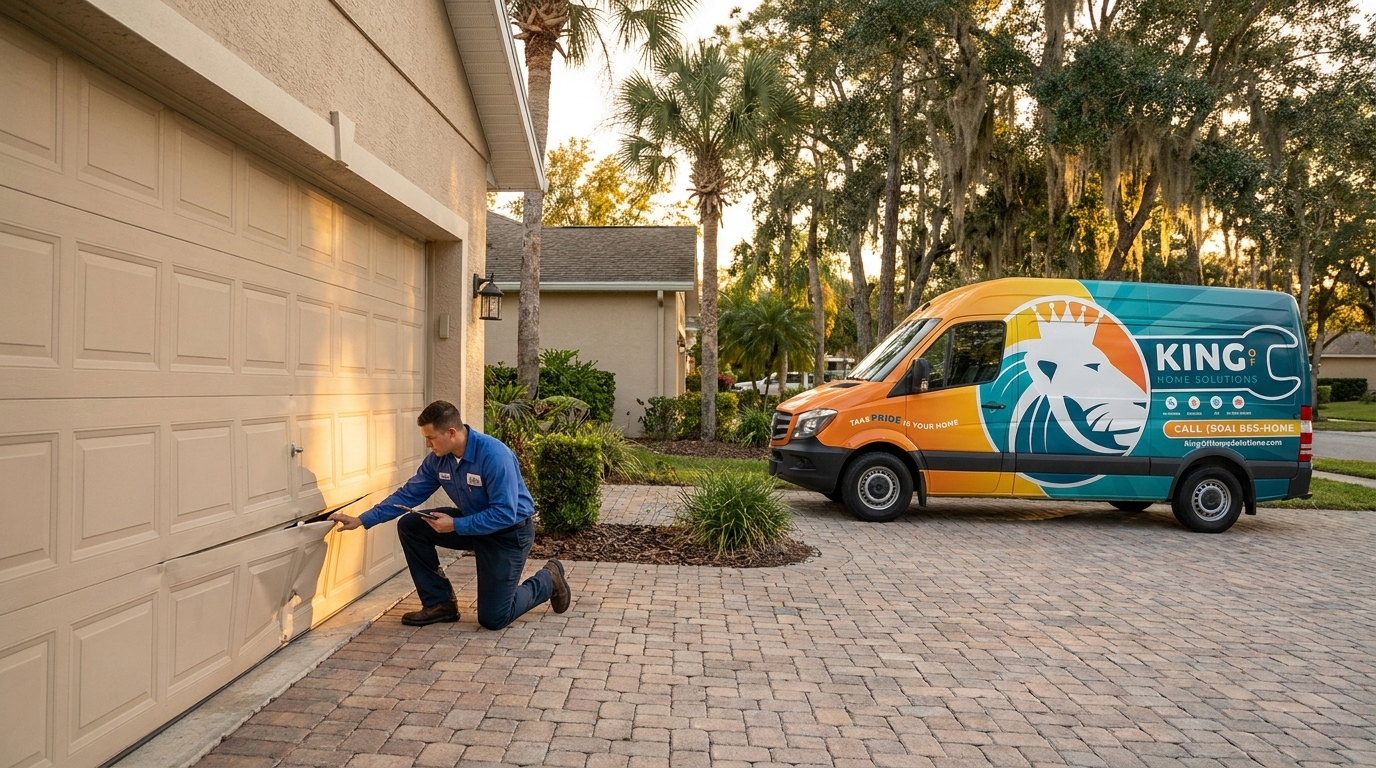
At King of Home Solutions, we work on doors throughout University Park and the surrounding Jacksonville neighborhoods, and reversal issues are one of the most common calls we get — especially heading into the summer humidity peak between June and September when sensor lenses fog fastest. One recent customer wrote that our team's "quality of craftsmanship was outstanding" after a new door install, which reflects how we approach diagnostic calls too: fix the actual cause, not the symptom.
Frequently asked questions
Why does my garage door reverse only sometimes and not every time?
Intermittent reversal usually points to marginal sensor alignment, a loose wire connection, or a force setting that's borderline. As the door ages and temperatures shift throughout a Jacksonville day, small changes in friction or beam alignment tip a marginal system into a reversal. Check sensor LEDs at different times of day and inspect wire staples along the sensor cable for signs they've backed out.
Can humidity in Jacksonville actually cause my garage door to reverse?
Yes. Jacksonville's average summer humidity above 75% leaves condensation on sensor lenses, corrodes wire connections, and dries out roller lubrication faster than in drier climates. University Park's mature tree canopy also drops pollen and fine debris that coats sensor lenses. Wiping sensors monthly and lubricating rollers twice a year prevents most humidity-related reversals.
How do I reset my garage door opener after fixing the sensors?
Most residential openers reset automatically once the sensor beam is restored — no manual reset needed. If the opener light continues to blink after alignment, unplug the unit for 30 seconds and plug it back in to clear the diagnostic code. If blinking continues, one sensor has likely failed internally and needs replacement.
Is it safe to disable the safety sensors to force the door closed?
No. Bypassing photo-eye sensors violates federal safety standard 16 CFR 1211 and removes the protection that prevents the door from closing on a person, pet, or vehicle. Some openers let you hold the wall button to force a close, but this should only be a one-time workaround while you diagnose the problem — never a permanent solution.
How much does a garage door reversal repair typically cost in Jacksonville?
Sensor realignment and minor adjustments generally run $85 to $150 as a service call in the Jacksonville market. Sensor replacement runs $150 to $250 including parts. Logic board replacement runs $200 to $400, and a full opener replacement typically runs $450 to $750 installed. Prices vary by opener brand and door size — get a written quote before work begins.
How long should a garage door opener last in a Jacksonville garage?
A quality residential opener typically lasts 12 to 15 years in Jacksonville's climate, versus 15 to 20 in drier regions. Heat, humidity, and coastal air shorten circuit board and gear life. If your opener is over 15 years old and giving reversal trouble, replacement is usually more cost-effective than repeated repairs and gives you current UL 325 safety features.
Getting the door working again
A garage door that reverses is telling you something specific — a sensor, a limit, a roller, or a board — and working through the checks above in order will identify which. Start with the free fixes (clean sensors, look for obstructions), move to simple adjustments (limits, force), then mechanical inspection, then electronics. Most University Park homeowners can resolve the issue in under an hour with a screwdriver and a cloth.
Readers in University Park and greater Jacksonville who'd rather have this handled professionally — or who suspect a spring, cable, or board problem — can reach King of Home Solutions at https://kingofhomesolutions.com to schedule a diagnostic visit. With a 4.9-star rating across 55 Google reviews, our team can usually pinpoint the cause in a single visit and walk you through the repair options before any work begins.