Garage Door Stops Halfway in Jacksonville, FL? Here's Why
Jacksonville, FL garage door stopping mid-travel or not sealing? Learn the real causes — limits, sensors, tracks, springs — and how to fix each one.
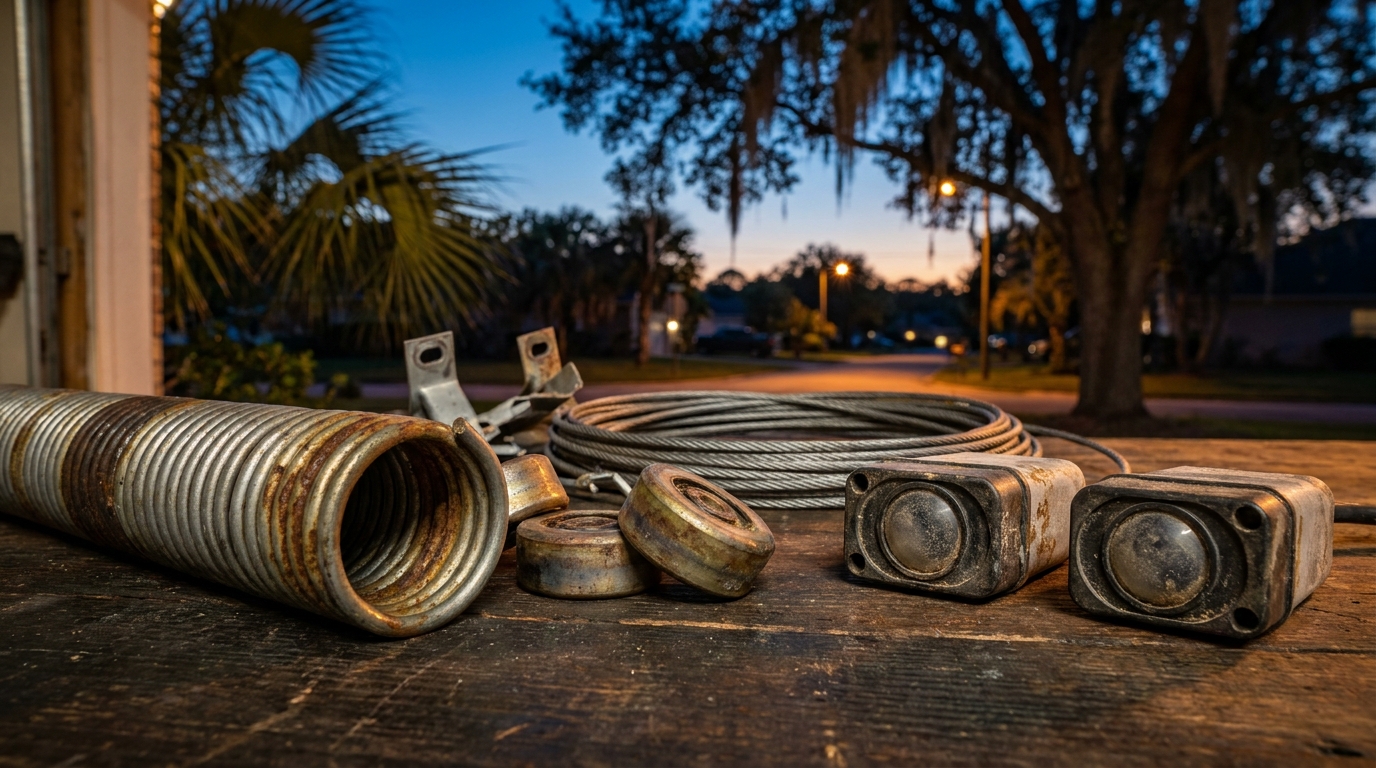
If your garage door opens partway and stops, or closes to within a few inches of the floor and reverses back up, the problem is almost never the motor itself. In Jacksonville, FL homes, partial-movement failures usually trace to four culprits: misaligned safety sensors, incorrect travel limit settings, a physical obstruction or worn roller in the track, or a broken torsion spring. The fix depends on which one — and a door that moves but won't complete its cycle needs a different diagnosis than one that won't move at all.
Why does my garage door stop halfway in Jacksonville, FL?
A garage door that stops halfway is telling you something specific: the opener is receiving a signal to stop, or it's hitting resistance it can't overcome. The three most common causes are a broken torsion spring (the door gets heavy fast), a track obstruction or bent rail section, and travel limit settings on the opener that were bumped out of calibration. Each has a different fix.
Jacksonville's coastal humidity plays a bigger role here than most homeowners realize. Salt air from the St. Johns River corridor and the Atlantic works its way into rollers, hinges, and spring coils, accelerating corrosion in ways you'd rarely see in a drier climate. A door that operated fine last spring can start binding by late summer simply because the rollers have seized. At King of Home Solutions, we see this pattern across neighborhoods from Riverside to Jacksonville Beach — same symptom, same root cause.
Why won't my garage door close fully in Jacksonville, FL?
A door that closes almost all the way and then reverses is almost always a safety sensor problem — the photo-eye sensors mounted about six inches off the floor on each side of the door. If they're misaligned, dirty, or one has a blocked lens, the opener interprets it as an obstruction and reverses the door as a safety measure. Federal law has required these sensors on residential openers since 1993 (UL 325 standard), so every opener under about 30 years old will have them.
Start by looking at the small LED on each sensor. Both should be lit and steady — usually one green, one red or amber. If either is blinking or dark, the sensors aren't seeing each other. Wipe the lenses with a soft cloth (spider webs and dust are surprisingly common causes in Jacksonville garages), then gently adjust each bracket until both LEDs go steady.
If the sensors check out and the door still won't close, the down-travel limit on the opener may be set too far — the opener thinks the door has hit the floor when it hasn't, and reverses when it senses continued resistance. That's a different adjustment, usually a screw or button on the opener motor housing.
What are garage door travel limit problems?
Travel limits are the settings that tell your opener where the door should stop when opening and where it should stop when closing. When these drift out of calibration, the door stops short in one direction or the other — opening only partway, or closing but leaving a gap at the floor. Most openers have two adjustment points (up-limit and down-limit), and recalibrating them takes just a few minutes on the right unit.
Belt-drive and chain-drive openers from LiftMaster, Chamberlain, and Genie all use slightly different adjustment methods — some use dial screws on the motor housing, newer models use programming buttons and a learn cycle. Consult the label on your opener before turning anything. If you set the down-limit too low, the door presses into the floor and the auto-reverse kicks in; too high, and daylight shows under the bottom seal. Either way, humidity and pests find their way in — a real concern here given Jacksonville's rainy season and the palmetto bugs that come with it.
How do I fix garage door sensor issues in Jacksonville, FL?
To fix most sensor problems: clean both lenses, confirm both LEDs are steady (not blinking), check that nothing is stacked or leaning in the sensor beam path, and gently realign the brackets until the lights hold steady. If a sensor light stays off entirely, check the wire connections at the sensor and at the opener motor — corroded or chewed wires are common in humid Florida garages, especially in older homes in areas like Murray Hill or San Marco where original wiring may date back decades.
If your sensors are wet after a storm — Jacksonville sees serious afternoon downpours through summer — let them dry fully before troubleshooting further. Water intrusion through a warped weather seal is a repeat problem in beachfront properties from Atlantic Beach through Ponte Vedra.
What's the most likely cause based on the symptom?
Different partial-movement patterns point to different failures. Use this table to narrow it down before you call anyone:
| Symptom | Most Likely Cause | Typical Repair Range |
|---|---|---|
| Door opens 1-2 feet then stops | Broken torsion spring | $200-$400 |
| Door closes then reverses at floor | Sensor misalignment or down-limit setting | $0-$150 |
| Door stops halfway with grinding noise | Bent track or worn roller | $150-$350 |
| Door opens partway, motor strains | Track obstruction or loose spring | $125-$300 |
| Door stops at same spot every cycle | Travel limit needs recalibration | $85-$150 |
Ranges reflect typical Jacksonville-area service pricing as of 2026 and vary by opener brand, door size, and after-hours scheduling.
When should you stop DIY-ing and call a professional?
Stop and call a professional the moment torsion springs, cables, or the door itself are involved. Torsion springs store enormous energy — a residential spring is wound to roughly 300-400 pounds of pull force, and a spring that lets go during an amateur repair sends metal across a garage at dangerous speed. Sensor cleaning and travel limit adjustments are reasonable DIY territory; spring and cable work is not.
The same goes for a door that's off its tracks or leaning. Jacksonville's building code requires that garage doors on homes built after 2026 meet wind-load ratings for hurricane exposure, and improper reinstallation can void that rating — a real issue when insurance carriers inspect after a named storm.
King of Home Solutions holds a 4.9-star rating across 55 Google reviews, with customers regularly noting punctuality and clear communication. One recent reviewer described the experience as "very responsive (even during a holiday week), great service, professional, on time." That kind of feedback matters when you're staring at a door stuck halfway open and your car is trapped inside.
Frequently Asked Questions
Why does my garage door open a few inches and then stop?
A door that lifts only a few inches and stops almost always has a broken torsion spring. Without spring tension, the opener motor is trying to lift the door's full weight — typically 150-250 pounds — which exceeds what residential openers are rated for. The motor senses the overload and shuts down. Do not try to force it. Call a technician for spring replacement.
Can humidity in Jacksonville really cause my garage door to malfunction?
Yes. Jacksonville's year-round humidity and salt-influenced coastal air corrode rollers, hinges, and spring coils faster than in drier climates. Bearings seize, tracks develop rust points, and metal fatigue accelerates. Most local doors benefit from lubrication every six months with a silicone or lithium-based garage door lubricant — never WD-40, which strips existing lubrication and attracts dust.
How much does it cost to fix a garage door that won't close all the way?
If the issue is sensor alignment or a travel limit adjustment, most Jacksonville technicians charge a service call fee of $85-$150 with no additional parts. If a sensor needs replacement, add roughly $75-$125. If the underlying cause is a bent track section or worn roller assembly, expect $150-$350 depending on how many rollers need replacement and whether track sections require straightening or replacement.
Why does my garage door reverse right before it touches the ground?
Two causes account for nearly all reversal-at-the-floor issues: photo-eye sensors that are slightly out of alignment, or a down-travel limit set too far so the opener senses resistance and interprets it as an obstruction. Clean the sensors and check both LEDs first. If they're steady and the door still reverses, the down-limit needs adjustment on the opener motor.
Is it safe to keep using a garage door that stops halfway?
No. A door that stops mid-travel may have a partially failed spring, a compromised cable, or a track problem — any of which can worsen suddenly. A fully failed spring on an unbalanced door can drop the door with enough force to injure a person or damage a vehicle. Disconnect the opener using the emergency release, secure the door in the down position if possible, and schedule a repair before further use.
How long does a garage door repair usually take in Jacksonville?
Most partial-movement repairs are completed in a single visit of 45-90 minutes. Sensor alignment and limit adjustments are typically under 30 minutes. Spring replacement on a standard double-car door runs 60-90 minutes. Track repairs and roller replacements vary — a full roller set replacement on a two-car door usually takes about two hours. Same-day service is common for calls booked before noon.
Getting it handled
A garage door that stops short is rarely a mystery once you know what to look for — sensors, limits, tracks, or springs, in roughly that order of likelihood. Cleaning lenses and checking LEDs takes ten minutes and solves a real share of these calls. What isn't DIY territory is anything involving spring tension, cable work, or a door that's off its tracks in a hurricane-code home.
Readers in Jacksonville, FL who want the problem diagnosed and fixed professionally can reach King of Home Solutions at https://kingofhomesolutions.com to schedule a service visit. Bring the opener brand and a quick description of when the door stops — that alone usually tells a technician which tools to load in the truck.