Gas Line Plumber in Jacksonville, FL: What They Can Do
A straight-answer guide to gas line work in Jacksonville, FL — who's licensed to do it, what permits apply, and how inspections protect your home.
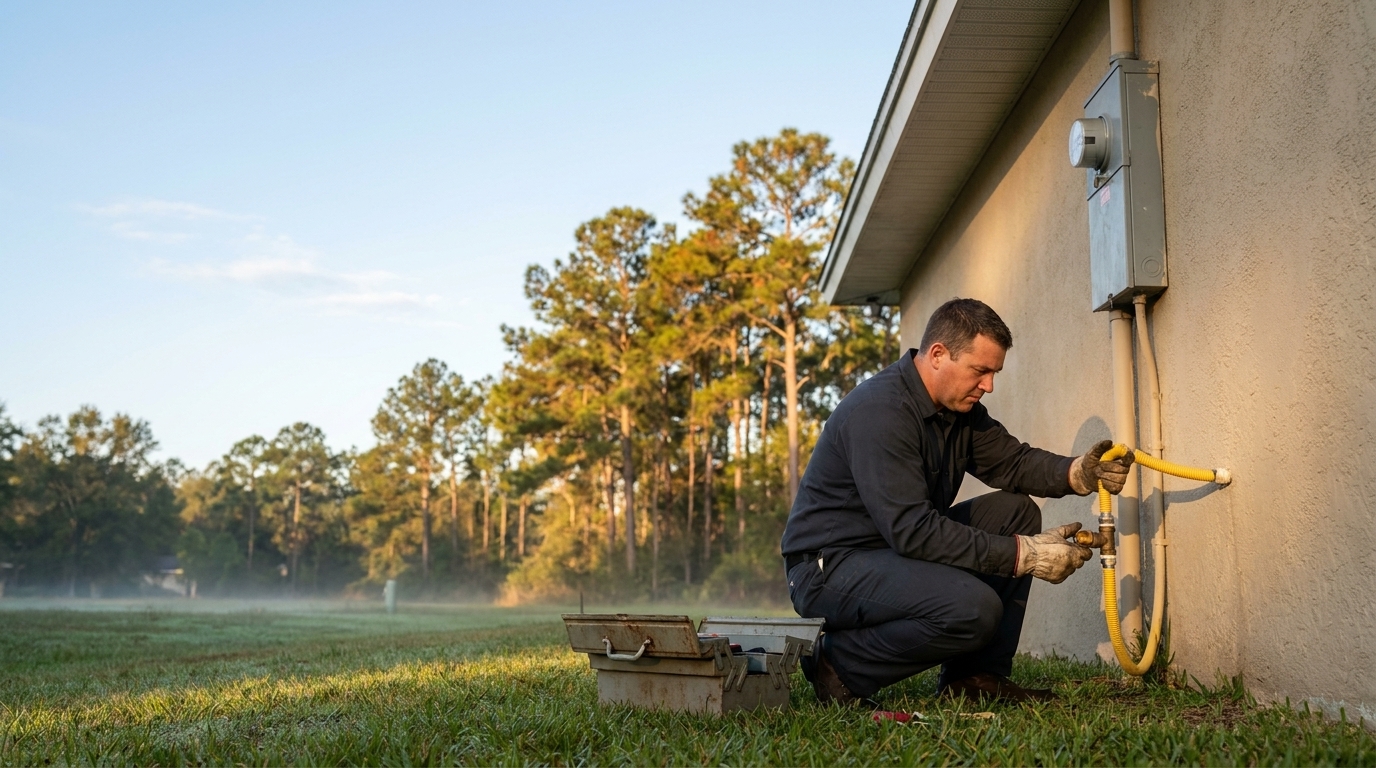
In Jacksonville, FL, gas line work on your home's building piping must be performed by a Florida-licensed plumbing contractor, and it requires a City of Jacksonville building permit before the work starts and a passing inspection before the system goes back into service. Natural gas and LP (propane) fall under two different licensing regimes in Florida — natural gas sits with licensed plumbers under state statute, while LP/propane dealers and installers are licensed separately by the Florida Department of Agriculture and Consumer Services. Everything else — scope, permits, inspections, and how to verify a contractor — flows from those two rules.
Can any plumber in Jacksonville legally work on gas lines?
No. Natural gas line installation, maintenance, repair, alteration, or extension on building piping must be performed by a Florida-licensed plumbing contractor under Florida Statutes § 489.105(3)(m), which explicitly includes natural-gas lines within the plumbing scope. A general handyman, a home remodeler without a plumbing credential, or an unlicensed helper cannot legally pull a gas permit or perform the work in Duval County.
King of Home Solutions is a Jacksonville residential plumbing company, and gas piping on a home's building system is squarely the kind of work this statute assigns to a licensed plumbing contractor rather than a general trade. If a company offering to run or repair a gas line can't produce a current State of Florida construction license, that's the end of the conversation.
What's the difference between natural gas and LP (propane) licensing?
Natural gas work on building piping is handled by Florida-licensed plumbing contractors. LP/propane work is governed separately: the Florida Department of Agriculture and Consumer Services (FDACS) licenses the individuals and businesses that sell, transport, dispense, or store LP gas and that manufacture, install, service, or repair LP gas containers, systems, or appliances. Make sure your contractor holds the right credential for the fuel in your home.
FDACS licensing isn't a formality. A Category I LP Gas Dealer must carry at least $1 million in bodily injury and property damage liability insurance covering the products and operations of the business, according to FDACS.
| Fuel type | Who's licensed | Primary regulator |
|---|---|---|
| Natural gas (building piping) | Florida-licensed plumbing contractor | Florida DBPR; City of Jacksonville Building Inspection Division |
| LP / propane (containers, systems, appliances) | FDACS-licensed LP gas dealer or installer | Florida Department of Agriculture and Consumer Services (FDACS) |
| Appliance connection within one piece of equipment | Qualified technician; no permit for part replacement within a single appliance | City of Jacksonville Building Inspection Division |
When is a Jacksonville permit required for gas work?
A City of Jacksonville building permit is required before installing, altering, repairing, or replacing a regulated gas system, including heating equipment such as gas fireplaces and wall heaters. The permit must be pulled by a contractor registered with the Jacksonville Building Inspection Division, and all permitted gas work must pass the required City inspections before the system is placed back in service.
A few narrow exceptions apply to plumbing generally — stopping a leak that doesn't require replacing or rearranging valves, pipes, or fixtures, clearing drain stoppages, replacing a part within a single piece of equipment, or connecting portable heating or cooling appliances. Those exceptions are not a workaround for a gas line project. If your work touches the regulated gas piping system, assume a permit is required and confirm with the City.
One more Jacksonville detail worth knowing: a Notice of Commencement is generally required on jobs over $5,000. For a larger gas repipe or a service upgrade, your contractor will walk you through that filing.
How do contractors register to pull gas permits in Jacksonville?
To pull permits in Jacksonville, a contractor must register with the Building Inspection Division by submitting a completed New Contractor Registration Form, a State of Florida construction license, a picture ID, and proof of workers' compensation insurance or exemption. Without that registration on file, a company cannot legally pull a gas permit for your home — even if its license is active elsewhere in the state.
If a homeowner pulls their own building permit, any licensed or registered plumbing contractor hired to perform the gas or plumbing work still has to obtain their own permits tied to the homeowner's permit. In other words, the plumbing credential and the permit paperwork follow the person doing the work, not just the project.
What does the Jacksonville safety inspection process look like?
Permitted gas work in Jacksonville must pass City inspections conducted by the Building Inspection Division before the system is placed in service.
Jacksonville's climate adds practical reasons to take inspections seriously. Humidity, salt air near the coast, and the occasional hard freeze all stress exterior gas piping, regulators, and appliance connections. Older housing stock in historic neighborhoods often involves retrofits where original piping has been modified over decades — exactly the situation where a code inspection catches problems a homeowner can't see.
Separately, utility-owned equipment or service lines may require approval or inspection by the serving gas utility in addition to the City's inspection. If your project touches the meter set or anything upstream, confirm with the utility before the contractor starts.
How do you verify a gas line plumber before hiring?
Verification in Duval County takes two phone calls and one document review. Confirm the contractor's State of Florida construction license through the Department of Business and Professional Regulation, then ask the contractor for proof of their Jacksonville Building Inspection Division registration and current liability and workers' compensation coverage. For LP work, also confirm the FDACS license category matches the job.
A trustworthy, always-available plumber for gas or flooding emergencies should answer those questions without hesitation. The same reasoning applies to any "licensed and insured plumber near me" search: the credentials either exist and can be produced, or they don't. King of Home Solutions focuses exclusively on residential plumbing in Jacksonville, so questions about licensing, permits, and the inspection sequence are standard conversation before any work begins.
Frequently asked questions
Can a handyman legally repair a gas line in Jacksonville, FL?
No. Natural gas line installation, maintenance, repair, alteration, or extension on building piping must be performed by a Florida-licensed plumbing contractor under Florida Statutes § 489.105(3)(m). A handyman without that credential cannot legally pull a Jacksonville gas permit or perform the work, regardless of experience. LP/propane work requires a separate FDACS license.
Do I need a permit to replace a gas water heater or gas fireplace?
Yes for the gas-side work. Jacksonville requires a building permit before installing, altering, repairing, or replacing a regulated gas system, and installation of heating equipment including gas fireplaces and wall heaters explicitly requires a permit. Replacing a part within a single piece of equipment is exempt, but anything touching the gas piping or a new appliance connection is not.
How do I verify a plumber is licensed in Duval County?
Contact the Florida Department of Business and Professional Regulation to confirm a contractor's State of Florida construction license. Then ask the contractor to show proof of their Jacksonville Building Inspection Division registration, workers' compensation insurance or exemption, and liability coverage. For LP/propane work, confirm the FDACS license category matches the type of installation or service you need.
What's the difference between a natural gas and a propane plumber?
Natural gas building piping is handled by Florida-licensed plumbing contractors regulated by DBPR. LP/propane is regulated by FDACS, which licenses businesses that sell, transport, dispense, or store LP gas and that install or service LP containers, systems, or appliances. Category I LP Gas Dealers must carry at least $1 million in liability insurance. One license does not substitute for the other.
Is a Notice of Commencement needed for gas line work?
In Jacksonville, a Notice of Commencement is generally required on jobs over $5,000. Smaller gas repairs often fall below that threshold, but a larger repipe, service upgrade, or multi-appliance project typically crosses it. Your licensed plumbing contractor should handle the filing as part of the permit process.
Who do I call for a 24-hour gas or flooding emergency plumber in Jacksonville?
Call a licensed Florida plumbing contractor who serves Duval County and can confirm active registration with the Jacksonville Building Inspection Division. For a suspected gas leak, leave the home first and call your gas utility's emergency line before calling a plumber. For flooding, shut off the water main if you can safely reach it, then call a licensed residential plumber such as King of Home Solutions.
The bottom line for Jacksonville homeowners
Gas work on your home's piping is one of the few trades where the licensing boundary is sharp and the inspection is non-negotiable. A Florida-licensed plumbing contractor, a City of Jacksonville permit, and a passing inspection are the three things that should be present on every gas job — and if any of them is missing, pause the project. Readers in Jacksonville, FL who want a residential gas line project handled by a licensed plumbing team can reach King of Home Solutions at (904) 865-4663 or https://kingofhomesolutions.com to get the conversation started.