Hidden Water Leaks in Nocatee, Ponte Vedra, FL
Suspect a hidden leak in your Nocatee home? Learn the warning signs inside walls, ceilings, and slabs — and how detection works in Ponte Vedra, FL.
If your water bill jumped for no reason, you hear water running when nothing's on, or you notice warm spots on the floor and musty smells in a Nocatee home, you likely have a hidden water leak. In Ponte Vedra's humid, slab-on-grade housing stock, concealed leaks inside walls, ceilings, or under the foundation are the most common — and most damaging — plumbing failures homeowners miss for weeks or months.
Below, we walk through exactly how hidden leaks reveal themselves, why Nocatee's newer construction has its own distinct failure patterns, and how professional leak detection actually works under the hood.
What are the earliest signs of a hidden water leak in your home?
The earliest signs are an unexplained water bill increase, a water meter that moves when every fixture is off, faint running-water sounds behind walls, and unexpected humidity or musty odors in closed rooms. Warm floor patches, warped baseboards, and yellowish ceiling stains follow next. Catching any one of these signals early is what separates a $300 repair from a $15,000 restoration.
Homeowners in Nocatee, Ponte Vedra, FL tend to notice the bill spike first. The JEA and St. Johns County utility bills are itemized clearly enough that a jump of 2,000-5,000 gallons in a single month stands out — and that's roughly what a pinhole leak inside a wall can waste before anyone sees water.
The meter test is the simplest DIY check: turn off every water-using appliance and fixture, find the meter at the street, and watch the low-flow indicator (usually a small triangle or dial). If it moves at all over 15 minutes, water is escaping somewhere on your side of the line.
How can you detect a water leak inside walls without tearing them open?
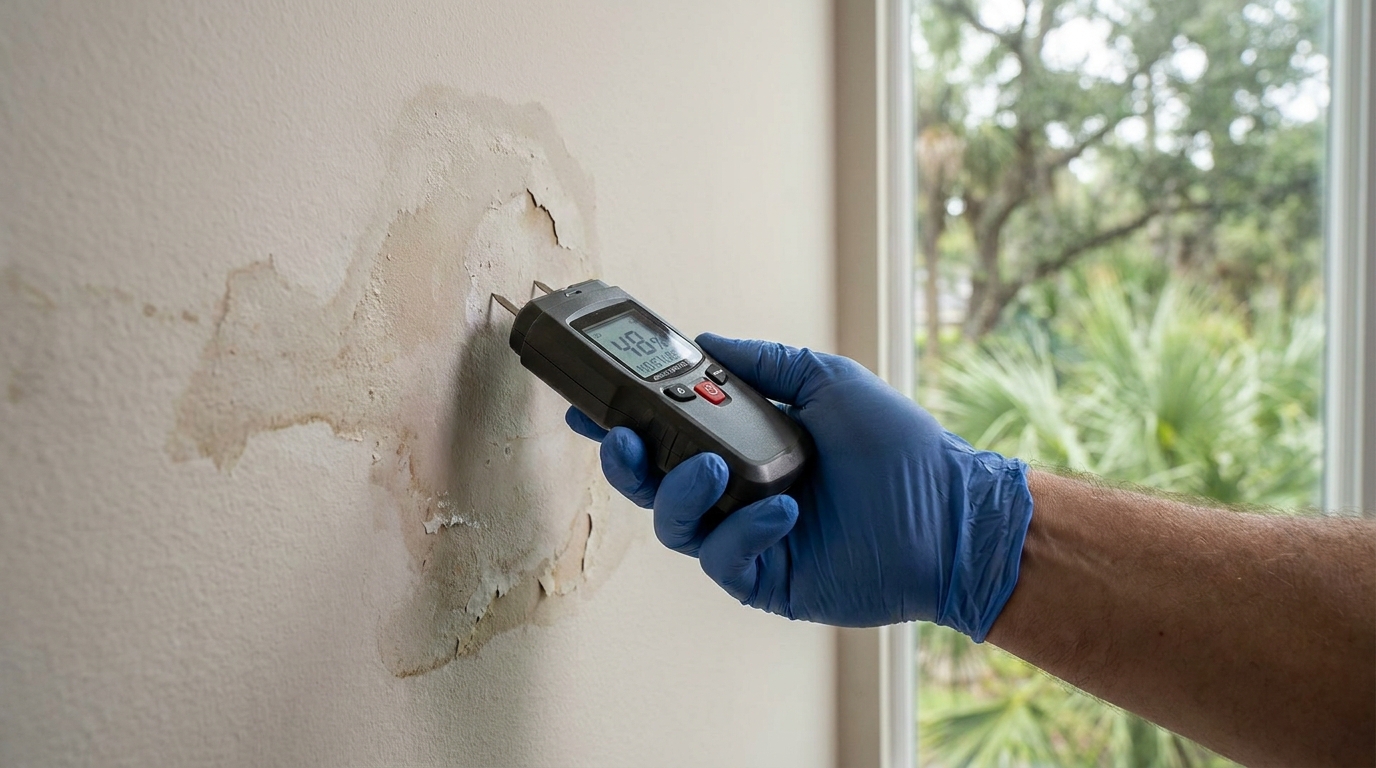
Wall leaks reveal themselves through five signals you can spot without demolition: discoloration or bubbling paint, soft or spongy drywall, a persistent musty smell in one specific area, visible mildew on baseboards or trim, and audible hissing or trickling when the house is quiet. Pros confirm with moisture meters, thermal imaging, and acoustic listening devices before cutting.
Nocatee's housing stock is largely post-2026 construction, which means most homes use PEX or copper supply lines running through interior walls. PEX resists corrosion but can fail at fittings; copper develops pinholes over time, especially where hard water accelerates internal erosion. Ponte Vedra's water hardness sits in the moderately hard range, which shortens copper lifespan compared to softer-water regions.
A thermal camera scan is the fastest non-invasive way to map a wall leak. Cold water lines show as blue streaks; hot water leaks show as warm plumes. At King of Home Solutions, we combine thermal imaging with acoustic amplifiers that can hear water moving through a pressurized line from several feet away, so we can pinpoint the leak to a single stud bay before opening drywall.
Why do Nocatee homes get hidden leaks under slabs and in ceilings?
Nocatee's slab-on-grade foundations and single-story layouts mean supply lines run either under the concrete or through attic space. Florida's humidity, expansive soils, and constant AC condensation create three specific failure points: slab penetrations where pipes exit concrete, attic-run lines that suffer thermal stress, and drain lines from second-story bathrooms leaking through first-floor ceilings.
Slab leaks are the trickiest because the evidence is subtle: a warm spot on tile flooring (hot water line), unexplained mildew along a baseboard, or the sound of water when nothing is running. Ceiling leaks from an upstairs bathroom usually announce themselves with a brown ring on the drywall — but by then, the subfloor has been wet for days.
Attic leaks are underrated in Ponte Vedra. Summer attic temperatures regularly exceed 130°F, which stresses PEX fittings and CPVC joints. A slow drip in the attic can travel along a truss, saturate insulation, and show up as a stain 10 feet from the actual leak.
How much water and money does a hidden leak actually waste?
The EPA's WaterSense program estimates that household leaks waste nearly 1 trillion gallons annually nationwide, and the average home loses about 10,000 gallons per year to leaks — enough to fill a backyard pool. A single 1/16-inch pinhole in a pressurized supply line can waste over 100 gallons per day, which typically adds $30-$80 to a monthly water bill before any structural damage begins.
| Leak Type | Typical Daily Water Loss | Common Detection Signal | Repair Urgency |
|---|---|---|---|
| Pinhole in copper supply line | 50-150 gallons | Bill increase, wall stains | Within days |
| Slab leak (hot water) | 100-300 gallons | Warm floor spot, high bill | Immediate |
| Leaking toilet flapper | 200-1,000 gallons | Silent bill increase | Within a week |
| Attic PEX fitting drip | 10-50 gallons | Ceiling stain, musty attic | Within days |
| Drain line leak (upstairs bath) | Varies with use | Ceiling ring, sagging drywall | Immediate |
Beyond the water bill, Ponte Vedra's humidity turns a small leak into a mold problem quickly. The Florida Department of Health notes that mold can begin colonizing damp drywall within 24-48 hours, which is why we treat any confirmed hidden leak as a same-week repair, not a next-month project.
What does professional leak detection look like under the hood?
Professional leak detection is a sequenced diagnostic process: pressure-test the plumbing system to confirm a leak exists, isolate the affected line (hot, cold, or drain), scan with thermal imaging and acoustic equipment to narrow the location, and confirm with a moisture meter before opening any wall, ceiling, or slab. Done right, it turns "leak somewhere in the house" into an X on the wall the size of a coaster.
Step one is a static pressure test. We shut the main, pressurize the system to normal operating pressure, and watch a gauge — if pressure drops, there's a leak on the supply side. If pressure holds but you still see water damage, the problem is on a drain line, which requires a different test using dye or a camera.
Step two is isolation. By closing the shutoff at the water heater, we can tell whether the leak is on the hot or cold side. That alone eliminates roughly half the plumbing runs in the house.
Step three is location. Acoustic listening devices amplify the hiss of water escaping a pressurized line; thermal cameras show temperature anomalies through drywall and tile. On a slab leak, we may also use tracer gas — a harmless helium-hydrogen mix injected into the empty line that rises through the concrete at the leak point.
Step four is targeted repair. Because the location is confirmed to within inches, we open one small access panel rather than tearing out a wall. For Nocatee homeowners, that difference typically saves several thousand dollars in drywall, paint, and tile restoration.
Frequently Asked Questions
How do I know if my water bill increase is from a hidden leak?
Compare your last three bills against the same months last year. A sudden jump of 20% or more with no change in household use — no guests, no new irrigation, no filled pool — almost always points to a leak. Run the meter test: shut off every fixture and appliance, then check whether the meter's low-flow indicator still moves. Any movement over 15 minutes confirms water is escaping somewhere.
Can a hidden leak cause mold in a Ponte Vedra home?
Yes, and quickly. Ponte Vedra's year-round humidity combined with warm interior temperatures creates ideal mold conditions inside wall cavities. Mold can begin colonizing damp drywall within 24-48 hours of a leak, per Florida Department of Health guidance. By the time you see a stain or smell mildew, colonies are usually established behind the surface, which is why fast detection matters more here than in drier climates.
What's the difference between a slab leak and an in-wall leak?
A slab leak occurs in the supply lines running through or under your concrete foundation, common in Nocatee's single-story slab-on-grade homes. An in-wall leak occurs in vertical or horizontal pipe runs inside interior walls. Slab leaks often produce warm floor spots and foundation-level moisture; in-wall leaks show up as paint bubbling, drywall softening, or ceiling stains. Detection methods overlap, but slab leaks usually require tracer gas or ground microphones.
How long does professional leak detection take?
Most residential leak detection visits in Ponte Vedra take 1-3 hours from arrival to a marked location. Simple wall leaks with clear surface evidence may take under an hour; slab leaks or multi-point failures can require a full morning. The detection phase is separate from the repair — knowing where the leak is lets you get an accurate repair quote before any wall or floor is opened.
Should I shut off my water if I suspect a hidden leak?
If you see active water damage, hear running water, or find a warm spot on the floor, yes — shut off the main valve at the street or house entry until a plumber arrives. For a suspected slow leak with no visible damage, you don't need to shut off water immediately, but you should schedule detection within a few days. The longer a leak runs, the higher the restoration cost climbs.
Does homeowners insurance cover hidden water leak damage?
In Florida, most standard homeowners policies cover sudden and accidental water damage from a hidden leak, but not the cost of repairing the pipe itself or damage from long-term, gradual seepage. Coverage varies significantly by carrier and policy — review your specific policy or call your agent. Documenting the leak with photos and keeping the professional detection report strengthens any claim you file.
Getting a hidden leak handled in Nocatee
Hidden leaks rarely fix themselves and almost always get worse — especially in Ponte Vedra's climate, where humidity turns a small drip into a mold and drywall problem within days. If the signals in this article match what you're seeing at home, the next step is a professional detection visit before you open any walls or make guesses about location.
Readers in Nocatee and the wider Ponte Vedra, FL area who want this handled professionally can reach King of Home Solutions at https://kingofhomesolutions.com to schedule leak detection. Our 4.9-star rating across 55 Google reviews reflects the communication and follow-through customers describe — as one recent reviewer put it, "great service, professional, on time, excellent communication and great price." That's the standard we bring to every hidden-leak call.