How Long Does an HVAC System Last in Ponte Vedra, FL?
Ponte Vedra's salt air and humidity shorten HVAC lifespan. Learn realistic replacement timelines, warning signs, and when repair still makes sense.
In Ponte Vedra, FL, most residential HVAC systems last 10 to 15 years — noticeably shorter than the 15-to-20-year national average because coastal salt air, year-round humidity, and heavy cooling loads accelerate corrosion and compressor wear. Well-maintained heat pumps in inland Nocatee neighborhoods often push past 12 years, while oceanfront homes near Ponte Vedra Boulevard frequently need replacement by year 8 to 10.
If your system is past year 10 and you're weighing another repair against replacement, the answer usually comes down to three things: refrigerant type, repair cost versus 30% of a new system, and how much your energy bills have crept up. The rest of this guide walks through each of those honestly.
Why do HVAC systems wear out faster in Ponte Vedra than inland?
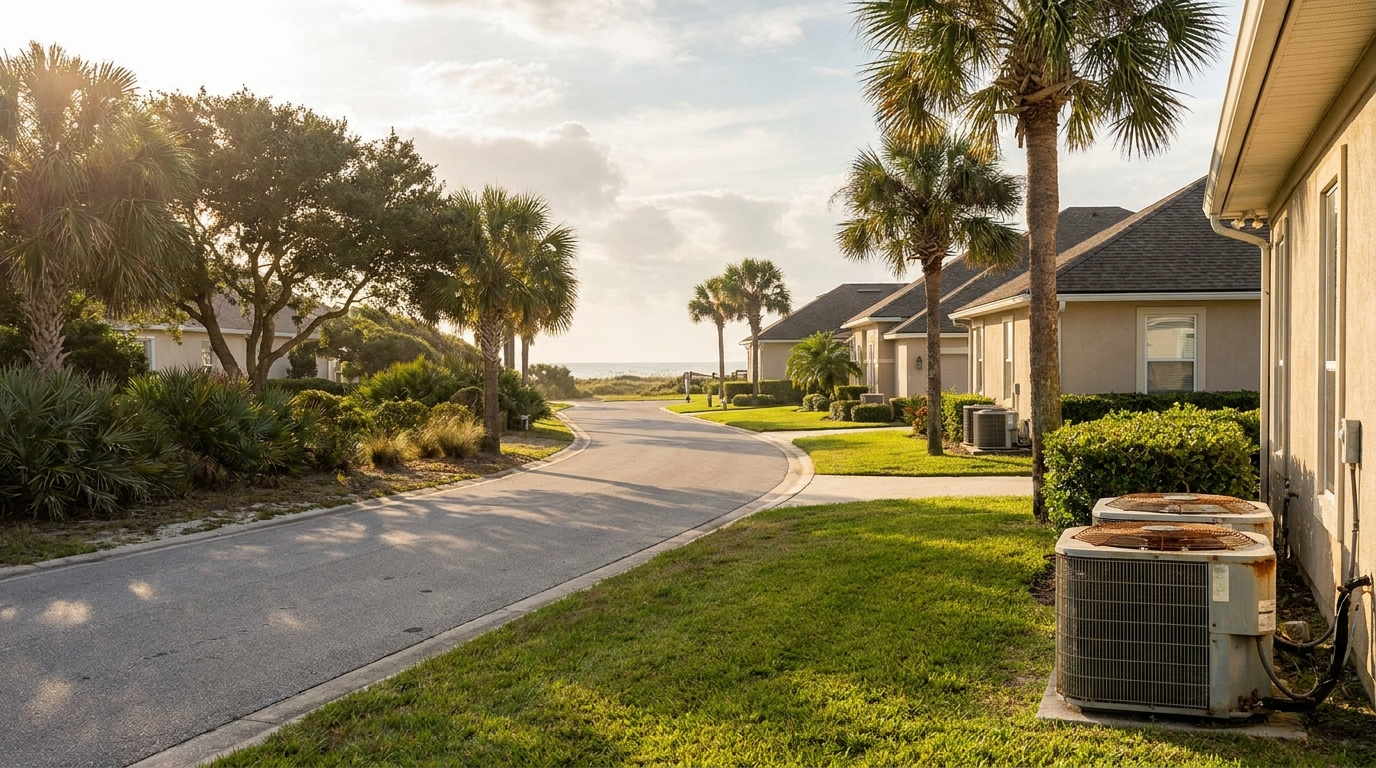
Ponte Vedra sits directly on the Atlantic, and salt-laden air corrodes outdoor condenser coils, copper line sets, and electrical contactors far faster than inland conditions. Add 70%+ average humidity and a cooling season that runs roughly nine months, and the compressor logs thousands more run hours per year than a system in Georgia or the Carolinas.
The closer your home is to the beach — think Sawgrass, Old Ponte Vedra, or anywhere east of A1A — the more aggressive that corrosion becomes. We've seen condenser coils on 6-year-old units in oceanfront properties look like 12-year-old units from Julington Creek. That's not a manufacturing defect; that's salt physics.
Inland communities like Nocatee, Palm Valley, and the Sawgrass Players Club sections west of the Intracoastal fare better, but the humidity load still shortens system life compared to drier climates. At King of Home Solutions, we plan maintenance schedules around this reality — coastal homes need coil rinses two to three times a year, not annually.
What's the realistic lifespan by system type in 2026?
Lifespan varies by equipment. Central air conditioners in Ponte Vedra typically last 10-13 years, heat pumps 8-12 years (they run in both heating and cooling modes, so they log more hours), gas furnaces 15-20 years, and ductless mini-splits 12-15 years. Coastal proximity can trim 2-4 years off any of these numbers.
| System Type | National Average | Ponte Vedra Coastal | Ponte Vedra Inland |
|---|---|---|---|
| Central AC | 15-20 years | 8-11 years | 10-13 years |
| Heat Pump | 10-15 years | 7-10 years | 10-12 years |
| Gas Furnace | 15-25 years | 15-20 years | 15-20 years |
| Ductless Mini-Split | 15-20 years | 10-13 years | 12-15 years |
| Air Handler | 15-20 years | 10-13 years | 12-15 years |
Heat pumps dominate new installations in St. Johns County because they handle our mild winters efficiently without needing a separate furnace. The tradeoff is shorter overall life, since the same equipment cycles year-round.
What are the signs I need a new air conditioner?
The clearest signs you need a new air conditioner are: the system is 10+ years old, uses phased-out R-22 refrigerant, needs repairs costing more than 30% of a replacement, cycles on and off constantly, struggles to dehumidify, or has driven your summer power bill up 20% or more year over year without a rate change.
A few specific patterns we see in Ponte Vedra homes:
- Humidity that won't drop below 55% even with the system running — usually a sign the compressor or evaporator coil is losing capacity.
- Ice on the refrigerant lines or outdoor unit — often a low-refrigerant symptom that keeps returning after recharges, meaning there's a slow leak in a corroded coil.
- Rust streaks or pitting on the condenser cabinet — cosmetic on the outside, but a preview of what the internal components look like.
- Uneven cooling between rooms in two-story homes near the beach, where duct insulation has degraded from attic humidity.
- Musty smell when the system starts — moisture in the ductwork or on the coil, which in coastal homes can progress to mold quickly.
That last one matters. One customer wrote that our team was "professional, knowledgeable, and very thorough" while remediating mold from their HVAC system before a home sale — a job that came up because a decade-old system had lost its ability to manage moisture properly. When dehumidification fails in Ponte Vedra, indoor air quality follows quickly.
Is it worth repairing an old air conditioner?
Repair makes sense when your system is under 10 years old, the repair costs less than 30% of replacement, and the refrigerant is still R-410A or newer. Replace when the system is 12+ years old, uses R-22, needs compressor or coil replacement, or has had multiple repairs in the past two years. The math almost always favors replacement past year 12.
The R-22 factor is the one homeowners often miss. R-22 refrigerant was phased out of production in 2026 under EPA rules, and remaining stockpiles now run $100-$175 per pound at wholesale. A single recharge on an older R-22 system can run $600-$1,200 — money spent on a system that will need another recharge as soon as the corroded coil leaks again.
The $5,000 rule is a useful shortcut: multiply the repair estimate by the system's age in years. If the result is over $5,000, replace. A $600 repair on a 9-year-old system ($5,400) is borderline. A $400 repair on a 6-year-old system ($2,400) is a clear yes to fixing it.
How can you extend HVAC lifespan in coastal Ponte Vedra?
Extending HVAC lifespan in Ponte Vedra comes down to fighting corrosion and reducing run hours. Rinse the outdoor condenser coil with fresh water every 3-4 months to remove salt deposits, change filters every 30-60 days during cooling season, schedule professional maintenance twice a year, and keep the outdoor unit shaded but with 24 inches of clearance on all sides.
A few underused tactics for coastal homes:
- Install a coastal-rated condenser (aluminum fins with polymer coating) on replacement — the upfront cost adds roughly $400-$800 but can add 3-5 years of life.
- Add a whole-home dehumidifier to reduce the AC's dehumidification workload, especially in homes east of A1A.
- Use a surge protector on the outdoor unit — Ponte Vedra averages significant lightning activity from June through September, and compressor boards fail fast without protection.
- Schedule tune-ups in March and October, before the summer humidity peak and before the brief winter heating season.
King of Home Solutions holds a 4.9-star rating across 55 Google reviews, with homeowners consistently pointing to punctuality, clear communication, and fair pricing — the same habits that translate into disciplined maintenance and honest repair-versus-replace advice.
Frequently asked questions
How long does an HVAC system last in Ponte Vedra, FL?
Most HVAC systems in Ponte Vedra last 10-15 years, with coastal homes east of A1A often replacing units at 8-11 years due to salt air corrosion. Inland Nocatee and Palm Valley homes typically get 12-15 years. Heat pumps run shorter than straight AC systems because they operate year-round, while gas furnaces can last 15-20 years even in coastal conditions.
Does salt air really shorten HVAC life?
Yes, significantly. Salt in the coastal air accelerates corrosion on the outdoor condenser's aluminum fins, copper refrigerant lines, and electrical contactors. Homes within a mile of the Atlantic can see condenser coils fail 3-5 years earlier than inland units. Rinsing the outdoor unit with fresh water every few months and choosing coastal-rated equipment on replacement noticeably slows this damage.
What is the average cost to replace an HVAC system in Ponte Vedra?
Full HVAC replacement in Ponte Vedra typically runs $7,500-$15,000 depending on tonnage, efficiency rating (SEER2), and whether ductwork needs replacement. Heat pump systems generally cost $8,000-$14,000 installed. Coastal-rated equipment adds $400-$800. St. Johns County requires a mechanical permit for replacements, which reputable contractors pull and include in the quote.
How often should HVAC maintenance happen in Ponte Vedra?
Twice a year — ideally March and October — is the right cadence for Ponte Vedra homes. Spring service preps the system for the long cooling season, and fall service checks heat pump reversing valves and heating operation. Coastal homes should add a condenser coil rinse every 3-4 months between professional visits to combat salt buildup.
Can I replace just the outdoor unit and keep the indoor unit?
Usually not recommended. Modern outdoor condensers use R-410A or the newer R-454B refrigerant and are engineered to match specific indoor coils. Mismatched systems lose efficiency, can void the manufacturer warranty, and often fail sooner. If the indoor air handler is over 10 years old, replacing both together nearly always makes more sense than a partial swap.
Do I need a permit to replace my HVAC system in St. Johns County?
Yes. St. Johns County requires a mechanical permit for HVAC replacement, and Florida law requires the work be performed by a licensed contractor holding a state Class A, B, or C mechanical license. The permit process includes an inspection to verify code compliance. Homeowners should always confirm their contractor is pulling the permit — unpermitted work can complicate home sales and insurance claims.
The bottom line
Plan on 10-15 years from a Ponte Vedra HVAC system, closer to 8-11 if you're east of A1A. Once you're past year 10, the smart move is usually to start budgeting for replacement rather than pouring money into repairs on a system that's approaching the end regardless. Track the age, watch for humidity control problems, and pay attention to summer power bills — those three signals will tell you where you stand.
Homeowners in Ponte Vedra who want an honest lifespan assessment, a straightforward repair-versus-replace opinion, or a detailed replacement quote can reach King of Home Solutions at https://kingofhomesolutions.com to get started.