How to Fix AC Not Cooling During Florida Heat Waves — Atlantic Highlands
AC not cooling during a Jacksonville heat wave? Here's how Atlantic Highlands homeowners can troubleshoot common Florida AC problems before calling a pro.

It's 96 degrees outside, the humidity is sitting around 80%, and your thermostat reads 81 even though it's set to 74. If you live in Atlantic Highlands and your AC has picked a Florida heat wave to give up on you, you're not alone — this is the single most common service call we field across Jacksonville every summer.
The good news: a lot of cooling problems have simple causes you can check yourself in ten minutes. The not-so-good news: Florida's heat and humidity put a unique kind of stress on residential AC systems, and some issues need a licensed tech with gauges and refrigerant certifications. This guide will walk you through both.
Why AC Systems Struggle More in Atlantic Highlands
Atlantic Highlands sits on Jacksonville's Westside, where a lot of the housing stock is mid-century ranch and split-level homes. Many of these houses have original ductwork running through hot attics, single-stage condensers, and undersized return air paths — all of which were fine in cooler decades but get pushed past their limits when daytime temps hit the mid-90s with a heat index well above 100.
Add in salt air drift from the St. Johns River and coastal humidity, and outdoor condenser coils in this part of Jacksonville corrode and clog faster than they do in drier inland markets. That matters because a dirty coil can cut cooling capacity by 20–30% on the hottest days — exactly when you need it most.
How to Fix AC Not Cooling in Florida Heat: Step-by-Step Troubleshooting
Work through these checks in order. Most homeowners find the problem within the first three.
1. Check the thermostat — really check it
Make sure it's set to COOL, not just FAN. Drop the setpoint at least 4 degrees below the current room temperature so the system has a clear signal to run. If the screen is blank, replace the batteries. We've driven out to Atlantic Highlands homes more than once for what turned out to be a dead AAA battery.
2. Inspect the air filter
A clogged filter is the number-one cause of AC underperformance in Florida. During heat waves, your system runs almost constantly, and filters that would last 90 days in spring can choke off airflow in 30. Pull yours out — if you can't see light through it, replace it.
3. Look at the outdoor condenser unit
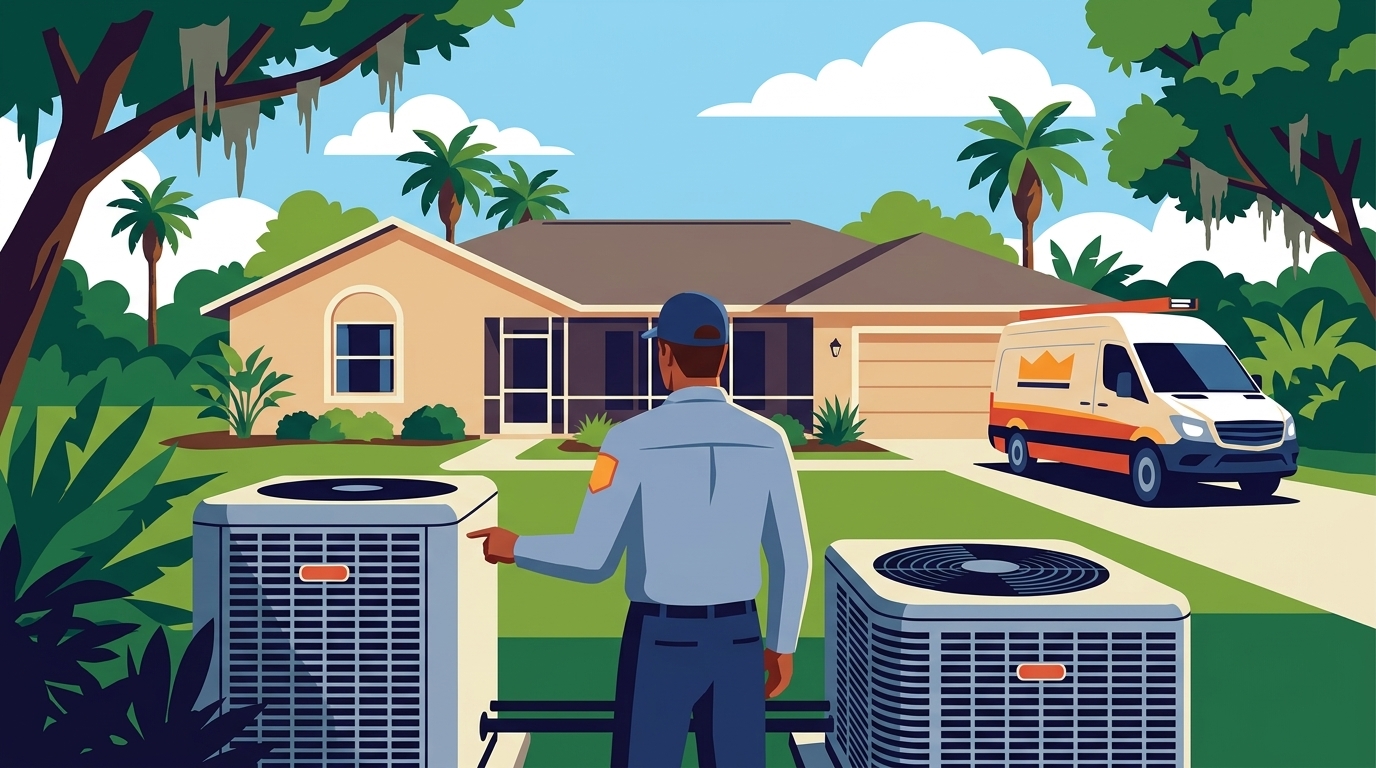
Walk outside to the condenser (the big metal box, usually on the side of the house). You're looking for three things:
- Is the fan on top spinning? If the unit is humming but the fan isn't turning, shut it off at the breaker. Running it like that will burn out the compressor.
- Is the coil clogged? Grass clippings, oak pollen, and lovebug residue are notorious in Jacksonville. Gently rinse the coil with a garden hose from the inside out if you can safely reach it. Never use a pressure washer.
- Is there clearance? The unit needs at least two feet of open space on all sides. Trim back any shrubs or vines.
4. Check for ice on the indoor unit or refrigerant line
Open the closet or attic where your air handler lives. If you see ice on the copper lines or the evaporator coil, your system is frozen. Turn the thermostat to OFF and the fan to ON for two to three hours to thaw it. A frozen coil usually means low refrigerant or restricted airflow — both of which need follow-up.
5. Find the condensate drain line
Florida humidity means your AC pulls gallons of water out of the air daily. That water exits through a PVC drain line, and if it clogs with algae, a safety float switch shuts the system down to prevent flooding. Look for a small white PVC pipe near the air handler with a cap on top. Pour a cup of distilled vinegar (not bleach in modern systems) down the access port to clear minor clogs.
6. Reset the breaker
Find your electrical panel. Locate the breakers labeled for the air handler and condenser. Flip each fully to OFF, wait 60 seconds, then flip back to ON. Give the system 10 minutes to restart.
When the Problem Is Bigger Than DIY
If you've worked through the steps above and your home still isn't cooling, you're likely dealing with one of these:
- Low refrigerant from a leak. Florida heat doesn't "use up" refrigerant — if you're low, there's a leak somewhere in the system. Topping it off without finding the leak is a short-term patch, and federal EPA rules require certified handling of refrigerants.
- Failing capacitor or contactor. These small electrical parts inside the condenser fail constantly in our climate. Symptoms include a humming outdoor unit that won't start, or a system that trips the breaker.
- Compressor issues. The most expensive failure. Often signaled by warm air, loud clattering, or repeated breaker trips.
- Undersized or leaky ductwork. If some rooms cool fine and others don't, the duct system is usually the culprit — common in older Westside homes where additions were tied into the original trunk line.
What Atlantic Highlands Homeowners Should Know About Florida AC Service
HVAC work in Florida is regulated at the state level. Any contractor installing, replacing, or repairing refrigerant-bearing components in Jacksonville must hold a Florida state license (typically a Class A or Class B HVAC license issued by the Florida Department of Business and Professional Regulation), and most major work in Duval County requires a permit pulled through the City of Jacksonville's Building Inspection Division. If a contractor offers to skip the permit to save you money, that's a red flag — unpermitted work can complicate future home sales and void manufacturer warranties.
Also worth knowing: Florida's heat season is genuinely brutal on equipment. Most residential systems in Jacksonville run roughly 2,500 hours a year — nearly double what the same system would run in the Midwest. That's why annual maintenance before summer humidity peaks (ideally March or April) extends equipment life significantly.
Frequently Asked Questions
How cold should my AC actually blow in Florida summer?
A healthy system should produce supply air about 18–22 degrees cooler than the return air. On a 95-degree day with a 78-degree house, expect roughly 56–60 degrees at the vent closest to the air handler. If you're seeing less than a 15-degree split, something is wrong.
Why does my AC run constantly but never reach the setpoint?During extreme heat, even healthy systems may run continuously to hold temperature — that's normal. But if indoor temps keep climbing despite constant runtime, the system is undersized for the load, the refrigerant charge is off, or the ducts are leaking conditioned air into the attic.Is it cheaper to repair or replace an aging Florida AC system?
The rough rule we use: if the unit is older than 12 years and the repair costs more than a third of replacement, replacement usually pencils out — especially given the efficiency jump from older SEER 13 units to current SEER2 minimums.
How fast can I get help during a heat wave?
Jacksonville service demand spikes during heat waves and same-day appointments fill quickly. Customers consistently note our responsiveness — one recent reviewer described the team as "very responsive (even during a holiday week)." Calling early in the morning gives you the best shot at a same-day slot.
Getting Professional Help in Atlantic Highlands
Most of the troubleshooting above is genuinely doable for a homeowner with basic comfort around a breaker panel and a garden hose. But once you're into refrigerant, electrical components, or duct diagnostics, you need a licensed Florida HVAC tech — both for safety and for the warranty paper trail.
Homeowners in Atlantic Highlands and the wider Jacksonville area who want this handled professionally can reach King of Home Solutions at kingofhomesolutions.com for a free estimate. Our 4.9★ Google rating reflects what we try to do on every call: show up when we say we will, explain the problem in plain language, and fix it right the first time — particularly during the stretches of Florida summer when getting your AC back online isn't optional.