Signs Your HVAC Needs Replacement in Jacksonville, FL
Learn the diagnostic signals — age, R-22 refrigerant, repair frequency, efficiency drops — that tell Jacksonville homeowners it's time to replace their HVAC.
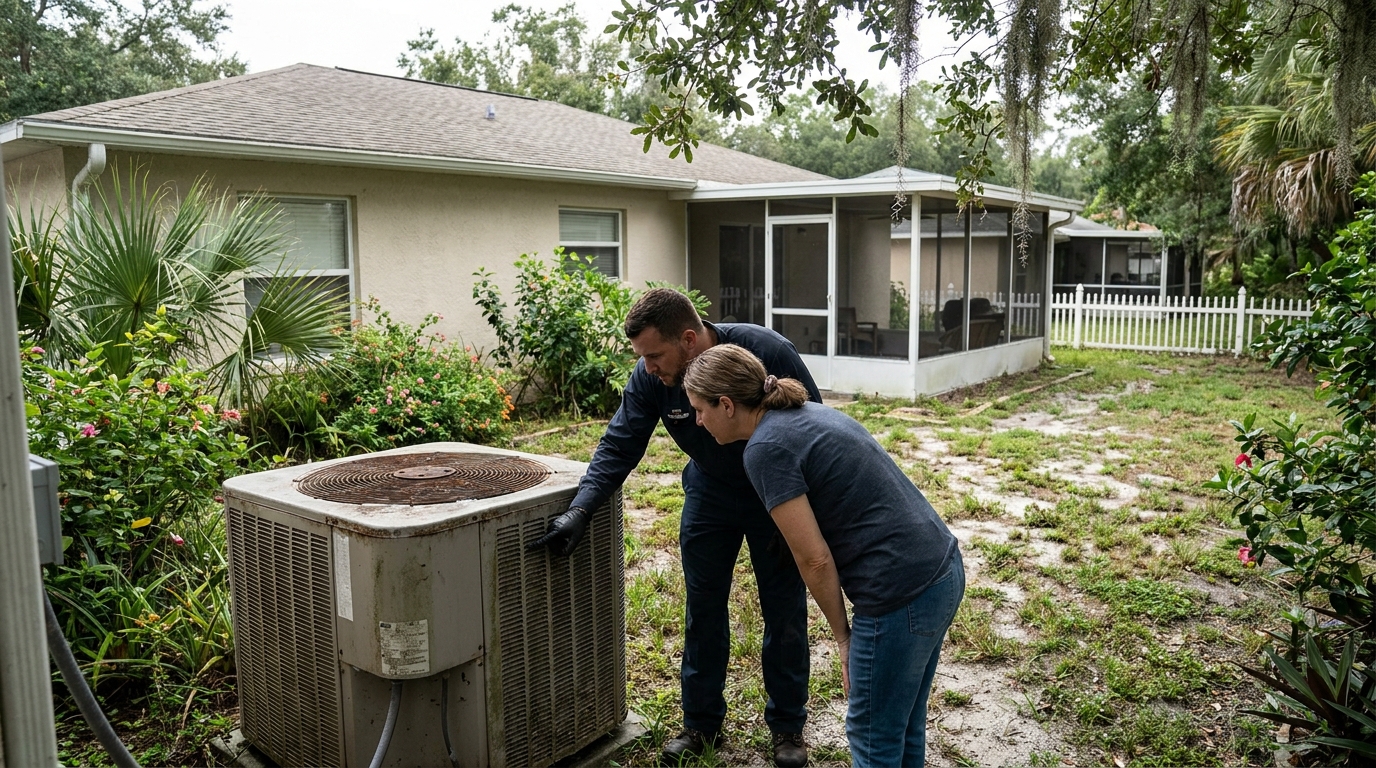
If your Jacksonville HVAC system is over 12 years old, still uses R-22 refrigerant, has needed multiple repairs in the last two cooling seasons, or your electric bills keep climbing while comfort drops — those are the four clearest signs you're past the repair threshold. In our coastal climate, systems age faster than the national average, and the math tips toward replacement sooner than most homeowners expect.
Below, we walk through the specific diagnostic signals — not the decision framework, but the actual evidence — that tell you a Florida HVAC system has reached the end of its useful life.
How old is too old for an HVAC system in Florida?
In Jacksonville's heat and humidity, most central air conditioners last 10 to 15 years, and heat pumps 10 to 14 years — noticeably shorter than the 15-to-20-year lifespan quoted for milder climates. If your system is pushing 12 years or older, replacement is usually the more economical path, even if it's still limping along.
Salt air from the Atlantic accelerates coil corrosion in neighborhoods like Atlantic Beach, Neptune Beach, and Mayport. Homes farther inland — Mandarin, Southside, Arlington — still run their systems roughly 2,500 to 3,000 hours a year, more than double what northern climates demand. That runtime compounds wear on compressors, blower motors, and capacitors.
Experts at King of Home Solutions have seen firsthand that a well-maintained 8-year-old unit can still be worth repairing, while a neglected 11-year-old unit rarely is. Age alone isn't the verdict — but paired with any of the signals below, it usually is.
What does R-22 refrigerant mean for your replacement decision?
If your system uses R-22 refrigerant (also called Freon), replacement is almost always the right call. The EPA banned the production and import of R-22 in the United States on January 1, 2026. What's left in circulation is reclaimed stock, and pricing has climbed sharply — a single R-22 recharge in Jacksonville can run several hundred to over a thousand dollars.
Any Jacksonville system installed before 2026 likely runs on R-22. If a technician pulls the data plate on your outdoor unit and confirms R-22, and the system also has a refrigerant leak, you're spending premium money on an obsolete chemical to patch a system that will need replacing anyway.
Modern systems use R-410A, and the industry is now transitioning to R-454B and R-32 under updated EPA rules for lower global warming potential refrigerants. That's another reason replacement now positions you on current-generation equipment rather than a shrinking supply chain.
How often is too often for HVAC repairs?
If you've called for two or more significant repairs in the last 12 months, or spent more than 50% of a new system's cost on repairs in the last two years, replacement is the smarter investment. Compressor failures, evaporator coil leaks, and repeated capacitor or contactor replacements on the same unit are all signals the system is unraveling.
Watch for these patterns in particular:
- The outdoor unit trips the breaker on hot afternoons
- Ice forms on the refrigerant lines or indoor coil
- The system short-cycles — turning on and off every few minutes
- You've had refrigerant added more than once
- Rooms in the same house have noticeably different temperatures
A single repair on an older system isn't a death sentence. A cluster of them in a single Jacksonville cooling season — roughly April through October — usually is.
What efficiency signals mean your Florida HVAC is failing?
Rising electric bills with no change in usage, longer run times to hit the thermostat setpoint, and humidity that won't drop below 55-60% indoors are the three efficiency signals that most reliably indicate a failing system. In Duval County's climate, humidity control is often the first thing to go — before cooling capacity noticeably drops.
Older systems are also rated at lower SEER (Seasonal Energy Efficiency Ratio) values. Anything installed before 2026 is likely SEER 10 or below. As of January 1, 2026, the federal minimum for new systems installed in the Southeast region — which includes Florida — is SEER2 14.3 (roughly equivalent to SEER 15). A jump from SEER 10 to SEER 15+ can reduce cooling costs by 30% or more, which matters when you're running the system eight months a year.
If your home feels muggy even when the thermostat reads 74, the system is no longer removing moisture effectively. That's a comfort problem and a mold-risk problem — one our team frequently sees when we're called out for indoor air quality complaints in older Jacksonville homes.
Repair vs. replacement signals at a glance
| Signal | Lean Toward Repair | Lean Toward Replacement |
|---|---|---|
| System age | Under 8 years | 12+ years |
| Refrigerant type | R-410A or newer | R-22 (Freon) |
| Repair frequency | First repair in years | 2+ repairs in 12 months |
| Repair cost | Under 30% of new system | Over 50% of new system |
| SEER rating | SEER 14+ | SEER 10 or below |
| Indoor humidity | Holds 45-55% | Consistently above 60% |
| Electric bills | Stable year-over-year | Climbing with no usage change |
What Florida-specific factors accelerate HVAC failure?
Jacksonville's combination of high humidity, salt air along the coast, and 8+ months of active cooling puts more stress on HVAC equipment than almost any other U.S. climate. Systems in Jacksonville Beach, Ponte Vedra, and other coastal areas typically lose 2 to 3 years of lifespan to salt corrosion on the condenser coil.
Hurricane season also plays a role. Power surges from summer storms and grid interruptions during named storms stress compressors and control boards. If your system took a hit during a recent storm event and hasn't run quite right since, that's worth having diagnosed before the next hurricane season peaks.
Florida also requires a permit through the local building department — in Jacksonville, that's the City of Jacksonville Building Inspection Division — for HVAC changeouts, and the installing contractor must hold a state license from the Florida Department of Business and Professional Regulation. Any quote that skips permitting is a red flag worth walking away from.
Frequently asked questions
Is a 15-year-old HVAC system in Jacksonville worth keeping?
Usually not. In Jacksonville's climate, a 15-year-old system is past the typical 10-to-15-year lifespan, likely uses R-22 refrigerant, and is running at SEER 10 or lower. Even if it still cools, you're paying 30% or more in electricity than a modern system would use, and any significant repair — compressor, coil, or blower — will cost enough that replacement makes better financial sense.
How do I know if my system uses R-22 refrigerant?
Check the data plate on your outdoor condenser unit. It will list the refrigerant type — either R-22, R-410A, or R-454B/R-32 on very new systems. If you can't find or read the plate, any licensed HVAC technician can confirm it in a few minutes during a service visit. Systems installed in Jacksonville before roughly 2026 typically use R-22.
What's the average lifespan of an AC unit in Florida?
Central air conditioners in Florida typically last 10 to 15 years, and heat pumps 10 to 14 years. Coastal homes near the Atlantic often see 2 to 3 years less due to salt corrosion. Regular maintenance — annual coil cleaning, filter changes, and refrigerant checks — can push a system toward the top of that range, but climate stress caps how long any unit realistically lasts here.
Does high humidity in my house mean the AC needs replacement?
Not always, but it's a strong signal. Persistent indoor humidity above 60% while the AC is running means the system is no longer removing moisture effectively — usually due to an oversized or aging unit, a failing evaporator coil, or refrigerant issues. If a technician rules out simple fixes and the system is over 10 years old, replacement is typically the durable solution.
Will a new HVAC system really lower my electric bill in Jacksonville?
Yes, meaningfully. Replacing a SEER 10 system with a SEER2 15 or higher unit typically reduces cooling energy use by 30% or more. In Jacksonville, where cooling runs 8+ months a year and accounts for roughly half of a typical home's electric bill, that translates into real monthly savings — often enough to offset a financed replacement over the equipment's lifespan.
Do I need a permit to replace my HVAC system in Jacksonville?
Yes. HVAC changeouts in Jacksonville require a mechanical permit through the City of Jacksonville Building Inspection Division, and the work must be performed by a contractor licensed by the Florida Department of Business and Professional Regulation. The permit covers inspection of the installation, refrigerant handling, and electrical connections. A contractor who suggests skipping the permit is one to avoid.
Getting a clear answer on your system
The signals above rarely appear alone. A 13-year-old system on R-22 with rising bills and two service calls last summer isn't a repair question anymore — it's a replacement question with a timing decision attached. The homeowners who spend the most on HVAC in Jacksonville are usually the ones who kept patching one more season.
Readers in Jacksonville who want a straight diagnostic — no pressure, just an honest read on whether your system has life left — can reach King of Home Solutions at kingofhomesolutions.com. The team holds a 4.9-star rating across 55 Google reviews, with customers consistently noting clear communication and fair pricing. One recent reviewer described the team as "professional, knowledgeable, and very thorough" — which is the standard we aim for on every diagnostic visit.