When to Change AC Filter in Jacksonville, FL: 2026 Guide
The 90-day filter rule fails in Jacksonville's humid, pollen-heavy climate. Here's the real replacement schedule for local HVAC systems, by season.
In Jacksonville, FL, most homeowners should replace a standard 1-inch or 2-inch HVAC filter every 30 to 60 days — not the 60 to 90 days the national guidance suggests. The combination of a near-year-round cooling season, coastal humidity, and a pollen season that can start as early as December pushes filters to load up faster than they do almost anywhere else in the country.
If you've been running the same filter for three months because that's what the box recommends, you're almost certainly running it too long. Here's what actually works in our climate — and how to tell when it's time to swap.
What's the real HVAC filter replacement schedule for Jacksonville, FL homes?
For most Jacksonville homes, plan on a 30 to 60 day replacement cycle for 1-inch and 2-inch filters, with the shorter end during peak pollen (roughly February through May) and peak cooling (June through September). The national guidance of 60 to 90 days assumes a shorter cooling season and lower allergen load than we have here on the First Coast.
The baseline that standard guidance cites — a 60 to 90 day interval for 1-inch and 2-inch filters, with pets cutting that roughly in half — is a sound starting point, but it's calibrated for an average U.S. home. Jacksonville isn't average. Our trees typically start producing pollen in February, and sometimes as early as December, which means your filter is doing allergen duty for the better half of the year. In 2026, Jacksonville ranked #53 on the AAFA's Most Challenging Places to Live with Spring Allergies list — still above average for airborne allergens, and still enough to shorten the useful life of any residential air filter.
At King of Home Solutions, we see the fallout from stretched filter intervals constantly: short-cycling systems, iced evaporator coils, and energy bills creeping up for no obvious reason. Most of it traces back to a filter that was changed on a national schedule in a local climate.
Why does Jacksonville's humidity and pollen change the math?
Three local factors — extended pollen season, near-year-round cooling, and consistently high coastal humidity — all push filters past their rated life sooner. Pollen loads the media faster, longer runtime moves more total air through the filter, and humidity means moisture that can dampen or deform the filter media.
Think about it this way: a filter's life isn't really measured in days. It's measured in how much air has passed through it and how much that air was carrying. When pollen or dust restricts that airflow, the whole system fights the restriction — longer run times, hotter components, higher bills. Replacing a clogged HVAC filter can meaningfully lower AC energy consumption, which in a Jacksonville summer is real money.
Humidity adds its own wrinkle. A damp or sagging filter is not a filter that needs a longer interval — it's a filter that needs to come out now, plus a conversation about why moisture is reaching it in the first place. In homes near the Intracoastal, in San Marco, or along the beaches, we check filter condition more carefully for exactly this reason.
Does the MERV rating change how often you replace it?
Yes — higher MERV filters catch more particles but load up faster and restrict more airflow, so a higher-MERV filter in a Jacksonville home may need replacement more frequently during pollen season. The MERV scale uses higher numbers to indicate greater filtration capability.
Here's a quick breakdown of what each range does and what it means for replacement cadence in our climate:
| MERV Range | What It Catches | Typical Jacksonville Interval |
|---|---|---|
| MERV 1–5 | Large debris only; acts as a prefilter with minimal protection against fine particles | Every 30 days — too coarse for most pollen |
| MERV 8 | Common dust, lint, mold spores | Every 30–60 days |
| MERV 10–12 | Pet dander, dust mites; ideal for most residential needs | Every 30–60 days |
| MERV 13 | — | Every 30–45 days during pollen peaks |
One important nuance: a dirty MERV 8 filter restricts airflow more than a clean MERV 13 filter does. The problem isn't the MERV number itself — it's leaving any filter in too long. And before you jump to a higher MERV, confirm your system can actually handle it. Residential blowers have airflow limits, and a filter too dense for your equipment will drop performance across the board. If you're not sure, we're happy to check your specs.
How do you know your filter is overdue?
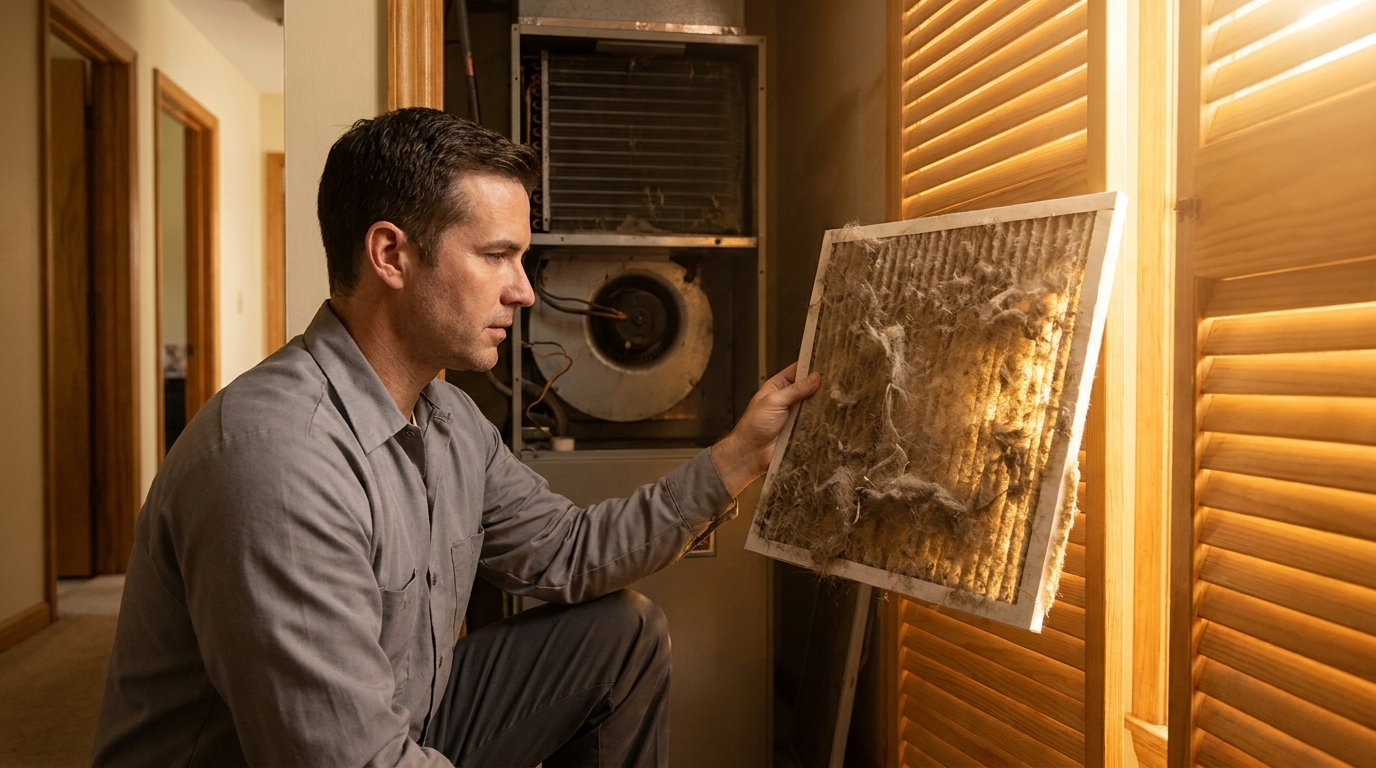
Five symptoms almost always point to a clogged filter: weak airflow at the vents, excess dust settling on surfaces, short cycling (the system turning on and off too quickly), rising energy bills, and a filter that no longer passes light when you hold it up. All five are typically signs that a fresh filter is overdue.
If you swap the filter and the symptoms don't clear, that's your signal that something else is going on — a dirty evaporator coil, a refrigerant issue, a thermostat problem, or airflow restrictions elsewhere in the ductwork. That's the point to bring in a professional. Our HVAC Maintenance Plan covers exactly these diagnostics: cleaning evaporator and condenser coils, flushing drain lines and drain pans, checking wiring, compressor, thermostat, refrigerant pressures, and safety devices, plus proactive system recommendations — across two service visits per year.
"Came out same day, diagnosed and replaced compressor within hours. Owner even stopped in to ensure everything was satisfactory. Thank you!"
What's the seasonal filter schedule for a typical Jacksonville home?
In Jacksonville, the practical rhythm is: check monthly, replace every 30 days from February through September, and stretch to 45–60 days from October through January. Homes with pets, smokers, or allergy sufferers should stay on the most frequent replacement cycle year-round.
- December–January: Early pollen can start now. Inspect monthly, replace every 45–60 days.
- February–May: Tree pollen season (river birch, bayberry, oak, cedar). Replace every 30 days.
- June–September: Heavy cooling demand and highest humidity. Replace filters frequently during this period and watch for moisture on the media.
- October–November: Shoulder season. Inspect monthly, replace every 45–60 days.
Frequently Asked Questions
How often should HVAC filters be changed in Jacksonville, FL?
In Jacksonville, FL, standard 1-inch and 2-inch HVAC filters should be replaced every 30 to 60 days — closer to 30 during pollen season (February through May) and peak cooling (June through September). Homes with pets, smokers, or allergy sufferers should plan on 30-day replacements year-round, since humidity and pollen load local filters faster than the national 60 to 90 day guidance assumes.
Does a higher MERV filter really need more frequent changes?
Generally yes. In Jacksonville, a MERV 11 or 13 filter often needs replacement every 30 to 45 days during pollen season, versus every 60 days for a lower-MERV filter in the off-season.
Can changing my filter really lower my energy bill?
Yes. Replacing a clogged HVAC filter can meaningfully lower AC energy consumption. In a Jacksonville summer, that difference shows up quickly on a JEA bill.
What happens if I leave the same filter in for six months?
Expect weak airflow, excess dust, short cycling, higher energy bills, and potentially a frozen evaporator coil. In humid Jacksonville conditions, a filter left too long can also sag, tear, or develop moisture damage, letting debris bypass the filter entirely and foul the coil.
Should I use a MERV 13 filter in my Jacksonville home?
Only if your HVAC equipment can handle the airflow resistance. MERV 13 filters capture more fine particles — including bacteria and smoke — but they're denser than the MERV 8 to 10 filters most residential systems are designed around. Confirm compatibility with your equipment before upgrading.
Do I need a professional to change my HVAC filter?
No. A like-for-like filter swap is a routine homeowner task in Florida and isn't established by state sources as requiring a licensed contractor. However, work beyond filter changes — equipment repair, installation, refrigerant handling — falls under Florida's Construction Industry Licensing Board rules and should be handled by a licensed HVAC contractor. If swapping the filter doesn't fix your symptoms, that's your cue to call one.
A practical closing thought
The 90-day rule isn't wrong — it's just not written for us. Jacksonville's climate, pollen calendar, and cooling demand all argue for a shorter, more attentive filter routine, and the payoff is real: lower bills, cleaner indoor air, and a system that lasts longer before it needs serious work. Build a habit of checking monthly and replacing on the 30 to 60 day cycle, and most of the small problems that lead to big repair calls simply don't start.
If you'd rather have a professional handle the inspections, coil cleaning, and system checks alongside your filter schedule, King of Home Solutions is based at 5151 Sunbeam Road in Jacksonville and can be reached at (904) 865-4663 or https://kingofhomesolutions.com to set up a maintenance visit or ask a question about your system.