Why Your AC Freezes Up in Jacksonville, FL — Safe Fix
Frozen AC coil in Jacksonville? Learn why Florida humidity causes freeze-ups, how to thaw the unit safely, and when to call an HVAC pro.
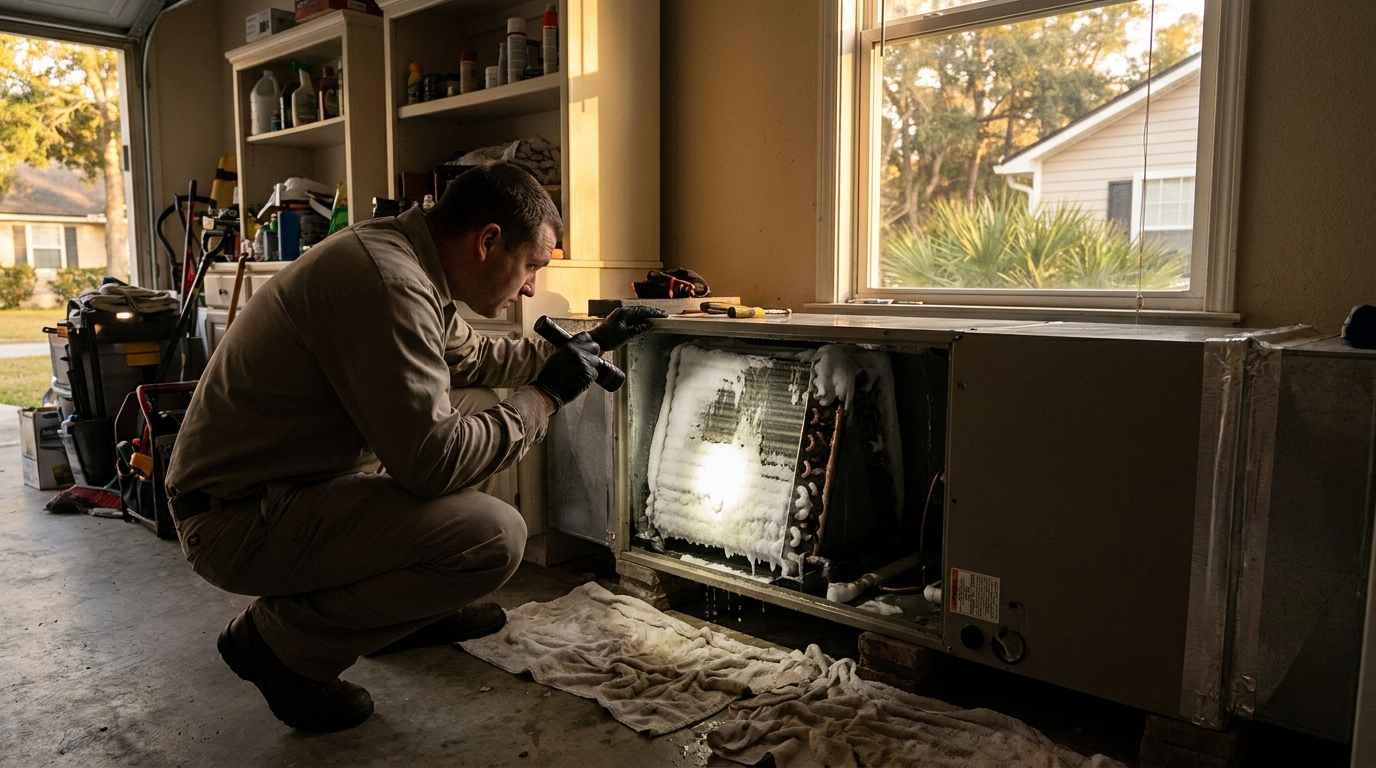
If your air conditioner is blowing warm air and you spot ice on the copper lines or indoor coil, your system has frozen up — and yes, this happens constantly in Florida's humid summers. The fastest safe fix is to turn the cooling OFF at the thermostat, switch the FAN to ON so it can push room-temperature air across the coil, and let the ice melt fully for 1 to 3 hours before restarting. Once thawed, check your air filter and return vents; if the freeze returns, you likely have a refrigerant, airflow, or blower issue that needs a licensed technician.
It feels backwards, doesn't it? It's 94°F outside with 80% humidity in Jacksonville, and somehow your AC is making ice. But that combination — extreme heat plus heavy moisture — is exactly what sets Florida systems up to freeze. Let's walk through why it happens, how to thaw safely, and what to check before you pick up the phone.
Why does an AC freeze up during a Florida summer?
An AC freezes when the evaporator coil drops below 32°F while humid air keeps condensing on it. In Jacksonville's summer humidity, moisture flash-freezes into a thick ice layer within an hour or two. The three usual culprits are restricted airflow (dirty filter, closed vents, dirty coil), low refrigerant from a leak, or a failing blower motor.
Here's the counterintuitive part. Your evaporator coil is supposed to run cold — around 40°F — to pull heat and moisture out of your air. When something disrupts the balance, the coil temperature drops below freezing. The humid air passing over it doesn't just cool; it freezes onto the metal. Once ice forms, airflow drops even further, the coil gets colder, and more ice builds. It's a runaway loop.
In coastal neighborhoods like Riverside, San Marco, and the Beaches, salt air and heavier dust loads accelerate coil fouling, which is one reason technicians at King of Home Solutions see freeze-up calls spike from June through September every year.
How do I thaw a frozen AC unit safely?
To thaw safely, set your thermostat's cooling mode to OFF and switch the fan to ON. This circulates warm indoor air across the frozen coil and melts the ice without stressing the compressor. Allow 1 to 3 hours for a full thaw, place towels near the indoor air handler to catch drips, and never chip at the ice with any tool.
Here's the sequence we recommend for Jacksonville homeowners:
- Turn cooling OFF at the thermostat. Running the compressor while frozen can destroy it — a repair that often runs $1,500 to $2,500.
- Set the FAN to ON. This speeds thawing considerably versus letting it melt passively.
- Check your drain pan and secondary pan. A large ice block can produce a gallon or more of water. Florida building code requires a secondary drain pan under attic air handlers, but overflows still happen.
- Wait for full thaw. Look at the copper refrigerant lines near the outdoor condenser — when they're no longer frosty and feel room-temperature, you're clear.
- Replace the air filter. If it's gray, dusty, or older than 60 days, swap it before restarting.
- Restart cooling and monitor. If ice returns within 24 hours, stop and call a technician.
What causes repeat freeze-ups in Jacksonville homes?
Repeat freeze-ups almost always trace to one of four issues: a low refrigerant charge from a slow leak, a dirty evaporator coil, chronic airflow restriction from undersized returns or closed vents, or a weak blower motor. Filter changes and thawing address symptoms, but a system that freezes twice needs diagnostic work on the underlying cause.
Low refrigerant (most common in older systems)
When refrigerant is low, pressure inside the evaporator drops, and the coil runs colder than designed. Jacksonville systems running R-410A that are 8+ years old are prime candidates. Leaks are common at flare fittings, Schrader valves, and coil U-bends. This requires an EPA-certified technician — refrigerant handling is federally regulated under Section 608 of the Clean Air Act.
Dirty evaporator coil
Florida's humidity plus pet dander, dust, and pollen builds up on the coil fins. Even a light film insulates the coil enough to disrupt heat transfer and trigger freezing. A professional coil cleaning typically runs $150 to $400.
Airflow restrictions
Closed supply vents in guest rooms, crushed flex duct in the attic, or a filter that's too restrictive (high-MERV filters in systems not sized for them) all starve the coil of the warm return air it needs.
What are the typical causes and fixes at a glance?
Here's how the common freeze-up causes break down by likelihood, DIY-friendliness, and typical Jacksonville repair cost.
| Cause | How common | DIY fix? | Typical cost (2026) |
|---|---|---|---|
| Dirty or clogged air filter | Very common | Yes | $15-$40 filter |
| Closed or blocked vents | Common | Yes | $0 |
| Dirty evaporator coil | Common | No | $150-$400 |
| Low refrigerant / leak | Very common in older units | No | $300-$1,500 |
| Failing blower motor | Occasional | No | $400-$900 |
| Clogged condensate drain | Very common in FL | Partial | $100-$250 |
| Thermostat set too low overnight | Common | Yes | $0 |
When should I stop troubleshooting and call an HVAC contractor?
Call a licensed HVAC contractor if the unit freezes again within 24 hours of a full thaw and filter change, if you see oil residue on the copper lines (a refrigerant leak indicator), if water has overflowed into a ceiling or wall, or if the outdoor unit is icing over. These situations mean the root cause is mechanical, not maintenance-related, and continuing to run the system risks compressor failure.
Florida requires HVAC contractors to be state-licensed through the Department of Business and Professional Regulation (DBPR), and refrigerant work requires EPA Section 608 certification. Any tech who arrives at your Jacksonville home should be able to produce both credentials on request. King of Home Solutions holds a 4.9-star rating across 55 Google reviews, with one recent client describing the team as "professional, knowledgeable, and very thorough throughout the entire process" — the kind of diagnostic work that separates a real fix from a recharge that leaks out again by August.
How can I prevent AC freeze-ups before Jacksonville's peak summer?
Prevention comes down to four habits: change your air filter every 30 to 60 days during summer, schedule a professional tune-up each spring before humidity peaks, keep all supply vents open (even in unused rooms), and have your condensate drain line flushed annually. Systems maintained on this schedule rarely freeze.
The best window for a Jacksonville tune-up is March through early May — before the humidity climbs and before service calendars fill with emergency freeze and no-cool calls. A proper tune-up checks refrigerant pressures, cleans the coil, tests capacitor microfarad readings, verifies blower amp draw, and clears the drain line with vacuum or nitrogen.
Frequently asked questions
Can I pour hot water on my frozen AC coil to speed up thawing?
No. Pouring hot water on a frozen evaporator coil can crack the copper tubing, warp the aluminum fins, or short out nearby electrical components in the air handler. The fan-on method is faster than passive melting and completely safe. If you're in a hurry, a portable box fan aimed at the indoor coil access panel adds a bit more airflow without any risk to the equipment.
Why is my outdoor AC unit iced over instead of the indoor coil?
Ice on the outdoor unit — the condenser — almost always means a serious refrigerant charge problem or a failed reversing valve if you have a heat pump. This is not a homeowner fix. Shut the system off at the thermostat and breaker, let it thaw completely, and call a licensed HVAC technician. Running a heat-pump compressor in this condition often causes catastrophic damage within minutes.
How long does a frozen AC take to thaw in Florida humidity?
With the fan running and cooling off, most Jacksonville freeze-ups thaw in 1 to 3 hours. A heavily iced system that ran for hours before you noticed can take 4 to 6 hours to fully clear. Do not restart cooling until the copper suction line at the outdoor unit feels room-temperature and you see no frost anywhere on the refrigerant lines.
Will running my AC while it's frozen damage the compressor?
Yes, and this is the most expensive mistake homeowners make. When the coil is iced, refrigerant returning to the compressor may be liquid rather than gas — a condition called slugging that destroys internal compressor components. Compressor replacements in Jacksonville typically run $1,500 to $2,800, versus a $200 to $500 refrigerant or coil service call if the system is caught early.
Does homeowners insurance cover a frozen AC repair?
Standard Florida homeowners policies do not cover mechanical breakdown or wear-and-tear on HVAC equipment, which is what most freeze-ups fall under. Coverage may apply if freezing caused secondary water damage to ceilings, drywall, or flooring — that portion is often claimable. Home warranty plans, sold separately, are more likely to cover the AC repair itself, subject to their maintenance and diagnostic clauses.
How often should I have my AC serviced in Jacksonville to prevent freezing?
Once a year at minimum, ideally in spring before humidity peaks. Homes near the beaches or the St. Johns River benefit from twice-yearly service because salt air and higher moisture loads accelerate coil corrosion and drain-line algae growth. A spring tune-up plus a fall drain flush covers most Jacksonville homes and catches the small issues that turn into July freeze-ups.
The bottom line
A frozen AC in Jacksonville is almost never a mystery — it's airflow, refrigerant, or a dirty coil, in that order of likelihood. Thaw it safely with the fan-on method, replace the filter, and give the system a full reset. If it freezes again, the root cause is mechanical and needs professional diagnosis before the compressor pays the price.
Homeowners in Jacksonville who want the diagnosis handled properly can reach King of Home Solutions at https://kingofhomesolutions.com — licensed, EPA-certified, and familiar with the exact freeze-up patterns Florida humidity produces every summer.