How to Lower Home Humidity Levels in Englewood, Jacksonville
Practical, Jacksonville-specific guide to lowering indoor humidity in Englewood homes — from HVAC tuning to dehumidifiers and ventilation fixes.

If your windows sweat in the morning, your floors feel slightly tacky, and the air in your living room smells faintly musty by mid-afternoon, you're not imagining it. Englewood homes deal with some of the most stubborn indoor humidity in Jacksonville — and a lot of that has to do with the neighborhood itself: older single-story ranches, slab foundations, mature tree canopy that traps moisture, and proximity to the St. Johns River basin to the east.
The good news is that lowering indoor humidity isn't a mystery. It's a sequence of small, practical fixes that work together. Here's how to reduce home humidity levels in Jacksonville, FL the right way — and what Englewood homeowners specifically should know.
Why Englewood Homes Hold So Much Humidity
Jacksonville sits in a humid subtropical zone, and from roughly May through October, outdoor dew points routinely climb into the 70s. That moist air finds its way into your home through every door swing, attic vent, dryer duct, and bathroom fan run.
Englewood adds a few wrinkles. The housing stock skews older — many homes were built in the 1950s through 1970s, before modern vapor barriers and tight building envelopes became standard. Slab-on-grade construction means moisture wicks up from the soil. And the area's heavy oak and pine canopy keeps yards shaded and damp, slowing evaporation around the foundation.
The ideal indoor relative humidity for a Florida home sits between 45% and 55%. Above 60%, you start to see mold growth, dust mite activity, warped trim, and that sticky feeling that no amount of thermostat-lowering seems to fix.
Step 1: Confirm Your Humidity Problem with a Hygrometer
Before changing anything, buy a small digital hygrometer — they run about $15 at any hardware store. Place one in your main living area and another in a problem room like the primary bedroom or a closet against an exterior wall.
Check readings at three times: early morning, mid-afternoon, and late evening. If you're consistently above 55%, you have a humidity issue worth solving. If you're spiking above 65%, you're in mold-risk territory.
Step 2: Make Your HVAC Work as a Dehumidifier
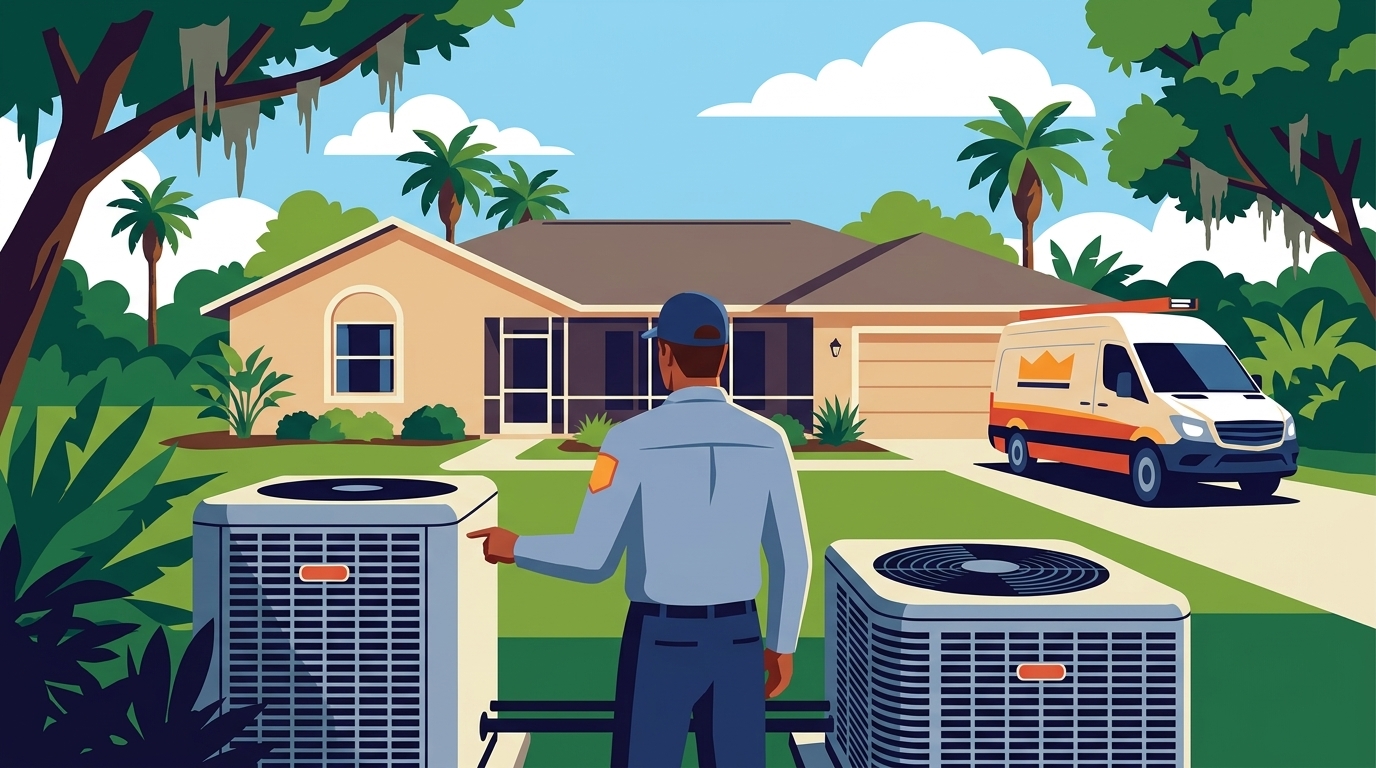
This is where most Englewood homeowners get it wrong. Your air conditioner already removes moisture — but only if it's sized and running correctly.
Right-size matters more than big-size
An oversized AC cools the room quickly, shuts off, and never runs long enough to pull moisture out of the air. That's why a brand-new 4-ton system in a 1,600-square-foot Englewood ranch can leave you feeling clammy at 74°F. Longer, slower cycles dehumidify better than short bursts.
Tune the fan setting
Set your thermostat fan to AUTO, not ON. When the fan runs continuously, water that just condensed on the cold coil gets blown right back into your house before it can drain away.
Keep the coil and drain clean
A dirty evaporator coil loses dehumidification capacity fast. So does a partially blocked condensate drain — and in Jacksonville's algae-friendly climate, those PVC drain lines clog every summer. An annual HVAC tune-up before the humid season catches both. This is the kind of seasonal maintenance our team at King of Home Solutions handles routinely for Englewood homeowners ahead of peak humidity in May.
Step 3: Decide — Dehumidifier vs. HVAC Upgrade
This is the big question Jacksonville homeowners ask us most often. Here's how to think about it.
When a standalone dehumidifier makes sense
- Your AC is relatively new and working properly, but humidity still creeps above 55%
- One specific room (a sunroom, garage conversion, or back addition) feels muggy while the rest of the house is fine
- You run the AC less in shoulder seasons (March, November) and humidity spikes when the compressor isn't cycling
A portable unit handles a single room. A whole-home dehumidifier that ties into your existing ductwork is the stronger play for an entire Englewood ranch — it runs independently of the AC and keeps the whole envelope dry.
When an HVAC upgrade makes more sense
- Your system is more than 12–15 years old and short-cycling
- You've noticed rising electric bills alongside the humidity issue
- Rooms farther from the air handler feel noticeably stickier than rooms close to it
Modern variable-speed and two-stage systems run longer at lower output, which is exactly what humid Jacksonville air needs. In many Englewood homes, replacing an aging single-stage condenser with a variable-speed system eliminates the humidity problem without any separate dehumidifier at all.
If you're unsure which path fits your home, an in-person assessment is worth more than any online calculator. The right answer depends on duct condition, insulation, square footage, and how your specific home behaves.
Step 4: Plug the Moisture Sources You Can Control
Even a perfect HVAC setup loses ground if moisture keeps pouring in. Walk through this checklist:
- Bathroom fans: Run them during every shower and for 20 minutes after. Confirm they vent to the outside, not into the attic — a common shortcut in older Englewood homes.
- Dryer vent: Make sure it terminates outside and the line is clear. A clogged dryer vent dumps gallons of moisture into your laundry room every week.
- Kitchen range hood: Use it. Boiling pasta and simmering sauces release more humidity than most people realize.
- Attic ventilation: Soffit and ridge vents should be unobstructed. Trapped attic moisture migrates down into living space.
- Plumbing leaks: A slow leak under a sink or behind a toilet can push a whole room above 60% humidity.
- Weatherstripping and door seals: Older Englewood homes often have tired thresholds that let humid outdoor air pour in around exterior doors.
Step 5: Don't Over-Cool to Compensate
Many Jacksonville homeowners crank the thermostat down to 70°F trying to feel less sticky. It rarely works, and it doubles your power bill. The issue isn't temperature — it's moisture. Fix the humidity, and 76°F will feel more comfortable than 70°F at 65% relative humidity ever did.
FAQ: Home Humidity Control in Florida
What humidity level should I set my Jacksonville home to?
Aim for 45–55% relative humidity year-round. Below 40% gets uncomfortably dry in winter; above 60% invites mold and dust mites.
Will a whole-home dehumidifier raise my electric bill?
It uses electricity, yes — but it often lets you raise the thermostat 2–3 degrees while feeling cooler, which usually offsets the cost. Net change is typically modest.
How often should my HVAC system be serviced in Jacksonville?
Twice a year — once before cooling season (March or April) and once before heating season (October). The pre-summer visit is the critical one for humidity control.
Can I just open windows to dry the house out?
In Florida, almost never. Outdoor air is usually more humid than your indoor air. Opening windows in July adds moisture; it doesn't remove it.
Is high humidity damaging my home?
Sustained humidity above 60% can warp hardwood floors, swell doors, peel paint, and grow mold inside wall cavities. It's worth addressing before damage compounds.
Getting Help in Englewood
Lowering indoor humidity in an Englewood home usually comes down to two things: making sure your existing HVAC system is dehumidifying as well as it can, and addressing whichever moisture source is overwhelming it. Sometimes that's a $200 service call. Sometimes it's a whole-home dehumidifier. Occasionally it's a system replacement that pays for itself in comfort and electric savings.
Homeowners in Englewood and the wider Jacksonville, FL area who want this diagnosed and handled professionally can reach King of Home Solutions at kingofhomesolutions.com for a free estimate. The company holds a 4.9★ rating across 48 Google reviews, with customers consistently noting clear communication and on-time service — one recent reviewer described the experience as "professional and reliable," which is the standard worth expecting from any HVAC contractor you bring into your home.