Low Water Pressure by Room: East Arlington, Jacksonville
Diagnose low water pressure room by room in East Arlington, Jacksonville homes. Learn which fixture points to which failure — and when to call a plumber.
If only one room in your East Arlington home has weak water pressure, the problem is almost always local to that fixture, its supply line, or its shutoff — not the city main. When pressure drops throughout the house, the cause usually sits at the meter, pressure regulator, or main shutoff. Diagnosing which is which is a matter of comparing rooms.
East Arlington's housing stock skews toward 1960s–1980s ranch and split-level homes off Fort Caroline Road, Monument Road, and the corridors near the University of North Florida. That means galvanized steel supply lines, aging brass shutoffs, and copper that has spent decades reacting to Jacksonville's hard, mineral-heavy well-and-surface-blended water. Room-by-room symptoms tell you exactly where in that aging network the flow is being choked.
Why does only one room have low water pressure in my Jacksonville home?
Low pressure isolated to one room points to a fixture-level problem: a clogged aerator, a fouled cartridge, a partially closed angle stop, or a corroded supply line feeding that room. Whole-house low pressure points to the pressure regulator, main shutoff, or municipal supply. The room where pressure fails is the diagnostic clue.
Before touching anything, run this quick baseline test: turn on the cold tap in every bathroom and the kitchen, one at a time, and note which are weak. If three fixtures run strong and one is a trickle, you have a localized problem. If everything sputters, the issue is upstream of the fixtures. At King of Home Solutions, this is the first sequence our technicians walk through on any East Arlington pressure call, because it saves an hour of guesswork.
What causes low kitchen sink pressure specifically?
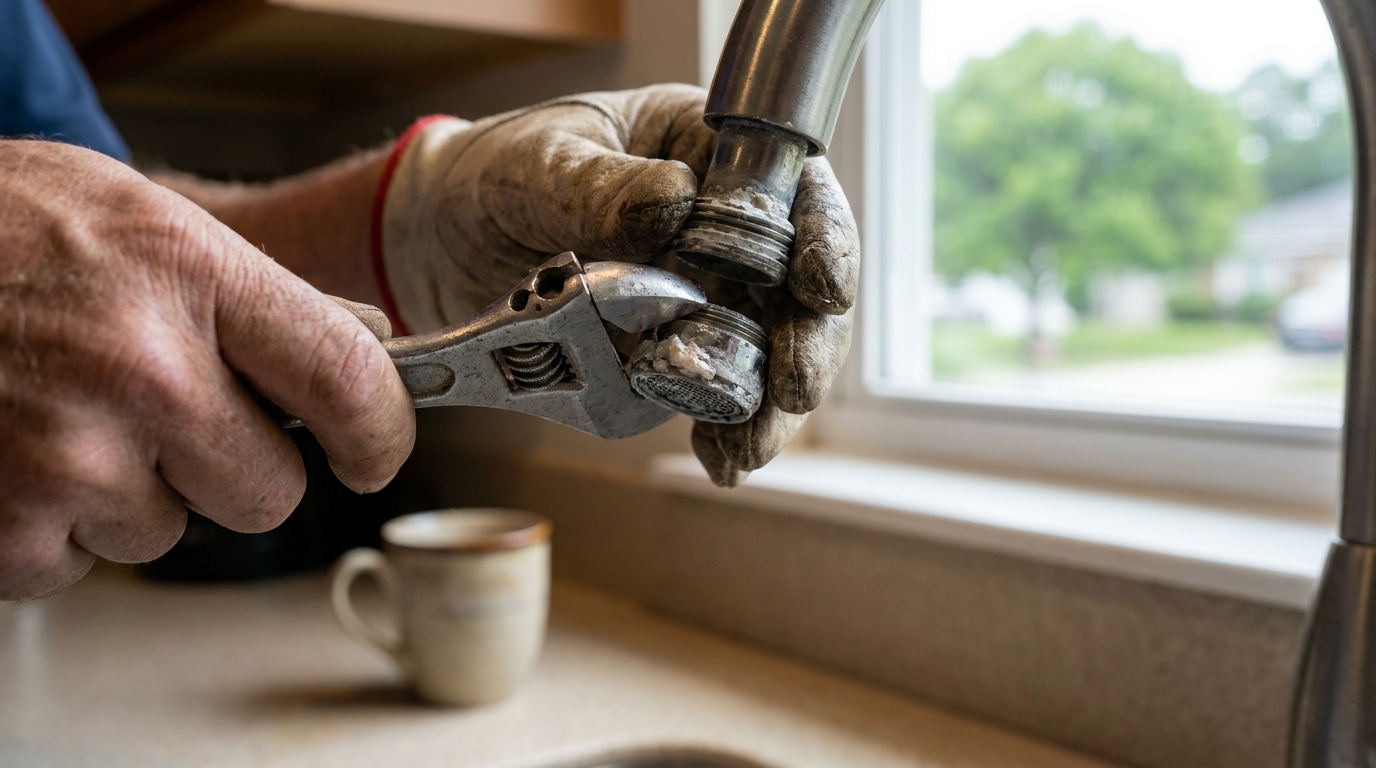
The kitchen sink is the most common single-room offender, and the culprit is usually the aerator or the pull-down sprayer hose. Mineral scale from Jacksonville's hard water clogs the aerator screen within 12–24 months. Less often, the angle stops under the sink have partially failed, or the sprayer diverter inside the faucet body is fouled.
Unscrew the aerator (twist counterclockwise, sometimes with a rubber jar gripper), rinse it, and soak it in white vinegar for 20 minutes. If pressure returns, you found it. If not, disconnect the sprayer hose at the faucet base and run the tap — full flow there means the sprayer or diverter is the problem.
Why is my bathroom shower pressure weak but the sink is fine?
When the shower drips but the vanity sink runs strong, the shower head, the mixing valve cartridge, or the shower's dedicated supply is the issue. In East Arlington homes built before 1990, the mixing valve cartridge is often the first failure point — sediment and scale seize the internal ports and restrict flow on the hot side, the cold side, or both.
Remove the shower head and run the shower briefly. Strong flow from the bare pipe means the head is scaled — soak it in vinegar or replace it. Weak flow from the bare pipe means the cartridge or valve body needs service. Cartridge replacement is a straightforward job for a licensed plumber and typically takes under an hour.
What if only the hot water has low pressure?
Hot-only low pressure — anywhere in the house — points to the water heater or the hot-side plumbing. The three most common causes are sediment buildup in the tank, a failing dip tube, or a partially closed shutoff on the hot outlet. In older East Arlington homes, galvanized hot lines corrode from the inside and constrict the pipe's inner diameter over time.
Check the shutoff valves on top of the water heater first — they should be fully open. If the tank hasn't been flushed in more than two years, sediment is a strong suspect. Florida water heaters generally have a useful life of 8–12 years; if yours is past that window and hot pressure is falling, the tank itself is often the answer.
Why does the whole house have low pressure at once?
Whole-house pressure loss almost always traces to the pressure reducing valve (PRV), the main shutoff, the meter, or a leak in the service line between the meter and the house. JEA delivers water to Jacksonville homes at pressures that typically run 50–70 psi at the meter; a failing PRV can throttle that down to a trickle without warning.
A licensed plumber will attach a pressure gauge to an exterior hose bibb to read static pressure. Under 40 psi at the bibb means the problem is upstream — regulator, main valve, or service line. Over 60 psi at the bibb with weak indoor flow means the problem is inside, likely in the distribution piping.
Room-by-room symptom guide
| Symptom | Most likely cause | Typical fix |
|---|---|---|
| One faucet weak, others fine | Clogged aerator or angle stop | Clean aerator; replace stop |
| Shower weak, sink strong (same bath) | Shower head scale or mixing valve cartridge | Descale head or replace cartridge |
| Hot water weak everywhere | Water heater sediment or failing dip tube | Flush tank or replace heater |
| Cold water weak everywhere | Main shutoff partially closed or PRV failing | Open valve fully; replace PRV |
| Whole house weak, all fixtures | PRV, service line leak, or meter issue | Pressure test; call JEA if meter-side |
| Pressure fell gradually over years | Galvanized pipe corrosion narrowing bore | Repipe affected runs in PEX or copper |
How Jacksonville's water and East Arlington's housing age factor in
Jacksonville water is treated by JEA and consistently tests within federal safety limits, but it carries enough dissolved minerals to scale fixtures faster than softer municipal supplies. Combine that with East Arlington's mid-century housing — many homes still have original galvanized branch lines feeding bathrooms — and slow pressure decline is essentially built into the neighborhood.
Homes built after roughly 1995 typically use copper or CPVC and don't suffer the same internal corrosion. If your East Arlington home has never been repiped and you're seeing pressure loss in multiple rooms simultaneously, a section-by-section repipe in PEX is often more cost-effective than chasing individual fixture repairs for another decade.
When should you call a licensed plumber?
Call a licensed Florida plumber when cleaning the aerator and shower head doesn't restore flow, when hot-side pressure has dropped, when you suspect the PRV, or when whole-house pressure has fallen. Florida requires plumbing contractors to hold a state-issued license through the Department of Business and Professional Regulation — always verify the license before hiring.
King of Home Solutions handles same-day plumbing diagnosis across East Arlington and the wider Jacksonville area, carries the required state licensing and insurance, and holds a 4.9-star rating across 55 Google reviews. One recent reviewer described the experience as "very responsive, great service, professional, on time, excellent communication and great price."
Frequently asked questions
How much does it cost to fix low water pressure in Jacksonville?
Simple fixes — aerator cleaning, shower head replacement, angle stop swap — typically run $125–$250 including the service call in the Jacksonville market. Cartridge replacement runs $200–$400. PRV replacement runs $350–$650. A partial repipe of galvanized lines in an East Arlington ranch home can range from $2,500 to $6,000 depending on access and square footage.
Can I fix low water pressure myself?
Yes for aerators, shower heads, and sometimes angle stops — these are homeowner-friendly fixes with basic tools. No for pressure reducing valves, mixing valve cartridges in older walls, water heater work, or anything involving the main shutoff or service line. Florida law requires licensed plumbers for most work beyond fixture-level maintenance, and mistakes on pressurized lines can flood a house quickly.
Does JEA affect my home's water pressure?
JEA delivers water to Jacksonville homes at a typical range of 50–70 psi at the meter, and occasional main work or hydrant flushing can temporarily reduce pressure in East Arlington. If your entire street is affected at the same time, call JEA before calling a plumber. If only your house is affected, the issue is on your side of the meter.
Why did my water pressure suddenly drop overnight?
Sudden overnight pressure loss usually means a failed pressure reducing valve, a broken service line between the meter and the house, or a stuck main shutoff. Slow declines over months or years point to scale buildup, aerator clogging, or galvanized pipe corrosion. The speed of the change is itself a diagnostic clue worth mentioning when you call a plumber.
How do I know if my pressure regulator is bad?
A failing PRV shows up as whole-house low pressure, wildly fluctuating pressure, or (on the opposite failure mode) dangerously high pressure that hammers pipes. A plumber confirms it by attaching a gauge to an exterior hose bibb and reading static pressure. Anything under 40 psi or over 80 psi at the bibb suggests the PRV needs replacement.
Can hard water in Jacksonville cause low pressure over time?
Yes. Jacksonville's mineral-rich water deposits scale inside aerators, shower heads, mixing valve cartridges, and eventually inside pipe walls themselves. In older East Arlington homes with original galvanized supply lines, decades of scale plus internal corrosion can reduce a pipe's effective inner diameter by half or more, causing gradual pressure loss no fixture repair can fully undo.
The bottom line for East Arlington homeowners
Which room is weak tells you where the failure lives. One fixture means fixture-level work; hot-only means the water heater or hot-side piping; whole-house means the PRV, main valve, or service line. Start with the aerator, work outward, and stop when the symptom stops. East Arlington homeowners who want a professional diagnosis — including a pressure test and a room-by-room walk-through — can reach King of Home Solutions at https://kingofhomesolutions.com for same-day service across Jacksonville.