Mold on AC Vents in Ponte Vedra Beach, FL: Fix Guide
Seeing mold around your AC vents in Ponte Vedra Beach? Learn what causes it, whether it's dangerous, and the right steps to clean, fix, and prevent it.
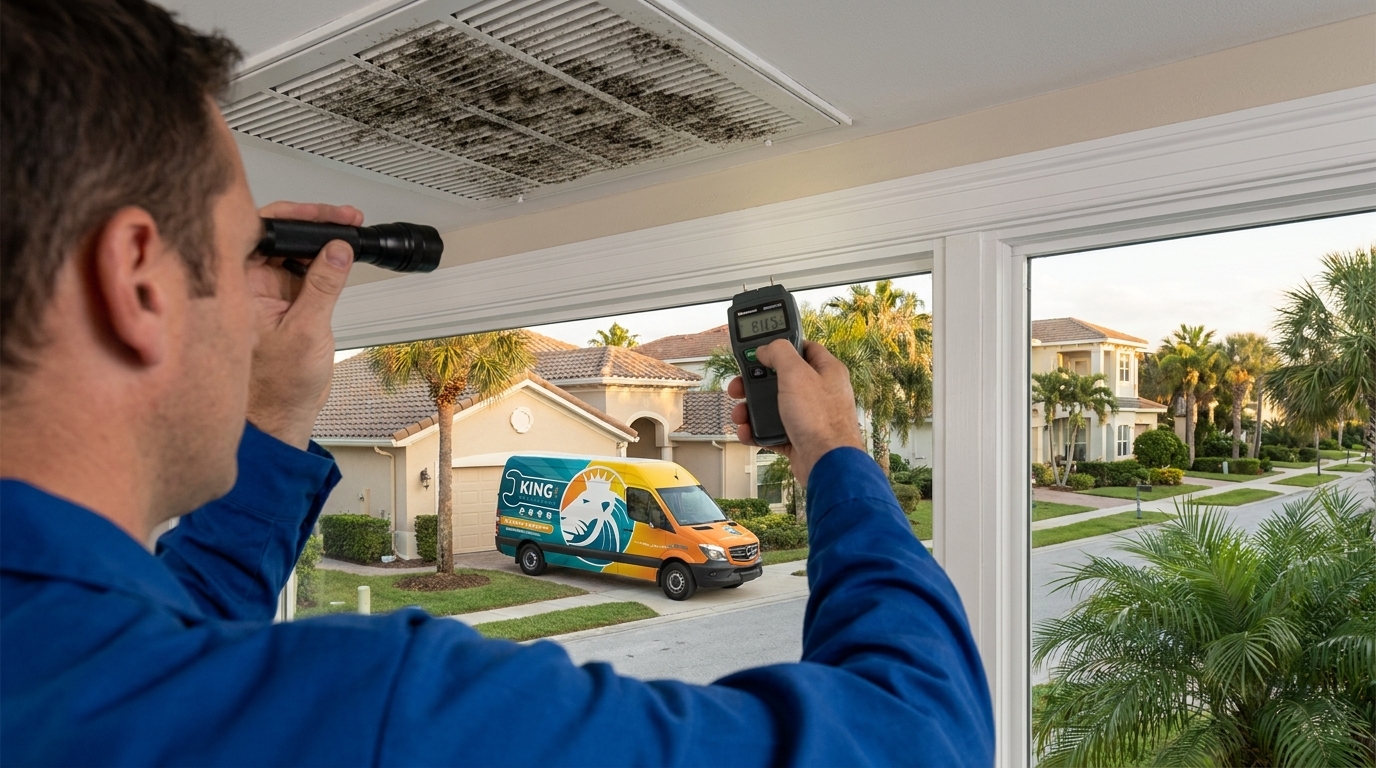
If you're seeing dark speckles or fuzzy patches spreading around the ceiling vents in your Ponte Vedra Beach home, that's almost certainly mold — and it's caused by warm, humid air hitting a cold vent surface and condensing. The fix isn't just wiping it away. You need to correct the underlying moisture problem inside your HVAC system, or it will come right back within weeks.
Here's what's actually happening, why coastal Northeast Florida homes are especially prone to it, and the order of steps we recommend.
Why Is There Mold Around My AC Vents?
Mold grows around AC vents when the cold metal register meets warm, humid indoor air and creates condensation. That moisture soaks into the drywall, paint, and dust around the vent — and mold spores (which are always in the air) settle in and multiply.
Four conditions have to line up for it to appear:
- Cold supply air hitting the register and boot
- Humid indoor air above roughly 55–60% relative humidity
- Poor or missing insulation around the duct boot in the attic
- Organic material — dust, drywall paper, paint — for mold to feed on
In coastal Ponte Vedra Beach, all four conditions show up together for most of the year. That's why this problem is so common here compared to drier climates.
Why Ponte Vedra Beach Homes Are Especially Prone to Vent Mold
Our climate is the biggest single factor. Ponte Vedra Beach sits on the Atlantic in a subtropical zone where outdoor humidity regularly runs 75–90% from May through October, and rarely drops below 50% even in winter. Salt air, afternoon storms, and the summer rainy season keep moisture pressed against your home constantly.
A few local factors make it worse:
- Slab-on-grade construction common in neighborhoods from Sawgrass to Nocatee traps moisture at floor level and pushes humid air up toward attic ductwork.
- Vented attics in Florida homes pull in humid outdoor air that surrounds cold ducts. Without proper duct boot insulation, condensation forms on the outside of vents.
- Oversized AC units — a common issue in homes near the coast where builders spec for peak load — cool the air quickly but don't run long enough to remove humidity. The result: cold house, damp air, mold.
- Snowbird and vacation-home schedules where thermostats get set to 78–80°F while the home sits empty for weeks let humidity creep up unchecked.
If you own a home east of A1A or anywhere in the Ponte Vedra Beach and Palm Valley area, you're dealing with a harder version of this problem than a homeowner inland.
Is the Black Stuff on My Vents Actually Mold?
Usually, yes. Black or dark gray growth around vent registers is most often mold — commonly Cladosporium or Aspergillus. True toxic black mold (Stachybotrys) is less common on vents specifically because it prefers constantly wet cellulose (like flooded drywall), but it can appear if there's a chronic leak.
You can't confirm the species by looking. What you can confirm:
- It smudges when you wipe it (dust wipes away clean; mold streaks)
- It reappears within days or weeks of cleaning
- It's accompanied by a musty smell when the AC kicks on
- Family members have new allergy symptoms, headaches, or asthma flare-ups
Any of those means you're dealing with active mold growth, not just dirty vents.
Is Mold Around AC Vents Dangerous?
It can be, especially for anyone with asthma, allergies, immune conditions, or respiratory sensitivity. Even non-toxic mold species release spores that circulate through your entire home every time the system runs — which in Florida is nearly constantly.
The health risks people report most often include sinus congestion, coughing, itchy eyes, skin irritation, and worsening asthma. Small children and older adults tend to feel it first.
Beyond health, unchecked vent mold typically means mold is also growing in places you can't see — inside the duct boots, on the coil, or in the drain pan. That's where remediation gets serious.
What to Do About Mold Around AC Vents: Step-by-Step
1. Don't just paint over it
Painting or bleaching the surface is the most common mistake we see. It hides the symptom for a week or two, then the mold blooms right back through — often worse, because the moisture source is still there.
2. Check your humidity
Get a cheap hygrometer and check the reading in the room with the affected vent. If it's above 55%, your AC isn't dehumidifying properly. That's the root problem you need to solve first.
3. Inspect the duct boot and insulation
Have someone go into the attic and look at the insulation wrapped around the vent boot. If it's compressed, missing, or wet, that's your condensation source. Replacing or upgrading duct boot insulation is often the single most effective fix.
4. Get the coil, drain pan, and ducts inspected
Visible vent mold usually means the evaporator coil and interior ductwork also need attention. An HVAC technician should check the coil, drain pan, drain line, and blower compartment for growth and standing water.
5. Schedule proper remediation, not just cleaning
If mold is confirmed inside the system, you need remediation — antimicrobial treatment, coil cleaning, duct sanitization, and in some cases replacement of contaminated flex duct. This is the work King of Home Solutions handles for Ponte Vedra Beach homeowners, and one recent client noted the team was "professional, knowledgeable, and very thorough" through the full process of cleaning and remediating mold from their HVAC system.
6. Fix the underlying moisture issue
Remediation without addressing humidity is a temporary fix. Depending on the home, that might mean a whole-house dehumidifier, right-sizing the AC, sealing attic bypasses, or adjusting thermostat settings when the house is unoccupied.
How to Prevent Vent Mold From Coming Back
- Keep indoor humidity between 45–55% — non-negotiable in our climate
- Run the AC on "auto," not "on" so the coil has time to drain between cycles
- Change filters every 30–60 days during humid months
- Schedule twice-yearly HVAC maintenance — ideally before hurricane season in late spring and again in fall
- Insulate duct boots properly and check them after any roofing or attic work
- Consider a whole-home dehumidifier if your AC alone can't hold humidity down
FAQ
Can I clean vent mold myself?
You can clean the visible register cover with a mix of water and mild detergent (or a diluted vinegar solution) if the affected area is small — less than a square foot — and you don't have respiratory issues. But if mold returns, or if you can see it inside the duct opening, stop and call a professional. Cleaning surface mold without fixing the moisture cause guarantees regrowth.
How much does HVAC mold remediation cost in Ponte Vedra Beach?
Costs vary widely based on how far the mold has spread. Simple coil cleaning and vent treatment falls at the low end; full duct replacement with remediation runs significantly higher. A proper inspection is the only way to get an accurate number — reputable HVAC contractors in Ponte Vedra Beach should give you a written estimate before starting work.
Will my homeowners insurance cover it?
Sometimes, and it depends heavily on your specific policy and the cause. Florida insurance policies often exclude mold caused by long-term humidity or neglected maintenance, but may cover it if the mold resulted from a sudden covered event like a pipe burst or storm damage. Call your carrier before assuming either way.
How fast can mold grow back after cleaning?
In Ponte Vedra Beach's humidity, visible mold can return within two to four weeks if the moisture source isn't fixed. That's why remediation without dehumidification and duct correction rarely holds.
The Bottom Line
Mold around your AC vents is a signal, not just a stain. It's telling you your HVAC system is producing condensation it shouldn't be, and that spores are circulating through your home every time the unit runs. Cleaning the vent cover is the smallest part of the fix — the real work is upstream, inside the system and the attic.
Homeowners in Ponte Vedra Beach, FL who want this handled properly can reach King of Home Solutions at kingofhomesolutions.com for an inspection and free estimate. They handle both the HVAC side and the mold remediation side, which matters — because splitting the job between two contractors is how the moisture problem gets missed.