AC Running but Not Heating in Jacksonville, FL: 2026 Fixes
Your Jacksonville heat pump cools fine but won't switch to heat? Learn the top causes, quick DIY checks, and when to call a pro before the next cold snap.
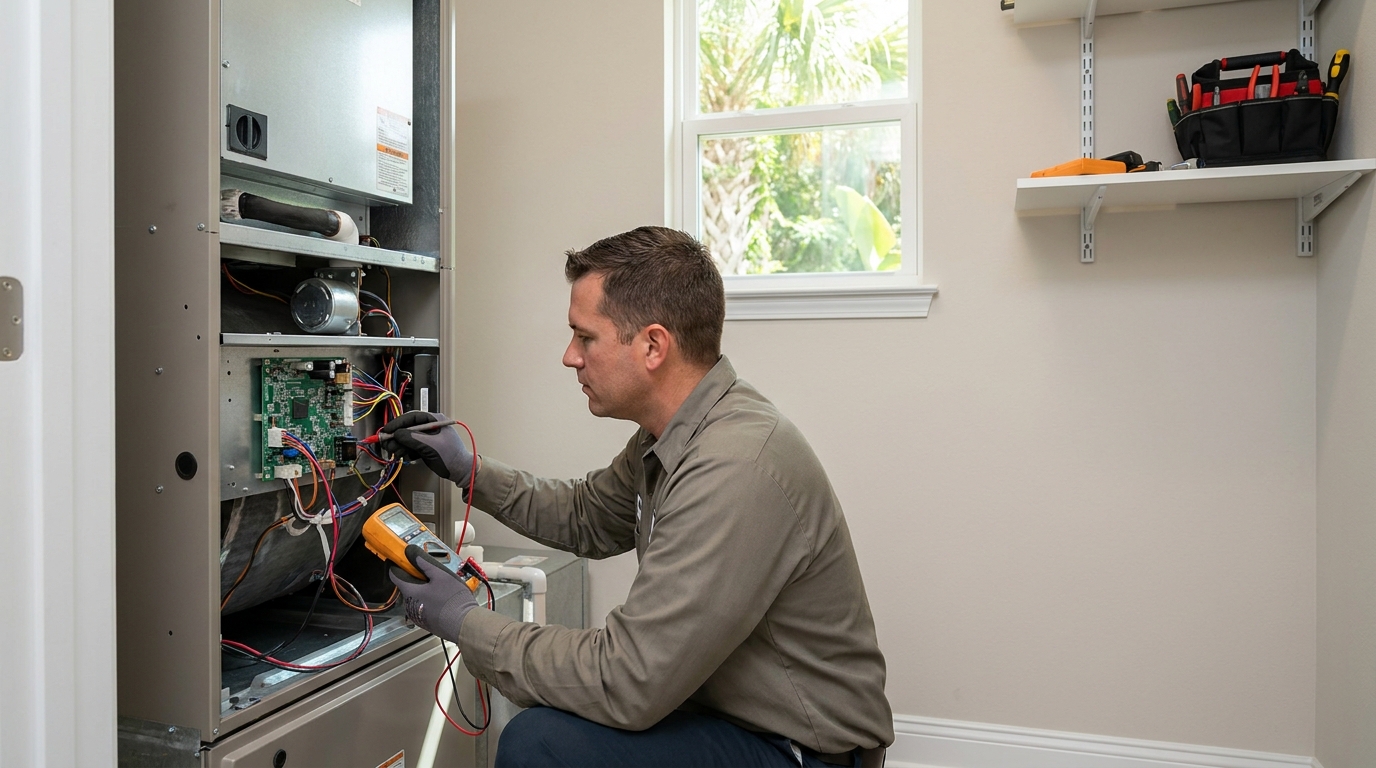
If your air conditioner is running but not heating in Jacksonville, FL, the most common culprits are a stuck reversing valve on your heat pump, a thermostat that isn't actually calling for heat mode, or a tripped auxiliary heat breaker. Jacksonville homes rely heavily on dual-mode heat pumps, and when the system cools fine but won't switch over, the problem is almost always in the changeover components — not the compressor itself.
Winter in Duval County is mild, but the January cold snaps that push nighttime lows into the 30s along the St. Johns River and out toward Mandarin and Orange Park are real. When your system refuses to flip into heat mode at 2 a.m., you need a clear diagnostic path — not guesswork. Here's how our team at King of Home Solutions walks Jacksonville homeowners through it.
Why is my AC running but not blowing hot air in Jacksonville, FL?
A dual-mode HVAC system that runs but won't heat usually has one of four problems: a stuck reversing valve, a failed thermostat call for heat, a tripped auxiliary heat strip breaker, or a defrost control board issue. In Jacksonville's humid coastal climate, corrosion on outdoor components accelerates these failures — especially on systems installed before 2026.
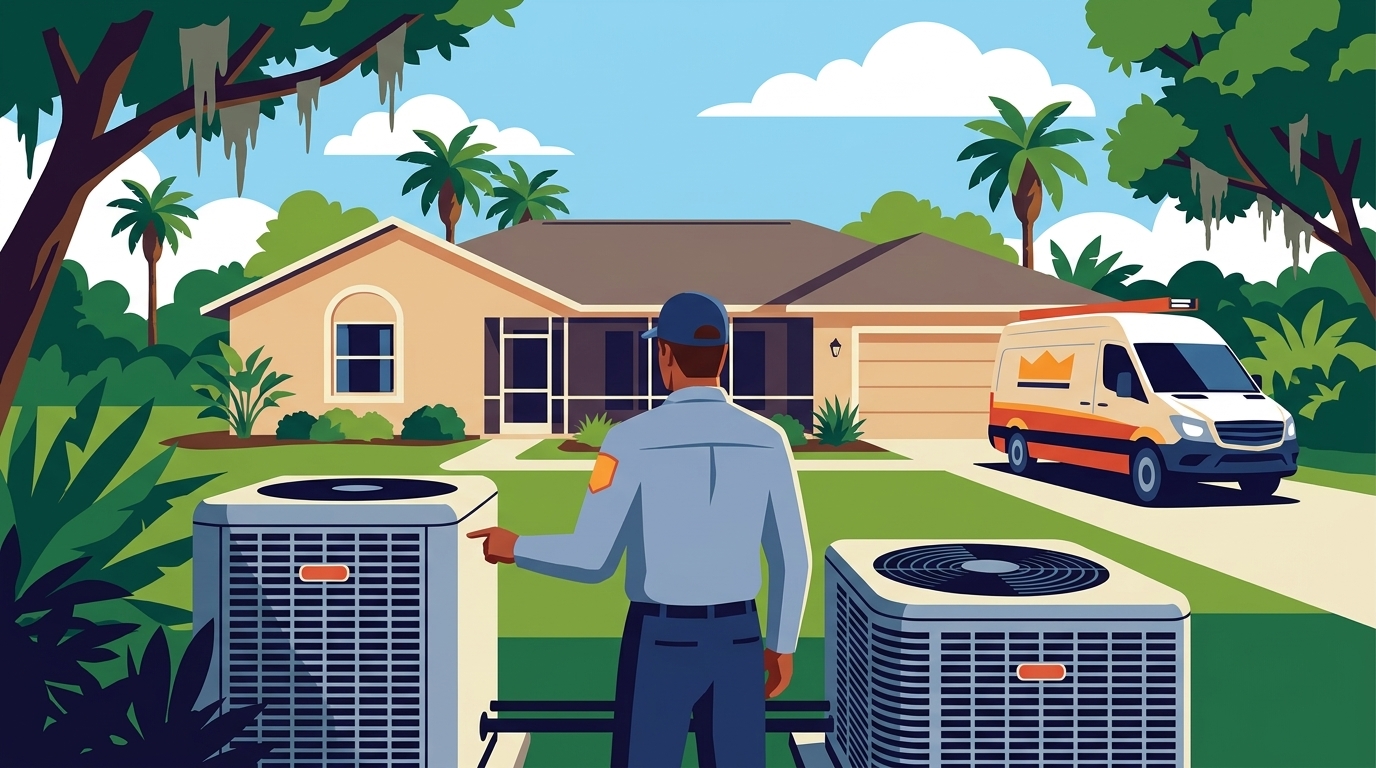
Most Jacksonville homes use heat pumps rather than gas furnaces because our winters rarely justify the cost of dual-fuel systems. That means the same outdoor unit handling your July cooling load is also responsible for December heating. The reversing valve is the part that literally reverses refrigerant flow to switch modes — and it's the single most common failure point for the "cools but won't heat" symptom.
How do I know if it's my thermostat or my HVAC unit?
Set your thermostat to Heat mode and raise the temperature 5 degrees above room temperature. Within 60 seconds you should hear a soft "whoosh" at the outdoor unit as the reversing valve shifts. If you hear nothing, or the outdoor unit keeps running in cool mode, the issue is downstream of the thermostat — likely the valve, the control board, or the low-voltage wiring.
A quick way to isolate the thermostat: pull it off the wall and check that the O/B wire (orange, sometimes blue) is seated firmly in its terminal. On heat pumps, this wire tells the outdoor unit to switch modes. A loose O/B wire is one of the most common calls we get after DIY thermostat swaps — homeowners install a new smart thermostat, miss the heat-pump configuration setting, and suddenly the system only cools.
Signs the thermostat is the problem
- Display shows Heat mode but outdoor unit doesn't cycle
- Recently replaced or reprogrammed the thermostat
- Emergency Heat setting works, but regular Heat doesn't
- Batteries are low or the C-wire isn't landed
Signs the outdoor unit is the problem
- You hear the compressor running but air stays cool
- Ice forms on the outdoor coil and never defrosts
- The reversing valve solenoid is silent when you switch modes
- Auxiliary heat kicks on constantly to compensate
What is a reversing valve and why does it fail?
The reversing valve is a solenoid-controlled component inside your outdoor unit that flips the direction of refrigerant flow to switch between cooling and heating. When it sticks — usually from sediment, worn internal seals, or a failed solenoid coil — the system stays locked in one mode. In Jacksonville's salt-air environment, especially in Atlantic Beach, Neptune Beach, and Jacksonville Beach, corrosion shortens the valve's typical 10-15 year lifespan.
A stuck reversing valve doesn't always require replacing the whole outdoor unit. Sometimes a technician can free it by tapping the valve body while the system cycles, or by replacing just the solenoid coil for a fraction of the cost. Full valve replacement is a bigger job because it requires recovering refrigerant, brazing new lines, and pulling a vacuum on the system — work that requires an EPA Section 608 certified technician under federal law.
Could my auxiliary heat strips be the issue?
Yes — and this is one of the most overlooked causes in Jacksonville homes. Auxiliary (or emergency) heat strips are electric resistance heaters inside your air handler that supplement the heat pump when outdoor temperatures drop into the 30s. They're on a separate high-amp breaker, and when that breaker trips, your system may still run in "heat mode" but blow room-temperature air.
Check your electrical panel for a tripped 30-60 amp double-pole breaker labeled for the air handler or heat kit. Reset it once. If it trips again, stop — a repeatedly tripping heat-strip breaker usually means a failed sequencer, a shorted element, or a wiring issue that needs a licensed technician. Florida requires HVAC work involving line-voltage components to be performed by a licensed contractor under Florida Statutes Chapter 489.
Quick diagnostic table: matching symptoms to causes
| Symptom | Most Likely Cause | Typical Repair Range |
|---|---|---|
| Thermostat set to Heat, outdoor unit silent | Thermostat wiring or O/B configuration | $85-$250 |
| Outdoor unit runs, air stays cool | Stuck reversing valve or solenoid | $300-$1,400 |
| Heat pump ices over and won't defrost | Defrost control board or sensor | $275-$650 |
| Emergency Heat works, regular Heat doesn't | Outdoor unit reversing valve or contactor | $300-$900 |
| Air blows lukewarm even in Emergency mode | Failed heat strip or tripped breaker | $150-$550 |
These are typical Jacksonville-area ranges for 2026 and assume the underlying system is otherwise serviceable. A system past 15 years old may make replacement more economical than repair.
When should I call a professional in Jacksonville?
Call a licensed HVAC contractor if you've checked the thermostat, reset the breaker, and confirmed the outdoor unit isn't switching modes — or anytime you're dealing with refrigerant, sealed-system components, or heat strips. These jobs require EPA certification and Florida state licensing, and mistakes with 240V circuits or pressurized refrigerant lines are genuinely dangerous.
King of Home Solutions handles dual-mode HVAC diagnostics across Jacksonville, from Riverside and Avondale to San Marco, Southside, and the Beaches communities. Our 4.9-star rating across 55 Google reviews reflects the thing homeowners tell us matters most on a cold-morning service call: showing up when we said we would, explaining what we found in plain language, and giving you an honest repair-or-replace recommendation before we start work. As one recent reviewer put it, our team is "professional, on time, excellent communication and great price."
Frequently asked questions
How cold does it need to be for my heat pump to struggle?
Most standard heat pumps in Jacksonville maintain full efficiency down to about 40°F and start relying on auxiliary heat below 35°F. When outdoor temperatures drop into the low 30s during a January cold snap, it's normal for auxiliary heat to run more often. If your system can't hold setpoint even with aux heat, that's a sign the heat pump itself isn't contributing — usually a reversing valve or refrigerant charge issue.
Is it safe to run my AC in heat mode if it's blowing cool air?
Running the system briefly to diagnose the issue is fine, but leaving it running for hours when it isn't heating properly wastes electricity and can accelerate wear on the compressor and heat strips. If auxiliary heat is running constantly to compensate for a failed heat pump, your power bill will spike noticeably — sometimes doubling during a cold week. Shut the system off and switch to Emergency Heat until a technician can diagnose it.
Why does my heat pump blow cool air when it first starts?
This is normal for the first 3-5 minutes of a heating cycle. Heat pumps produce warm air rather than hot air — typically 85-95°F at the register — and the ductwork itself needs to warm up before you feel it. If air is still cool after 10 minutes, or noticeably cooler than room temperature, that's when you have a real problem worth investigating.
Do I need a permit to replace HVAC components in Jacksonville?
Yes for most work. The City of Jacksonville and Duval County require permits for HVAC system replacement, ductwork changes, and gas line work through the local building department. Minor repairs like thermostat replacement or capacitor swaps typically don't require permits, but any refrigerant work must be performed by an EPA Section 608 certified technician, and any licensed HVAC contractor in Florida operates under state license CAC or CMC classifications.
How much does it cost to fix a heat pump that won't switch to heat mode?
Repair costs in Jacksonville typically range from $85 for a simple thermostat reconfiguration to $1,400 for a full reversing valve replacement including refrigerant recovery and recharge. Most dual-mode diagnostic calls resolve in the $250-$650 range. If your system is over 12 years old and needs a major refrigerant-side repair, it's worth getting a replacement quote to compare — modern heat pumps use R-410A or newer refrigerants and run significantly more efficiently.
Can a smart thermostat cause heat mode problems on a heat pump?
Yes, this is one of the most common calls we get. Smart thermostats need to be specifically configured for heat pump operation, including correct O/B reversing valve orientation (O for cooling on most brands, B for heating on a few) and proper auxiliary heat staging. A thermostat set up as a conventional furnace controller on a heat pump system will cool correctly but fail to switch modes for heating.
Getting your system back on heat
Dual-mode HVAC problems are rarely as bad as they feel at 6 a.m. on a cold Jacksonville morning. Most of what we diagnose comes down to a thermostat setting, a tripped breaker, or a reversing valve component — all fixable, most of them affordable. The key is a systematic diagnostic approach rather than swapping parts and hoping.
Jacksonville homeowners who want this handled professionally can reach King of Home Solutions at https://kingofhomesolutions.com to schedule a diagnostic visit. Our team works across Duval County and the surrounding Beaches communities, and we'll walk you through what we find before any repair work begins.